Supreme Court justices' ideologies don't always fit 'liberal' and 'conservative' labels
Published in Political News

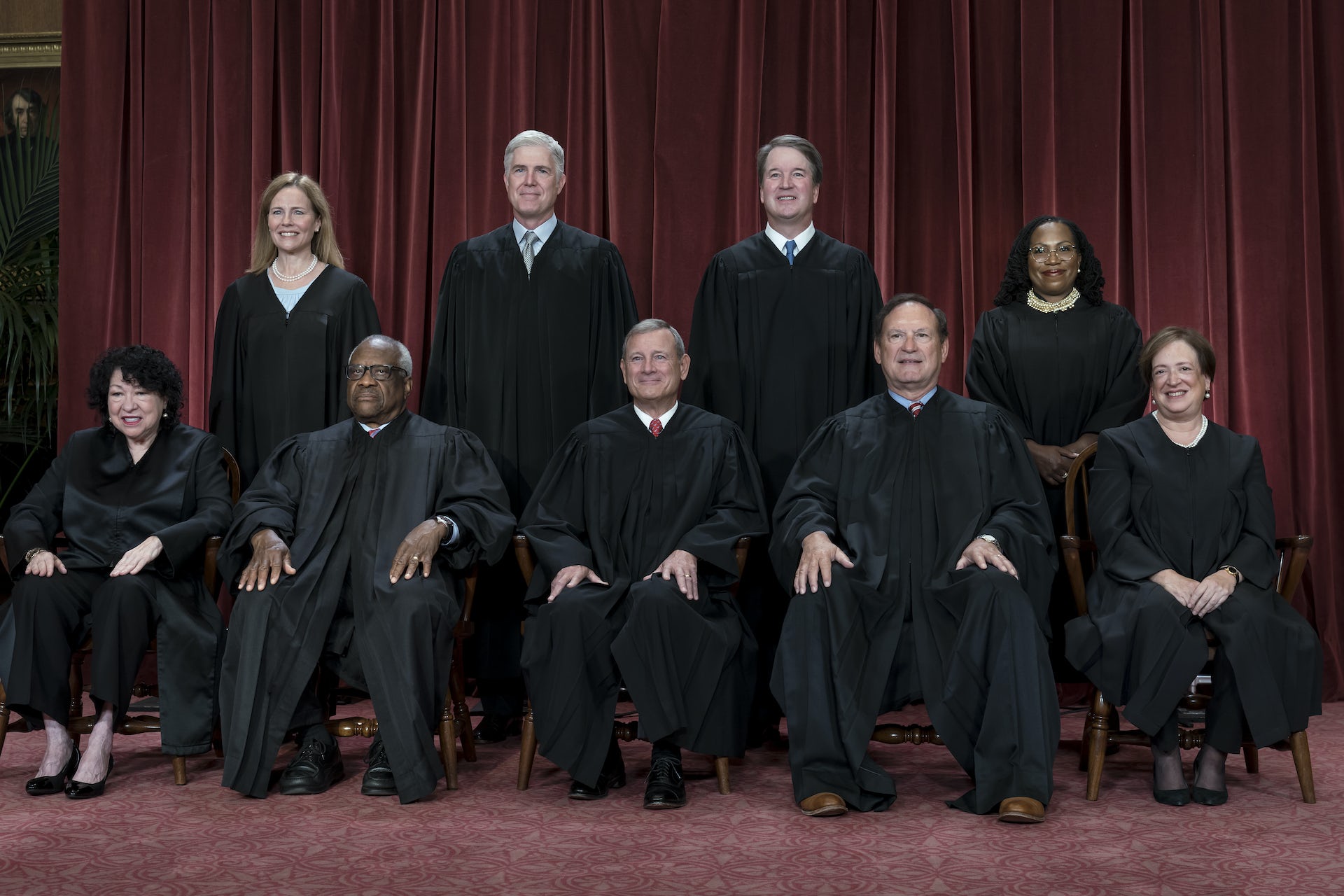

When the Supreme Court is in the news for overturning a long-standing precedent or violating standard judicial ethics, the news is often accompanied by the description of one or more justices as liberal or conservative.
You’d think it would be easy to tell the difference between the two, but judicial scholars will tell you it’s more difficult than you might think. There’s more to the story than who appointed those justices and the labels given in the media.
The first scholar to really call attention to judges’ personal views, as measured by judicial ideology, was political scientist C. Herman Pritchett. In 1941, his study on the number of dissents in the court during that term revealed a wide range of decisions, despite the fact that seven of the nine were committed New Deal supporters who had been appointed by President Franklin D. Roosevelt. Explanations from the legal community, such as precedent, weren’t enough to explain the rulings.
Even though they were viewing the same facts and working with the same laws, “It may well have been the most divided court in Supreme Court history,” Pritchett wrote at the time. His work led to a wave of scholars searching for personal attitudes and judicial ideologies as a determinant of Supreme Court voting behavior.
One contemporary analysis of Supreme Court justices is the “Martin-Quinn” measure of judicial ideology, calculated for every justice from 1937 to 2021, developed by political scientists Andrew D. Martin and Kevin M. Quinn.
Their research, and work by judicial scholar Lee Epstein, shows many cases where justices crossed traditional judicial ideologies on Supreme Court rulings in the 2021-22 term.
In June 2021, ABC News research “found 67% of the court’s opinions in cases argued during the term that ends this month have been unanimous or near-unanimous with just one justice dissenting.” The report cited Jeffrey Rosen of the National Constitution Center, who credited Chief Justice John Roberts and Justices Stephen Breyer, Elena Kagan, Brett Kavanaugh and Amy Coney Barrett for “the project of bipartisan unanimity” during the the 2020-21 term. And according to SCOTUSblog, an average of 48% of Supreme Court rulings from 2010 to 2018 were unanimous. Another 8% were nearly unanimous.
Scholars have noticed that labeling justices’ ideologies based upon their voting records in court rulings can involve flawed logic. Are judges labeled conservative or liberal based upon their judicial ideology or how they vote? Or is their judicial ideology determined by their voting record? It’s a chicken-and-egg question of which came first.
Another challenge with labeling justices’ views is that politics change over time. Today’s conservative may be yesterday’s liberal. For instance, analyzing the 1908 ruling in Muller v. Oregon, judicial politics authors Lee Epstein and Thomas G. Walker write, “the Supreme Court upheld a state law that set a maximum number on the hours women (but not men) could work.”
“How would you, as a twenty-first century student, view such an opinion?” Epstein and Walker write. “You probably would classify it as conservative because it seems to patronize and protect women. But in the context of the early 1900s, most considered Muller to be a liberal ruling because it allowed the government to regulate business.”
Making matters even more complicated, it’s not always clear-cut whether a ruling is conservative or liberal in its own time.
Take the Supreme Court’s 1992 decision in R.A.V. v. City of St. Paul, where the court considered the conviction of a person prosecuted under a local hate-crime ordinance for burning a cross outside a Black family’s home. The justices unanimously struck down that conviction, saying it unconstitutionally restricted free speech based on the content of that speech. A liberal could view this as a victory because free speech was upheld. A conservative could also claim victory because the ruling restricts the power of local governments.
Justices are not always easy to pigeonhole, either. For instance, Gorsuch votes along conservative lines on economic issues but on more liberal grounds on issues involving Native American rights.
Gorsuch joined four other conservative justices in the 2022 West Virginia v. Environmental Protection Agency decision striking down a power plant regulation because the EPA’s regulation exceeded the authority Congress had granted to the agency.
But he also wrote the majority decision in the 2020 ruling on McGirt v. Oklahoma, which upheld sovereignty promises the federal government made to several tribes in 19th century treaties.
The justices themselves often reject the idea of judicial partisanship. In an October 2018 speech, Roberts paraphrased Kavanaugh, saying, “We do not sit on opposite sides of an aisle, we do not caucus in separate rooms, we do not serve one party or one interest. … We serve one nation.”
A month later, then-President Donald Trump criticized Judge Jon Tigar of the U.S. District Court in Northern California as an “Obama judge,” because of who appointed him, in his ruling on migrants and asylum policies. Roberts again rejected the criticism: “We do not have Obama judges or Trump judges, Bush judges or Clinton judges,” he wrote in a statement to The Associated Press. “What we do have is an extraordinary group of dedicated judges doing their level best to do equal right to those appearing before them.”
Whether you agree with Roberts or not, it’s clearly true that judges, over the courses of their careers, generally exhibit traits that are more nuanced than just “liberal” or “conservative.”
LaGrange College undergraduates Ema Turner and Jenna Pittman contributed to the research for this article.
This article is republished from The Conversation, an independent nonprofit news site dedicated to sharing ideas from academic experts. Like this article? Subscribe to our weekly newsletter.
Read more:
The Supreme Court’s originalists have taken over − here’s how they interpret the Constitution
Justice Clarence Thomas and his wife have bolstered conservative causes as he is poised to lead the Supreme Court rolling back more landmark rulings
John A. Tures does not work for, consult, own shares in or receive funding from any company or organization that would benefit from this article, and has disclosed no relevant affiliations beyond their academic appointment.



















































Comments