In fractious debate, GOP candidates find common ground on cause of inflation woes and need for school choice
Published in Political News
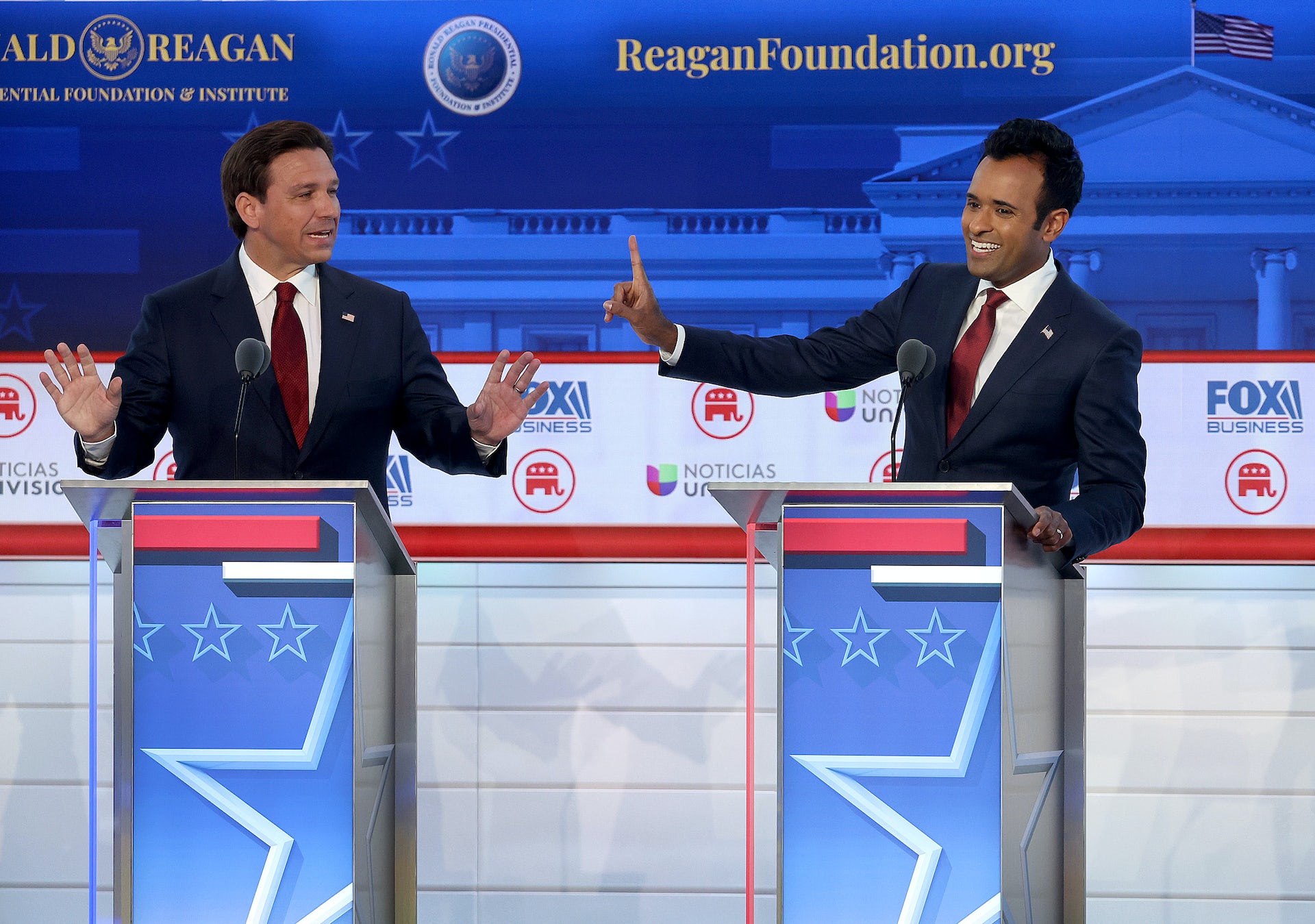
It was a night in which even “the great communicator” himself may have struggled to be heard.
At the Ronald Reagan Presidential Library in California on Sept. 27, 2023, seven Republican candidates looking to become the leading challenger to the absent GOP frontrunner Donald Trump interrupted, cross-talked and bickered – often to the exasperation of the debate moderators.
And yet, between the heated exchanges, important economic and business issues were discussed – from national debt and government shutdowns to labor disputes and even school choice. One thing the candidates agreed on: They aren’t fans of Bidenomics.
Listening in for The Conversation were economists Ryan Herzog of Gonzaga University and University of Tennessee’s Celeste K. Carruthers. Here are their main takeaways from the debate.
Ryan Herzog, Gonzaga University
The most recent Fox News survey showed that 91% of Americans are worried about inflation and 80% about rising housing costs. I tuned into the second GOP debate hoping to hear how the candidates would solve these problems. I was left disappointed.
Not a single candidate mentioned rising housing costs, and few even acknowledged inflation. Given how much the issue has dominated the news, I assumed the candidates would mention it more than the eight times they did in the prior debate. I was wrong.
First, let’s check some inflation facts. Former South Carolina Gov. Nikki Haley claimed that the average household is spending US$7,000 more per year on groceries and gas due to inflation. I believe she also meant to include housing costs. The latest data show the annual inflation for food at home – as opposed to restaurant meals – is rising less than 3% per year. While that’s up 24% since the start of the pandemic, it’s far below what you’d need for an increase of nearly $600 per month.
Next, former Vice President Mike Pence said that recent wage gains have not kept up with inflation. But according to the most recent data, average wage growth has actually outpaced inflation. Indeed, workers in lower-wage industries that are seeing labor shortages, such as the leisure and hospitality sector, have seen very substantial pay increases.
Nearly every candidate blamed inflation on excessive federal spending. Under Presidents Donald Trump and Joe Biden, the total level of U.S. government debt increased by nearly $8 trillion and $4.5 trillion, respectively. As expected, most candidates proposed cutting government spending and taxes to help struggling families. But it’s unclear if those policies, taken together, would be effective at lowering inflation.
The candidates also agreed on the need to promote U.S. energy independence – through drilling, fracking and coal – to promote low and stable inflation. But while reducing energy costs would support lower inflation, there was zero discussion of how new technologies like artificial intelligence could be used to fight inflation – for example, by improving productivity. In the end, most candidates resorted to old arguments and avoided debate on 21st-century solutions.
Celeste K. Carruthers, University of Tennessee
Before a commercial break midway through the debate, moderators teased viewers to return for questions on education in the U.S. It’s understandable that voters would want to hear what candidates have to say on the issue. Younger students have a long way to go to recover from COVID-era learning losses, and many families are dissatisfied with public education to the point that they are leaving public schools for home school and private school options. The education portion of the debate ended up being a short exchange, however, with more focus on immigration, inflation, border security, foreign policy and the opioid epidemic.
One common theme across candidates was at least a brief mention of school choice. School choice describes a variety of different policies that give the parents of pre-K-12 students more options for where they send their kids to school. These options can include charter schools, magnet schools, public schools outside of a student’s school zone or in another district, or even private schools.
Gov. Haley voiced a commonly held view among school choice supporters that providing students with more schooling options improves education by encouraging competition. Gov. DeSantis referenced “universal school choice” in his home state of Florida, which recently passed legislation that allows any student to apply for several thousand dollars in state funds that can be used toward private school tuition.
Researchers have found that earlier phases of private school vouchers in Florida led to improvements in public school student test scores, absenteeism and suspensions, which supports the idea that competition from private schools can benefit students who opt not to use vouchers and stay in public schools.
Private school vouchers are, however, a contentious topic. Opponents of vouchers and school choice policies more generally argue that they put traditional public schools at a financial disadvantage. Critics have also noted that some of the early voucher advocates viewed them as a way to avoid racial integration.
Additionally, school choice can theoretically lead to sorting, where higher-achieving or higher-income students group together, and this can be detrimental to lower-achieving students who are left behind. There is evidence of sorting like this, particularly in large-scale voucher systems outside the U.S.
Florida’s newly expanded model of school choice is one of the most comprehensive in the country. Several other states have also recently revised their school choice policies, generally extending eligibility for vouchers and education savings accounts beyond needy populations. In time, we can expect the evidence on school choice to grow substantially and perhaps occupy more attention in future debates.
This article is republished from The Conversation, an independent nonprofit news site dedicated to sharing ideas from academic experts. The Conversation is trustworthy news from experts, from an independent nonprofit. Try our free newsletters.
Read more:
Yes, debates do help voters decide – and candidates are increasingly reluctant to participate
Presidential pauses? What those ‘ums’ and ‘uhs’ really tell us about candidates for the White House
The authors do not work for, consult, own shares in or receive funding from any company or organization that would benefit from this article, and have disclosed no relevant affiliations beyond their academic appointment.




















































Comments