Editorial: Enough with the politicking. Just fix the FAA
Published in Op Eds
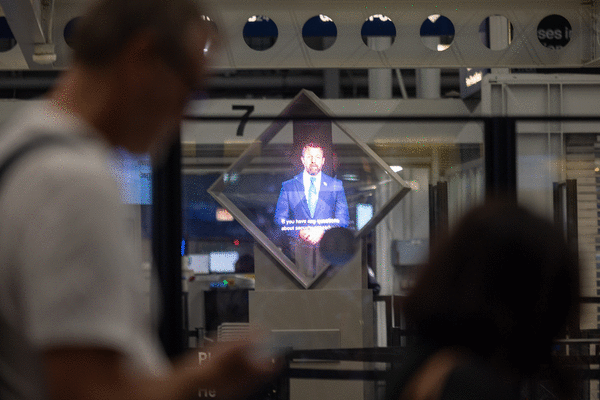
Anyone in the U.S. airline industry will tell you that when it comes to safety, all competitive backbiting stops.
There is a reason why your pilot often tells you that flight attendants are there primarily for your safety and that his or her job is to get you to your destination not necessarily as quickly as possible but as safely as possible. That’s because those things are true and aviation lives and dies by them.
Even Scott Kirby, the outspoken CEO of United Airlines and a deft and loquacious underminer of airlines other than his own, would not even dream of suggesting that any other carrier was less than safe.
The skies may not always be friendly — and those of us whose plans were ruined this past weekend by the Federal Aviation Administration’s hourslong ground stoppage on Friday hardly found them that way — but safety is an article of faith in an industry that has millions of lives in its hands every day. So when specialists at the FAA think that a failure in communications between airplanes in the air and controllers on the ground presents a risk to safety, we say hold the planes on the ground. There were myriad irritations this weekend (and into the first part of this week) for flyers, but everyone landed safely.
Or, to put that another way, Secretary of Transportation Sean Duffy and his FAA staffers did their most important job perfectly well.
Such is the hatred among Democrats of anyone affiliated with the Trump administration, though, that you’d think President Donald Trump himself toddled off to Dorado, Arkansas, and, with his own chubby fingers, installed a faulty router in the equipment there for nefarious purposes of his own.
He did not and his transportation secretary did not either; that was the private contractor L3Harris replacing archaic copper telecommunications lines with fiber-optic cable. A replacement that, for the record, was long overdue. And, similarly for the record, L3Harris has been working with the FAA since 2002, which was during the presidency not of Donald Trump, who was at the time appearing in McDonald’s commercials and voicing content for the video game “Donald Trump’s Real Estate Tycoon,” but of George W. Bush. And L3Harris continued through the administrations of Barack Obama and Joe Biden.
We’re dismayed at the myriad attempts to score political points at this past weekend’s troubles and we see no serious evidence of Duffy’s alleged incompetence.
A lot of early commentators were looking to pin this on the so-called SMART system, trying to capitalize on the public’s current fear of artificial intelligence. Actually, the SMART system (which moves flights around more efficiently, saving time and fuel) has been one of the few 21st century positives in the world of the FAA and had nothing to do with what happened on Friday, as Duffy and his lieutenants had to keep stating and restating.
In fact, Duffy has been banging the drum about the FAA’s chronic technology problem louder than all of his predecessors, even though the problems date back decades. And while you certainly could question the contractor’s wisdom of replacing a copper line on a busy Friday afternoon, as distinct from, say, 3 in the morning with few planes in the air, such a replacement was at least getting rid of copper lines with the less-than-novel technology of fiber optic cable. And now the data exists to make sure that does not happen again.
Copper lines are but one example of the FAA’s long-standing tech problems, of course. A technological fix was supposed to be done 20-odd years ago, as per the 2003 directive of Congress, but Friday reminded us not just that it has yet to happen but of the difficulty of getting there in an era when the demand for air travel has exploded beyond all expectations and the system is designed now never to shut down. Roads close and train lines are paused for maintenance, but we expect the FAA to rebuild itself without any disruption whatsoever to the close to 50,000 flights each and every day. And counting.
What to do? Duffy now has called for $50 billion in new funding. Taxpayers deserve assurances that will be well spent, not on fancier airports or featherbedding of any kind, but on the actual system that keeps us safe in the air for years to come.
It is often observed that this nation has reached a kind of paralysis when it comes to the building of public infrastructure, making it the laughingstock of the world when it comes to those areas. It sure was jarring in the last few days to see SpaceX, a private enterprise, figure out how to snatch a rocket from midair with a giant claw and yet know that the people we love are up there in the sky being tracked by landlines and pieces of paper.
There are a lot of good ideas for improvement out there. Nav Canada, a private, nonprofit operation, fills this role in Canada. Fly from Chicago to New York and you are one of the beneficiaries. In the United Kingdom, NATS is a public-private partnership.
Indeed, more than 60 countries have removed their air traffic control systems in recent years from direct government management and set them up as various flavors of self-supporting corporations or private-public partnerships. That way governments can concentrate on regulating and ensuring safety, not fighting with unionized air traffic controllers and trying to protect their budget appropriations from local politicians’ pork.
Can Democrats and Republicans lock themselves in a room and figure this out? We doubt it, but then we also know there really is no other choice. The airlines already know that without guaranteed safety, their industry would be dead in the water.
Politicians have family members flying every day. You’d think they could get this done together.
_____
©2026 Chicago Tribune. Visit at chicagotribune.com. Distributed by Tribune Content Agency, LLC.
















































Comments