John Rash: 'You can see everything' -- Except, it seems, the truth these days
Published in Op Eds
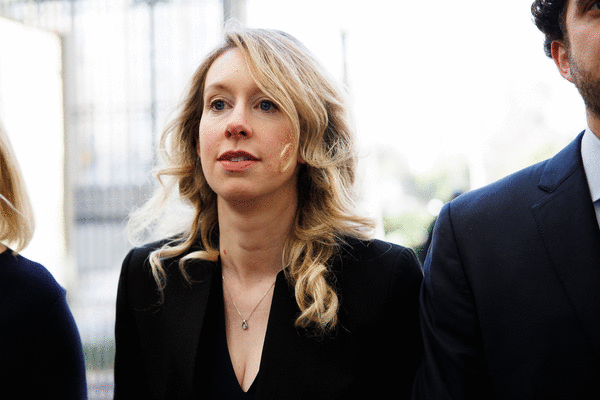



Within hours on Oct. 16 the curtain fell on the five-day stint of the White House press secretary Katie Zacharia and rose on “You Can See Everything,” the documentary about Elizabeth Holmes, the fraudulent founder of blood-testing company Theranos.
While separate events, they’re linked in an era of ever elusive truth.
The story about Zacharia is more straightforward, at least compared with the shape-shifting one about Holmes that the fascinating new film captures. The press secretary’s undoing wasn’t because of how she did her job — after all, aides who hew to the president’s narrative, however incongruent with the truth, are standard capital kabuki. And in fact, Zacharia had only one (unimpressive) turn at the lectern.
It was because of how she got her job. Zacharia repeatedly represented herself as a “lawyer” and allowed the president to introduce her as an “attorney,” even though she had never passed the bar exam. She’d also elevated conspiracy theories about Democrats and pedophilia and had a yearslong involvement in a multilevel-marketing health-supplement company she conceded was “sort of a pyramid scheme.”
Taken together, these revelations made Zacharia’s tenure untenable, especially because her job was to present ostensibly truthful information.
Conversely, Holmes’ story is less straightforward. Well, maybe not to the legal system, which convicted her of fraud and sentenced her to 11 years in prison. But to documentarian Nathan Fielder, and by extension viewers of this riveting film, which offers an at-times uncomfortably close look at Holmes, her partner and father of her two children (sketchy tech exec Billy Evans), and extended family at a San Diego beach house about a month before she reports to prison.
Fielder, a clever Canadian comedian known for unconventional reality shows, plays the straight man here, effectively eliciting laughs, especially with deadpan stares (if reaction shots were an Academy Awards category, Fielder would be an Oscar lock) that channel the audiences’ stunned reaction to Holmes’ and Evans’ mendacity.
Critical acclaim for “You Can See Everything” may propel it to a best picture nomination, which would be a first for a documentary. The film covers a scandal that received saturation news coverage, inspired a Hulu miniseries and sparked controversy and countless commentaries. Yet “You Can See Everything” contains so many surprises that critics are contorting themselves to avoid revealing spoilers.
So, this column won’t either. But the twists and turns of the kaleidoscope of lies are as disorienting as they are compelling, just as were the manipulations presented to Theranos investors — a cohort including supposedly wise men of Washington and Wall Street such as former Secretaries of State Henry Kissinger and George Schultz, former Defense Secretary James Mattis, media mogul Rupert Murdoch, members of the Walton (Walmart) family and scores more.
Years later, the untruths Holmes seems to tell Fielder and, perhaps most profoundly, herself (including claiming she’s never told a lie in her life, ever) captivate viewers while capturing these times.
That also seems to be the intent of a new documentary on Elon Musk (whose director deemed his subject “sociopathic”) as well as a new drama about Mark Zuckerberg (whose Meta was ordered on Wednesday to pay a $25 billion fine for deceiving on privacy). Indeed, the admirable space-race movie heroes of “Hidden Figures” and “The Right Stuff” have given way to today’s not-so-hidden attention seekers, who too often show the wrong stuff.
Screenings of “You Can See Everything” sold out at many of the more than 2,000 theaters showing it nationwide, including at the Main Cinema in Minneapolis, fueling even more curiosity. As with other zeitgeist moments, many factors are likely at play, including rave reviews from film critics (and buzz from those fortunate enough to score a ticket), Fielder’s built-in audience from his quirky comic/reality shows, and the enduring curiosity about Holmes.
But part of it may be a more profound public pivot toward a desire, demand even, for truth — at a time when AI-amplified distortions, (anti-) social media (including the often dishonest Truth Social, President Donald Trump’s site losing users and stock price) as well as reckless rhetoric from politicians are all increasingly detached from lived reality. People have always sought the truth, of course, but it seems to be increasingly transient or transactional, not a permanent virtue. So the pushback against Holmes and even Zacharia, both fabulous fabulists until they weren’t, may signify a significant shift.
“I feel like I’m living in a parallel universe,” a phrase blurted by Holmes in the film, could have just as easily come from Fielder, moviegoers or society at large. “You Can See Everything” is a parable of that parallel, and what it portends will be worth watching, just like the movie itself.
_____
©2026 The Minnesota Star Tribune. Visit at startribune.com. Distributed by Tribune Content Agency, LLC.

















































Comments