Commentary: How the federal debt happened
Published in Op Eds
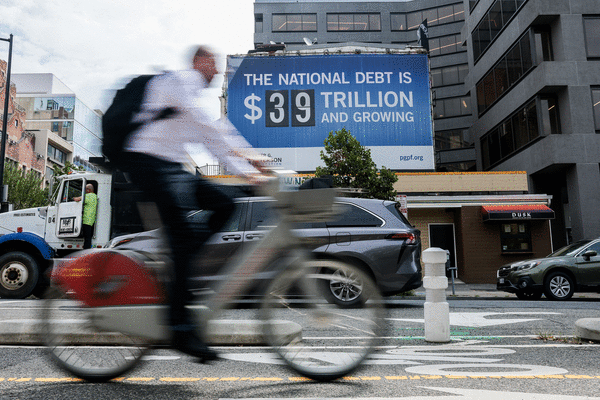
The federal government is drowning itself in red ink, caused by its spending far more than the revenues it collects. Economists agree that the debt explosion raises Americans’ borrowing costs, inhibits economic growth, and makes us all poorer. Yet our citizenry is rarely provided with detailed information about what drives this problem and what laws must be changed to correct it.
To answer these questions, in 2013, I began quantifying the leading contributors to the federal fiscal imbalance, periodically updating the findings. This year’s update shows that nearly three-quarters of the problem is caused by spending growth in just a few areas of the budget: Medicare, Medicaid, Affordable Care Act (ACA) marketplace subsidies, and Social Security. This is roughly consistent with previous results.
Until recently, the problem was almost entirely on the spending side, but that has since changed. With the enactment of the One Big Beautiful Bill Act (OBBBA) in 2025, roughly one-quarter of the imbalance now derives from tax cuts.
Remarkably, over 87% of the worsening shortfall was legislated in just two concentrated periods of fiscal irresponsibility: the first from 1965 to 1972, the second beginning in 2010 and continuing through the present. Less than 13% of the problem was created in all the intervening years, encompassing the combined presidencies of Ford, Carter, Reagan, Bush 41, Clinton and Bush 43.
The earlier period can be thought of as a time of legislative hubris, when lawmakers enacted massive new mandatory spending obligations with little appreciation for the cost growth they were unleashing. Specifically, there were the creations of Medicare and Medicaid in 1965, followed by expansions of both programs and Social Security in the early 1970s. Whatever the merits of these programs, the stubborn fact remains that Washington has yet to determine how to keep their cost growth at sustainable levels.
The second period of deficit-expanding legislation, from 2010 to the present, began similarly with new mandatory spending: the ACA’s dramatic expansion of Medicaid and its new subsidies for health insurance coverage. But our era’s deficit-driving behavior has more recently shifted to tax cuts, including the OBBBA as well as 2019 legislation to repeal taxes originally intended to finance the ACA.
Any single year’s deficit usually has a much longer list of contributors and tends to be more greatly affected by recent legislation. The 2026 deficit is no exception. Still, the vast majority of it — nearly 85% — was created by legislation enacted during the same two pivotal time periods of 1965-1972 and 2010 through the present.
Nearly two-thirds of this year’s deficit is attributable to spending exceeding historical norms, while a little over one-third stems from recent tax cuts. On the spending side, the biggest contributors are growth in Medicaid and ACA spending, Medicare and Social Security, in that order, followed by recent expansions of veterans’ benefits and military retirement spending. The OBBBA tax cuts alone are responsible for roughly 30% of the deficit, by far the leading contributor on the tax side.
Assigning responsibility depends on how one views the culpability of presidents versus Congress. Roughly 65% of the long-term imbalance was enacted when Democrats controlled both congressional chambers, 29% when Republicans did, and only 6% under split control. However, the presidency shows nearly the opposite tilt. More than 63% of the shortfall was enacted during Republican presidencies.
Using an assumption that responsibility is shared 50/50 between presidents and Congress, the 2021 edition of my study found President Lyndon B. Johnson to be the biggest contributor because of Medicare and Medicaid. In the 2026 update, current President Trump replaces Johnson in the top spot, due to tax cuts enacted during his two terms.
Fiscal track records can look better or worse depending on whether one looks at current deficits or contributions to future ones. By any measure, the Trump and Obama presidencies have added greatly to the fiscal imbalance. Legislation enacted during the Nixon presidency with an all-Democratic Congress added enormously to the long-term imbalance, but did not produce historically large deficits at the time. By contrast, President Biden presided over exceptionally large annual deficits, but very little of the projected future fiscal imbalance is attributable to legislation during his administration.
Politicians will always blame the other party for rising debt, but there is plenty of blame to go around. Neither party has a compelling claim to superior fiscal responsibility. Rarely are American voters told the truth: that we won’t fix the problem until we moderate the growing costs of Medicare, Medicaid, the ACA and Social Security, and until we stop cutting taxes in the absence of spending restraint.
____
Charles Blahous is the J. Fish and Lillian F. Smith Chair and Senior Research Strategist at the Mercatus Center at George Mason University and a former public trustee for Social Security and Medicare.
_____
©2026 Tribune Content Agency, LLC.















































Comments