Mark Z. Barabak: How the Golden State lost its gleam. And what that means for 2028
Published in Op Eds
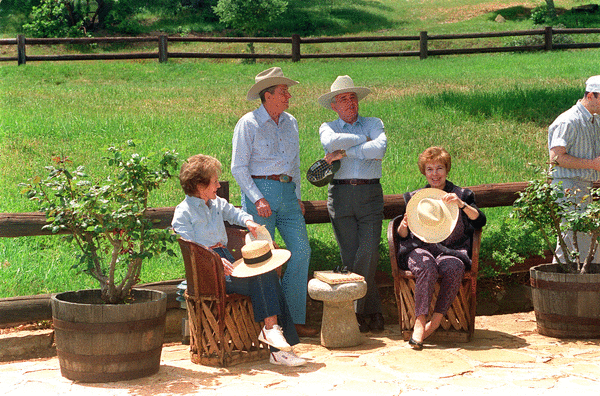
Nearly 40 years have passed since a Californian was president.
Several have pursued the White House in the decades since Ronald Reagan ambled into retirement, in January 1989. But not a one succeeded. Kamala Harris, who was saved from political purgatory when Joe Biden chose her as his running mate, came closest — though not close — in 2024.
The 2028 race could bring at least three more California contestants, none of whom seem likely to end the state’s presidential dry spell.
Some of that speaks to the individual flaws and political frailties of those who are, at the least, eyeing a 2028 bid: Harris, outgoing Gov. Gavin Newsom and five-term Silicon Valley Rep. Ro Khanna.
The problem they all face is their return address.
“There was a cliche that dates to the ‘60s or ‘70s, or maybe before that,” said Matthew Dallek, who was born and raised in Los Angeles and now teaches political management at George Washington University. “‘As California goes, so goes the nation.’ I don’t think that world exists anymore.”
Or as Jim Newton, a former L.A. Times reporter and editor and now a biographer and California historian, bluntly put it, the state has migrated in the minds of many beyond its golden confines “from a kind of serious west of the West place to a kind of hippy-dippy silly place.”
Not necessarily an accurate assessment on the part of those naysayers, but a damning perception nonetheless.
Political bookends
In many ways, Reagan and Harris serve as ideal exemplars of their home state and how it’s changed — along with attitudes toward California — in the decades between Reagan’s 1980 election as president and what would be, in 2028, Harris’ third try.
(The former vice president hasn’t ruled in or out another White House bid. Newsom has said he won’t run if Harris does. Khanna is in limbo until after November’s midterm election. )
Reagan was a product of the nation’s heartland and a California transplant. The state that launched him to the White House was predominantly white and Republican, an arsenal of the Cold War and the birthplace of a grass-roots anti-tax movement that swept the nation. His conservatism was seen by many as an antidote to the excesses of the 1960s and 1970s.
“California was in some ways on the cutting edge of American politics because it was signaling the direction in which our national politics were trending,” said Dallek, who wrote a book about Reagan’s first electoral victory, in the 1966 gubernatorial race. “Reagan was kind of the tip of the spear.”
Although leaning to the right, especially in presidential races, California was a robust two-party state until the mid-1990s, with several Democrats holding statewide office and long periods when Democrats controlled one or both houses of the Legislature. That competitiveness, along with California’s sizable cache of electoral votes, helped boost Reagan’s political standing nationally.
Harris was born in Oakland, the daughter of a father from Jamaica and a mother from India. By the time the Democrat left for Washington in 2017, to serve as a U.S. senator, then vice president, California had turned as blue as a cloudless desert sky.
California had more brown than white residents. The military was no longer the all-mighty economic engine it had been. And with Democrats in hegemonic control of Sacramento, the state had become the country’s preeminent bastion of liberal values and policies.
Many see that progressivism as overly obsessed with identity politics, personal pronouns and the like, ignoring practicalities and the day-to-day concerns of most voters.
California “has sort of gone off the deep end,” said Ken Khachigian, a longtime conservative strategist in Orange County, who worked for both Reagan and Richard M. Nixon.
(Between the two, California had a seat in the White House for more than half a roughly 40-year stretch. Nixon served two terms as vice president before winning the presidency in 1968. His second term was cut short when the Watergate scandal drove him from office.)
Khachigian noted that Republicans rule over states that are just as politically lopsided as California: Indiana, Mississippi, Idaho and Utah, for instance. “But they don’t seem crazed like California,” he said.
That’s obviously one partisan’s perspective.
‘Far left ... ungovernable’
But Dallek agreed it’s no longer a political asset to come from California, which much of the country sees as “pretty far to the left.”
“And somewhat ungovernable at this point,” he added. “You have incredible, insane amounts of wealth concentrated in places like Silicon Valley and parts of Los Angeles and then you have incredible amounts of poverty and homelessness.... There’s not a sense that what’s happening in California really resonates across the country.”
There is a case to be made that California is great and good in so many ways, beyond just its incredible natural splendor.
It has the world’s fourth-largest economy, as Newsom and others never tire of pointing out. It remains on the cutting edge of culture, research and technology. It’s still a place that offers fertile ground for the imagination, for reinvention and for second chances.
Newcomers, from other states and abroad, are welcomed like in few other places. The unofficial California credo — live and let live — makes it possible to be one’s authentic self without fear of shame, ostracism or constraint.
Harris, Newsom, Khanna or any Democrat hailing from California will doubtless argue those virtues are what makes the state truly shine, convinced it’s a model they can sell the rest of America.
Good luck with that.
©2026 Los Angeles Times. Visit at latimes.com. Distributed by Tribune Content Agency, LLC.
















































Comments