Editorial: Kids should learn cursive. Their print needs work, too
Published in Op Eds
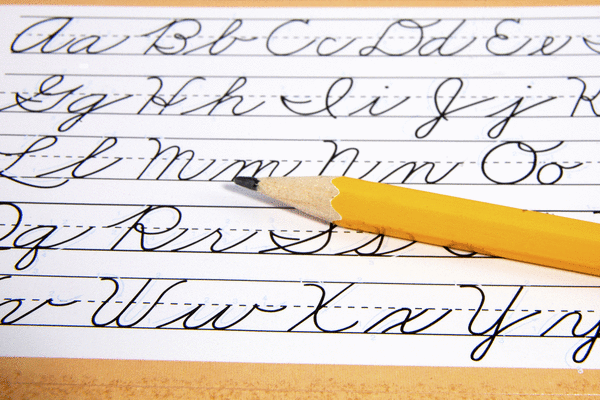
Parents dismayed by the sorry state of penmanship, take heart: A decade and a half after most states stopped requiring cursive in public schools, instruction is making a comeback.
More than a dozen states have reintroduced cursive mandates in recent years, New Jersey and Pennsylvania the latest among them. The measures come amid rising concerns about the harms of classroom technology — and the revelation that deliberate lack of instruction has left a generation of students incapable of reading the Declaration of Independence or signing their names.
Some form of cursive has been taught in the U.S. since the nation’s founding. By the early 20th century, schoolchildren also began learning “print,” which was thought to help establish early literacy skills by mirroring the text read in books.
The intrusion of technology has long been a concern for handwriting sticklers. In 1955, the Saturday Evening Post blamed the “increasing reliance on the telephone, typewriter, dictating machines and electronic brains” for turning America into a “nation of scrawlers.”
The 2010s nevertheless marked a turning point. Common Core national standards removed the recommendation for cursive in favor of keyboarding. Many states took the opportunity to free up curricula for other priorities, effectively limiting print instruction to kindergarten and first grade. Then schools started giving students individual laptops — and screen time soared.
Although longitudinal surveys of handwriting quality are scant, parents, teachers and occupational therapists broadly agree about the results of this dim experiment: Skills have deteriorated.
And yet, educators aren’t uniformly happy about cursive’s revival. “Another mandate,” one teacher says. A colossal waste of time, another wrote. “I love cursive, but we need to get the basic concepts of writing down first, such as capitals, punctuation” and, perhaps optimistically, “writing in a straight line.” They have a point.
Decades of research support the benefits of handwriting. Forming letters by hand activates regions of the brain that help children learn to read. Handwriting instruction also has been shown to improve legibility, spelling and fluency, as well as composition quality. The complex connection between the brain and body needed for writing, meanwhile, can sharpen executive-functioning skills — that is, the ability to focus, plan and juggle multiple tasks. More broadly, writing can boost reading comprehension and overall learning, including in math. (Ah, the three R’s.)
The case for cursive, however, is less clear-cut. Some studies have linked cursive instruction to better spelling and writing fluency, and there’s evidence it can help children with learning disabilities such as dyslexia. Many kids enjoy it. Yet there’s little to show that cursive is superior to print.
A better approach, researchers say, would be to teach both. Doing so properly will require training and investment many districts aren’t prepared to provide. Just 12% of teachers say their education courses in college adequately prepared them to teach handwriting, according to one survey. Teachers colleges, as a start, should incorporate evidence-based methods of instruction — and credentialing should depend on it. School districts, meanwhile, should reinforce consistent teaching methods while allocating time in the curriculum (say, by replacing excessive computer use). Handwriting instruction should be explicit, frequent and incorporated with other subjects.
Parents, for their part, should recognize that preparation for writing starts in infancy. Gross motor strength is needed for the hand stability that supports a proper pencil grip. Unstructured play, such as swinging and climbing, likewise is developmentally essential — as are fine-motor tasks such as stringing beads, cutting with scissors and playing with clay. Too often, risk- and mess-averse parents allow screens to replace such activities. It doesn’t help that schools have reduced recess. (Some have even banned tag.)
The cursive renaissance is welcome insofar as it directs attention to the collapse of handwriting more broadly. Although fixing the problem will require a more ambitious reset, the potential gains — for aspiring scholars and society — are well worth it.
_____
The Editorial Board publishes the views of the editors across a range of national and global affairs.
_____
©2026 Bloomberg L.P. Visit bloomberg.com/opinion. Distributed by Tribune Content Agency, LLC.

















































Comments