Commentary: The US and China created a new 'Trade Board' built on buzz words
Published in Op Eds
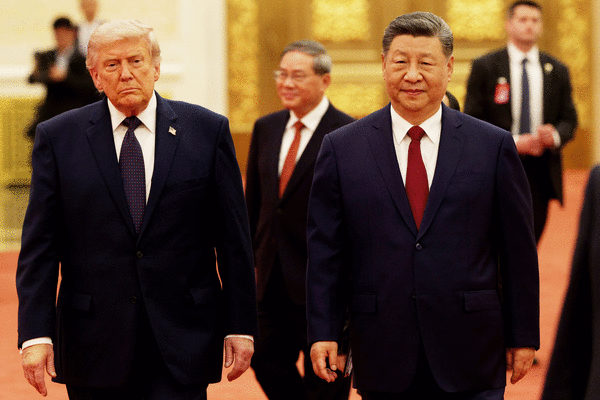
Last month, the White House announced that the United States and China had “operationalized” their new Board of Trade. The working procedures, however, say remarkably little about how the board is actually supposed to operate.
Years of tariff disputes between Washington and Beijing have produced many announcements. The Board of Trade is the newest one. Tariffs and other forms of trade restrictions have been a largely ineffective strategy against China. President Donald Trump famously tried them in 2017 and 2018. “Rather than changing its practices,” the 2019 Economic Report of the President stated, “China announced retaliatory tariffs on U.S. goods.” In 2025, Trump escalated tariffs against China to 145%. And while American purchases of Chinese goods did fall by 20%, China more than made up for this dip through increased trade with other countries.
Every time trade disputes have escalated between the U.S. and China, the resulting truce has required something to announce. In 2020, it was the Phase One agreement, in which China promised to buy an extra $200 billion of U.S. exports. These, according to a report by the Peterson Institute for International Economics, never materialized. This time, after Trump visited Beijing in May, he announced the board as the “cornerstone” of the “historic agreement” between the two nations. The board’s introduction certainly grabbed headlines, but whether it will actually result in lower tariffs or a more stable trade relationship is a different matter.
Defenders rightly point out that U.S. trade with China is different. When an American company purchases goods from a Mexican supplier, two private companies are involved. But when a Chinese supplier is involved, Beijing often inserts itself in the deal. After years of chaotic trade policy, with U.S. and China relations arguably the most chaotic of all, a standing forum gives officials a place to settle problems before they escalate. A flexible arrangement can be adapted as conditions change. Formal treaties, the thinking goes, could be too slow. These are reasonable beliefs.
However, what assures these beliefs are the rules and procedures. Unfortunately, the board’s documentation falls short.
The governing document for the Board of Trade spans just two pages and lists no authors. The length itself is no problem. As the U.S. Constitution shows, brief documents can say a lot when each clause addresses something specific: who holds which powers, how laws get made and what happens when different branches disagree with one another.
The board’s procedures do none of that. The stated mission is “to optimize bilateral trade,” but “optimize” is never defined and could mean anything a reader wants it to mean. Treasury Secretary Scott Bessent and Jamieson Greer are the principals for the U.S. while He Lifeng, vice premier of the State Council, is the principal for China. What do these people do in their capacities? They “consider proposals” made by the deputies. Who are these deputies? The documents don’t name them, but we do know they’re supported by “staff.”
How do the principals make decisions? Do both sides have to agree? Who sets the agenda for meetings? Who decides whether an agreement has been honored? We don’t know. Even the parts of this document that are the most concrete are shaky. Deputies will meet “no less than quarterly,” the staff will meet “regularly,” and the principals will meet “whenever necessary,” though “the frequency of meetings may be increased or decreased as appropriate.”
And what do the principals do with the decisions they reach? They have already “ approved” two product lists, yet the documents state that any actual tariff cuts “will be determined and implemented in accordance with each side’s domestic legal processes.” Which processes? For the U.S., do they go to Congress or the president? Neither document makes it clear.
To be fair, the board has identified goods for possible tariff cuts, including toys, small appliances, bedding and car seats coming into the U.S. Lower tariffs on these items would be worth celebrating, especially as we enter the holidays. The board has also listed almonds, pistachios, walnuts, oranges, grapes, cherries, wine and beef going into China as another set of goods targeted for lower tariffs.
For California’s agricultural sector, a path back to China’s markets is vital. The Giannini Foundation at the University of California finds that “the total value of the top 13 commodities exported to China dropped from an average of $1.5 billion (2020 through 2024) to just $554 million in 2025, a 64% decline.” But what rates would apply, and when? The framework doesn’t say.
According to the board’s Terms of Reference, “the two sides do not envision making adjustments more frequently than on an annual basis.” A pistachio farmer whose trees take years to grow and bear fruit needs to know a tariff cut will still be in effect come harvest time. A promise resting on two pages with no enforcement mechanism and no clear path into law provides little assurance.
After almost two years of tariffs being announced, paused, reversed and announced again under a different heading, the administration has now created a board that might lower a few of them. California’s growers lost a large portion of their Chinese customers to a trade war that Washington started and families around the country have been paying higher prices. A board with two pages of governing documents does little to fix this.
____
David Hebert is the director of economics and economic freedom and a senior research fellow at the American Institute for Economic Research.
©2026 Los Angeles Times. Visit at latimes.com. Distributed by Tribune Content Agency, LLC.













































Comments