John M. Crisp: What's on TV tonight? How about an execution?
Published in Op Eds
One night in 2005, I sat in a church in Texas listening to a lecture by Helen Prejean, the prominent opponent of capital punishment. Her book about her work among death row inmates had been made into the film “Dead Man Walking.”
Mostly, Prejean was preaching to the choir. She talked convincingly about the brutality and futility of capital punishment, a message that most of her audience probably already believed. One could sense their agreement.
But as soon as Prejean finished describing her opposition to the death penalty and invited questions, a young woman in the row directly behind me stood up and faced the audience. She held a picture of her sister, a beautiful girl who had been one of at least five victims of a serial killer. Her murderer was still on death row.
The young woman described the torture and murder of her sister, as well as the pain that her family still experienced every day from the knowledge that this monster was still alive. The picture and her speech administered an uncomfortable jolt to the convictions against the death penalty held by many in the audience.
But this is the dilemma we face: Our instincts compel us to impose on the sister’s killer precisely the treatment that he gave his victim. Or, if we don’t have the stomach to torture him to death, then, at least, to kill him. An eye for an eye.
But the death penalty is fraught with problems. We’ve never managed to apply it equitably across economic classes, gender and race. There is little evidence that putting people to death deters crime. And it’s inevitable that some percentage of the executed are innocent.
The Death Penalty Information Center reports that since 1973 at least 203 people sentenced to death row in 30 states have been exonerated. As long as we permit capital punishment, an unacceptable percentage of its victims will be innocent.
And even though we’re skillful and experienced at killing people, at home and abroad, we’re not very good at executing them. Christa Pike, for example, recently survived a botched execution. She’s recovering from the damage while the state of Tennessee is deciding whether to try again. She’s hardly the first or only victim of a clumsy execution. The agonies of the hapless sufferers clearly qualify as cruel and unusual punishment.
For these and other reasons, nearly all of the world’s countries have abolished the death penalty. By retaining it, the United States keeps company with countries such as Iran, North Korea, China and Saudi Arabia.
The history of civilization is a long, fitful slog away from primitive, brutal practices. Consider the cruelties that most civilized cultures have consigned to the past: human sacrifice, slavery, torture, foot-binding, eunuchs, child marriages, genital mutilation, child labor and so on.
Most countries—but not the U.S.—include capital punishment on this list of abandoned barbaric practices. But at least the U.S. has been able—since 1936—to include public executions on the list of things we don’t do.
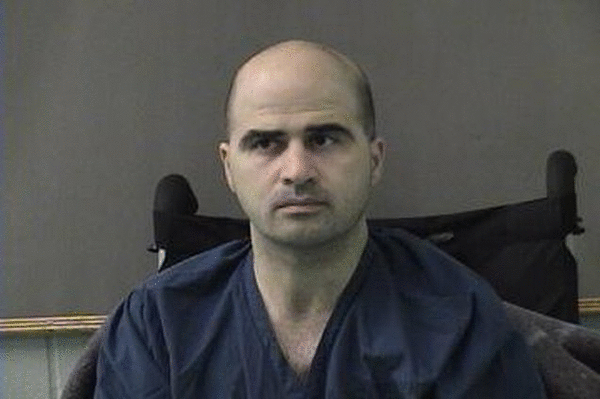
Not anymore. Secretary of Defense Pete Hegseth has decided to execute Nidal Hasan, convicted of killing 13 people at Fort Hood, Texas, in 2009, by firing squad on Dec. 3 and livestreaming the event.
I oppose the death penalty. Nevertheless, I’ve written that executions should be televised, and they should use more brutal methods than the peaceful passage provided by lethal injection, when it works. Why not firing squads, hangings and beheadings? Put them on pay-per-view and make a fortune.
Is irony dead? My argument is rhetorical, made in hopes that Americans—once they actually witness the violence committed by the state on their behalf—will be disgusted and join most of the rest of the world in abolishing this brutal practice.
President Donald Trump was enthusiastic about a public execution—“Absolutely”—but he could change his mind. He, Congress, the courts—someone—must stop this shameful setback for civilizational progress.
Remember: Capital punishment is not about the criminal; it’s about who we are. A public execution on Dec. 3—or its prevention—will tell us a lot.
_____
_____
©2026 Tribune Content Agency, LLC
















































Comments