Editorial: Can Washington trust Moscow?
Published in Op Eds
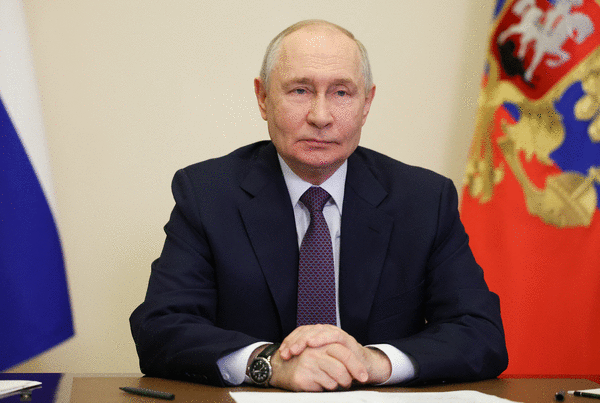
Russia’s war against Ukraine has become a test of American judgment. This weekend, Russian strikes in Ukraine’s Zaporizhzhia region killed at least 20 people, including children, according to Ukrainian officials. At the same time, President Donald Trump called for Ukraine to get a new president, arguing that Volodymyr Zelenskyy has failed to make a deal with Moscow.
The timing matters. Trump had just announced an agreement with Russian leader Vladimir Putin to supply diesel to U.S. and global markets. The administration temporarily eased sanctions on Russian fuel to allow the shipments. Zelenskyy warned that the arrangement could bring Moscow revenue to help sustain its war. Trump, by contrast, blamed Ukraine’s attacks on Russian oil refineries for high diesel prices and pressed Zelenskyy to stop them.
That raises a difficult question: Has Ukraine’s survival become secondary to a transaction meant to ease fuel prices? The administration can argue that cheaper energy serves American families and businesses. But the benefit is uncertain. Energy analysts have questioned whether Russian diesel will significantly lower prices. The political and strategic signal is clearer: Washington is willing to relax pressure on Moscow while publicly pressuring Kyiv.
A peace agreement should end the killing and protect the sovereignty of the country invaded. It cannot be measured only by whether leaders announce a deal or whether fuel prices briefly fall. Putin has insisted that Russia retain Ukrainian territory it does not fully control. If that demand is rewarded, what prevents Moscow from rebuilding its strength and threatening Ukraine again?
Can we trust the Russian government to honor a settlement? Trust is earned through actions, not warm words between presidents. Russia launched a full-scale invasion of its neighbor and continues to attack Ukrainian cities. That record does not make diplomacy pointless. It makes verification, enforceable terms and credible security guarantees essential.
And this is a judgment about the Russian government, not the Russian people. The Kremlin’s choices should not be confused with the hopes or character of ordinary Russians. But American leaders have a duty to assess the government across the negotiating table by what it does, not by what it promises.
Trump is right that wars must end. But asking Ukraine to yield leverage while Moscow receives economic relief is not a balanced path to peace. Calling for Zelenskyy’s removal further weakens Ukraine’s position and risks implying that the invaded country, rather than the invader, is responsible for the failure to settle.
America should pursue diplomacy. It should also be honest about what diplomacy requires: pressure on the aggressor, protection for the nation under attack and guarantees that make renewed aggression costly. If the diesel deal rewards Moscow while Ukraine is told to stand down, Americans should ask plainly: Are we helping end Russia’s war or helping Russia wait for its next opportunity?
_____
Baltimore Sun editorial writers offer opinions and analysis on news and issues relevant to readers. They operate separately from the newsroom.
_____
©2026 The Baltimore Sun. Visit at baltimoresun.com. Distributed by Tribune Content Agency, LLC.

















































Comments