Commentary: Why we shouldn't expect rape survivors to report
Published in Op Eds
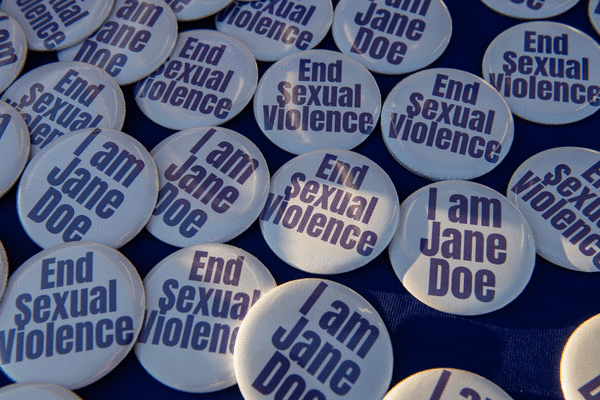
At the rape crisis center where I was trained in Chicago, we didn’t refer to the criminal justice system. We called it the criminal legal system: because justice, while aspirational, is rarely achieved. As an emergency room advocate, I was taught never to pressure survivors to report to the police, but simply to outline their options and support whatever choice they made.
The Cornell case is a prime example of why we took that approach. We knew exactly how much the reporting process asks of survivors, and how few actually receive justice at the end of it.
The details of the Cornell case are devastatingly familiar: a college student, unable to consent, assaulted by fraternity members. Failed by the police, who treated normal aspects of trauma as evidence of unreliability, and therefore left out key parts of her testimony. Failed by the district attorney, who declined to review additional evidence. Failed by her university, who allowed many of the men who assaulted her back on campus.
Thanks to relentless reporting of Cornell students and the resulting public pressure, Jane Doe’s case has now been reopened. But the burden of proof this survivor will face in New York — a state that requires a survivor prove they were physically helpless (in other words, unconscious) for the entirety of an assault— will still make a conviction extraordinarily difficult.
Neither this case, nor the many systemic failures it involves, is extraordinary. Research suggests that in many reported sexual assault cases, police neglect to do the bare minimum of investigating. According to RAINN, police decline to investigate key evidence like texts and emails in about 80% of sexual assault cases between people who know each other, which accounts for the vast majority of sexual assaults.
In the case of the Jane Doe from Cornell, this evidence — which police appear to have failed to request or pass along to the D.A. — included a screenshot of a group text during which her semi-conscious body was offered up like free pizza, and a text from one of her alleged rapists the next morning, apologizing vaguely for “how things went down.” Perhaps as a result of this institutional neglect, 4 out of 5 perpetrators are never charged, and of the 80% of cases where sexual assault is categorized as founded — in other words, as likely to have happened — only 8% of them result in conviction.
Is it any wonder, given these sadly familiar facts, that people are reluctant to report? We can hardly expect any different, especially given the enormous personal costs they are asked to undergo in order to do so.
For those fortunate enough to have never been through the process, here is what one can generally expect when reporting a sexual assault. If you go to the emergency room, you will be offered a sexual assault forensic exam (colloquially known as a “rape kit”), during which you will be asked to undress, giving your clothes up as evidence, have photos taken of your naked body, have your hair combed and your nails scraped for DNA evidence, and have Q-tips inserted in your anus, mouth, vagina and/or genitals. You will be asked detailed and invasive questions from first a nurse — who, if you live in a state that requires the use of Sexual Assault Nurse Examiners, will at least be trained in how to ask them sensitively — and a police officer, who likely will not.
You will have to answer those questions again and again if your case progresses. You will be asked to recall minor details surrounding the incident with an accuracy that most of us don’t have about a normal Tuesday, much less the most traumatic day of our lives. You will be asked about your relationship status, your sexual history, your substance habits. If your case goes to trial, you will have to answer all of these questions again in front of an audience, from both the D.A., who is on your side, and the defense attorney, whose job it is to make the jury doubt your testimony, with the side effect that you sometimes end up doubting your own reality.
This process may last years, during which time you will be asked to put your life on hold to make room for interviews, hearings and trial dates, the schedules of which are constantly shifting according to everyone’s calendar but yours.
At every stage of this process, there are opportunities for people or systems to fail you, and the statistical likelihood is that one of them will. At the end of it, if you are part of the 8%, this process may result in conviction, and the person who assaulted you may receive punishment in the form of a prison sentence. Or he may be given six months and a slap on the wrist, because he had a promising future.
I say all this not to discourage people from reporting, but to outline the costs of what we ask of survivors when we demand that they report. Because sexual assault is not like other crimes. Victims of armed robberies are not typically asked to prove their own innocence. And when we expect and even demand that victims report, we are asking them to do just that: to take on a part-time, unpaid job of proving their innocence in a crime that happened to them.
If we are going to continue to ask victims to take on the burden of reporting, then we owe it to them to provide the bare minimum of support: mandating the right to SANE nurses and hospital and legal advocates in every state, training police forces — including campus police — in trauma-informed questioning, funding services that victims need to survive the harrowing aftermath of assault: from legal support to help them file for orders of protection, to emergency housing, to mental and reproductive health services.
Until then, we owe survivors the agency to decide for themselves what is best for them, and not to pressure or disbelieve them if they decide that what is best for them is to not report.
As a child sexual assault survivor, I did not have the vocabulary about what happened to me at the time in order to tell my parents, much less the police. I wonder sometimes what would have happened if I had spoken up. I wonder whether it would have prevented the assaults I was later told that he went on to commit (though I have no proof of them, no more than I have proof of my own).
It took me the better part of two decades to recover from the assault. But I wonder how much longer it would have taken if I had reported: If in addition to the scars of anxiety, nausea, nightmares and flashbacks that recurred for years, leaving me disassociated and unfamiliar to myself, I would’ve also had to contend with scars from a court process that took up my adolescence and retraumatized me over and over — all for an 8% chance that the person who assaulted me would receive any consequences at all.
When I think about that, it’s not regret that I feel for not speaking up: It’s relief.
____
Alison Murphy is a writer and the director of policy and communications for the Chicago Committee on Immigrant and Refugee Rights.
©2026 Los Angeles Times. Visit at latimes.com. Distributed by Tribune Content Agency, LLC.


















































Comments