Commentary: Minnesota was ready
Published in Op Eds
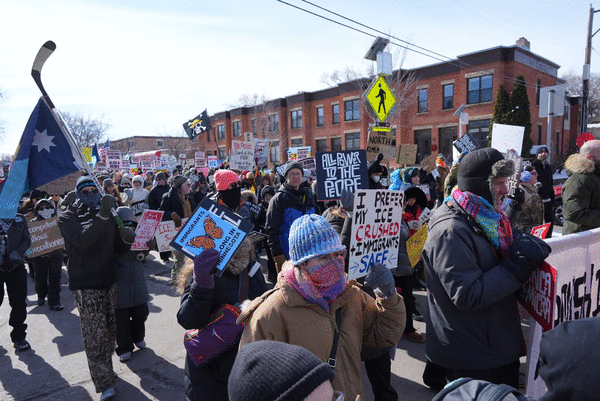
Last summer I returned to Minnesota after 12 years working in Washington, D.C. I spent much of that time helping cities in North America and Europe build the relationships and civic capacity that allow democracy to endure stress and division.
I was far from the front lines of Minnesota's response to the federal immigration surge last winter. The people who opened their churches, organized neighbors, documented events, provided legal support, cared for families, and showed up day after day own that story. Since coming home, however, I have had the privilege of helping shape the Minneapolis Foundation's Minnesota Meeting on "The Surge & What's Next" and listening to residents describe what happened and why.
Minnesota's response to the immigration surge played no small role in my decision to come home. From Washington, I watched with admiration. Since returning, I have spent months listening to the people who lived it directly. Their experiences are their own, and I do not presume to speak for them. But as someone who has spent years working on democratic resilience, I have been struck by what their stories reveal about Minnesota itself.
When people around the country ask what happened in Minnesota during the federal immigration surge, they are often asking some version of: Why did so many people show up? Why did neighbors mobilize so quickly? Why did churches open their doors? Why did artists, business owners, teachers, students, and retirees suddenly find themselves standing together in below-zero temperatures?
The better question is: Why was Minnesota ready?
Minnesota is often praised for high voter turnout. But voting is only the visible tip of the iceberg. The deeper story is the network of relationships and institutions that teach people how to work together long before Election Day arrives.
Across Minnesota, people belong to congregations, unions, neighborhood associations, sports clubs, immigrant support networks, mutual aid groups, and schools that see themselves as civic institutions. Together they form a web of relationships that teaches people how to act collectively.
In ordinary times, that civic infrastructure can seem invisible. It organizes food drives, supports new arrivals, coaches youth sports, and helps families through hardship. In extraordinary times, it becomes something else. In this case, it became democratic resilience.
When federal enforcement activity intensified last winter, Minnesota did not wait for instructions. People relied on trusted relationships they already had. Information moved through churches. Artists created spaces for expression and solidarity. Labor unions mobilized volunteers. Neighborhood networks checked on vulnerable residents. Businesses offered support. Journalists documented events. People who had never viewed themselves as activists acted on a simple conviction: neighbors protect neighbors.
The remarkable thing was not just the scale of participation. It was its familiarity. Many residents described their actions as ordinary acts of moral responsibility, not extraordinary acts of political engagement.
That helps explain why outside observers have struggled to categorize what happened here. Some have looked for charismatic leaders. Others have searched for sophisticated organizing strategies. Both existed. But neither fully explains the story.
The true protagonist was the civic culture itself
Minnesota has long cultivated a belief that democracy is not something that occurs only during elections. Democracy is something people do together. It's a verb. It lives in the daily practice of solving problems, showing up, volunteering, debating respectfully, and remaining invested in people beyond one's immediate circle.
Minnesota has also made deliberate investments in civic life. Minneapolis' 20-year neighborhood revitalization initiative, for example, helped create a generation of residents who learned how to organize, solve problems together, and exercise local leadership. Long before this crisis, people had practiced the skills democratic resilience requires.
That tradition is imperfect. Like every state, Minnesota carries contradictions and unfinished work. We continue to wrestle with inequities, divisions, and questions of representation and trust. But those challenges make the larger lesson more meaningful, not less.
Last winter's events showed that democratic resilience does not emerge during a crisis. It is built before a crisis through relationships, trust, participation, and shared responsibility. When pressure arrives, communities draw on reserves accumulated over decades.
This is why the story of Minnesota matters beyond Minnesota. At a moment when trust in institutions is declining across the country, people are asking how democracy can regain strength. The answer may be less about creating new systems than investing in the relationships that allow existing systems to work.
People often describe what happened in Minnesota as a resistance movement. I understand why. But after months of listening, I have come to see it differently.
This was not primarily a story about opposition. It was a story about connection.
Not politics, but people.
Not ideology, but neighboring.
And perhaps that is the most important lesson Minnesota has to offer: when communities spend years building the habits of civic life, they are ready when history unexpectedly comes knocking.
____
Steven Bosacker is the Senior Advisor to the President at The Minneapolis Foundation. He previously served as SVP & Director of Cities at the German Marshall Fund, the Principal for Public Sector & Partnerships at Living Cities, City Coordinator for the City of Minneapolis, and as Chief of Staff to former Minnesota Governor Jesse Ventura.
_____
©2026 The Fulcrum. Visit at thefulcrum.us. Distributed by Tribune Content Agency, LLC.














































Comments