Commentary: Christa Pike execution shows lethal injection is breaking down
Published in Op Eds
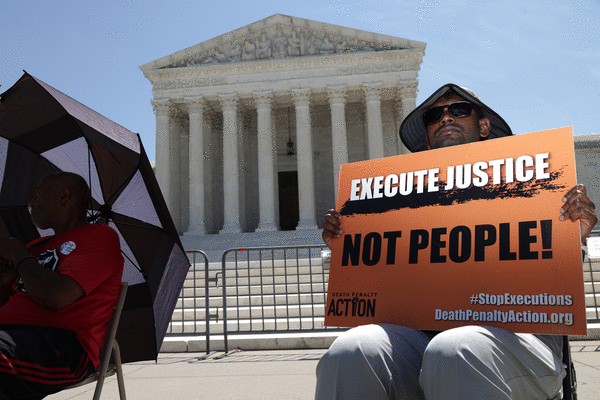
Christa Pike’s execution in Tennessee was a disaster waiting to happen. The warnings did not only come from her lawyers or opponents of the death penalty: Doctors in Tennessee and Republican state senators called for the state to pause executions, because the chances of one going catastrophically wrong were so high.
Tennessee Gov. Bill Lee did not heed those warnings. Now, the defining image of the death penalty in 2026 is a woman strapped to a gurney, in unbearable agony, being tortured by prison officials tasked with killing her but unable to do so.
In May, Tennessee officials stabbed Tony Carruthers with needles and a scalpel for more than an hour while blood streamed down his chest. In August 2025, Byron Black groaned and cried out in obvious distress as he died. But this is not the story of a handful of botched executions. We are witnessing the complete breakdown of the dominant method of execution in the United States.
My organization, Reprieve, studied botched lethal injections that were carried out from 1977 to 2023. Over a third of them lasted more than 45 minutes, and over a quarter lasted longer than an hour. Secrecy was among the risk factors we identified, increasing the chances an execution would go wrong. Haste was another. Taken together, they define the approach being taken by execution-seeking states during President Donald Trump’s second administration.
The death penalty in the U.S. relies entirely on secrecy. Indeed, the whole point of lethal injection is to obscure the violence of the state taking a human life. Tennessee’s secrecy law is extremely broad, but no more so than many other death penalty states. The curtain that officials brought down to prevent witnesses seeing Pike’s suffering is merely the visible manifestation of a process that is hidden from voters by design.
Tennessee refuses to say where it gets its execution drugs. It will not disclose how many vials it has on hand, how they are stored, when they expire or even whether it uses compounded or manufactured pentobarbital in executions. It was recently revealed that the state spent $650,000 on a supply of execution drugs.
If a state purchases manufactured drugs on the black market, which comes at a huge markup, that breaks pharmaceutical company distribution controls.
From the executive order “Restoring the Death Penalty,” issued on his first day back in office, Trump made clear that he wants to see more executions. Some executing states have been following his cue. Nationally, there were 47 executions last year, but three-quarters of these were in just four states and 40% in Florida alone.
In April, the Department of Justice published a death penalty report that bizarrely asserted that all methods of execution available to states are constitutional and humane, from lethal gas to the electric chair, the firing squad and lethal injection.
Alabama has been busily demonstrating that the reverse is true, following a string of hideous botched lethal injection executions with a series of no less gruesome executions with nitrogen suffocation. After a federal court prohibited further nitrogen executions, the state switched back to the old, broken method.
In the aftermath of the failed execution of Pike, Tennessee officials issued a statement observing that they had “followed every step of the State’s lawful, established execution protocol approved by the Attorney General’s Office.” We have become accustomed to states breezily dismissing witness reports of a man violently thrashing for 22 minutes as he dies as “ nothing out of the ordinary,” but this was staggering, even by those debased standards.
In the 2015 landmark U.S. Supreme Court ruling in Glossip v. Gross, which held that condemned prisoners may only challenge their method of execution after providing a known and available alternative method, Justice Samuel Alito wrote for the majority that “our decisions in this area have been animated in part by the recognition that because it is settled that capital punishment is constitutional, ‘it necessarily follows that there must be a (constitutional) means of carrying it out.’”
The cruel and unusual punishment of Pike, following a horrific run of botched executions, must be a turning point. Facing the reality of capital punishment as it is carried out in 2026, we should turn Alito’s logic on its head. If there is no constitutional means of carrying out the death penalty, it follows that the capital punishment itself is unconstitutional.
____
Maya Foa is CEO of Reprieve and Reprieve US, leading a team of lawyers and investigators fighting against human rights abuses, including the death penalty, torture and indefinite detention without trial.
___
©2026 Chicago Tribune. Visit at chicagotribune.com. Distributed by Tribune Content Agency, LLC.

















































Comments