Commentary: New York is making childcare affordable. Don't forget the people providing it
Published in Op Eds
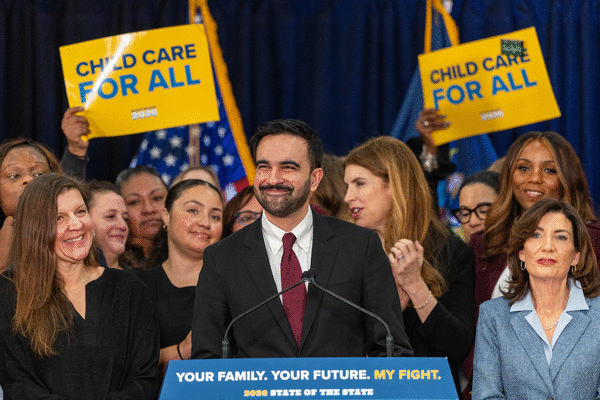
Last month, New York City opened its first free 2-K classrooms. Roughly 2,000 two-year-olds got seats, the beginning of Mayor Zohran Mamdani’s push for universal childcare.
More than 5,700 applied for those first 2,000 seats, which gives some sense of the demand. Childcare has become unaffordable for too many parents, and New York is doing something important by treating it less as a private family expense and more as a public responsibility.
But something else happened in that first week. Some of the people providing the care were still waiting to be paid.
Providers described dipping into savings, taking out loans and struggling to cover payroll — asking staff to work for free without any supplies — while city contracts were still being processed. In the worst case, programs delayed opening, leaving families scrambling for last-minute care.
The city has acknowledged the problem and is working to fix it, with a $43 million effort to improve early childhood contracting and offering interest-free bridge loans.
While the delays may be temporary, they exposed a blind spot that is all too familiar in childcare: we often design around making childcare work for families, and forget the realities of those providing the care itself.
Home-based childcare providers are a crucial part of 2-K, and are among the easiest to overlook. Richard Buery, who helped build New York City’s universal pre-K program a decade ago, has warned that 2-K’s heavy reliance on home-based providers makes payment delays particularly risky. A larger childcare organization may have reserves to keep operating while it waits for a city contract to clear. Many providers running programs out of their homes do not. For them, a delay can quickly become a question of whether they can pay staff, buy food or keep the doors open.
Andrea Pena has cared for children in the Bronx for nearly three decades. Her home-based program is licensed for 14 children and is usually full. After paying her employees and expenses, she estimates she earns about $9.50 an hour — less than New York’s minimum wage. The median wage for New York’s home-based childcare providers is just $6 an hour. Selling coffee at Dunkin’ Donuts is three-times more lucrative than caring for babies during their most critical stage of development.
“Going through my budget, it’s like my stomach aches,” she told Gothamist. “It hurts, because I’m not making any money.”
I have heard versions of that sentence for years, only usually 7,000 miles away.
In Nairobi’s informal settlements, some of the childcare providers I work with run their businesses from a single ten-foot-by-ten-foot corrugated metal shack. Their family sleeps there at night. By sunrise, it is full of babies and toddlers whose parents have gone to work.
I’ve spent much of my career in rooms like that. Of course the dollar amounts are nowhere near New York’s, but the experience of waiting for money is the same.
Most parents in Nairobi’s urban slums work as casual laborers — washing clothes, cleaning homes or selling fruits and vegetables door-to-door — which means there is no predictable paycheck, and often no guarantee that they will earn anything that day. If a mother does earn something, she may pay the childcare provider, or use that money to cover dinner for the night. If she doesn’t, the fee rolls over, often for weeks or months on end.
Turning a child away doesn’t necessarily solve the problem. Without childcare, the mother may lose that day’s work, along with the chance to earn the money she already owes. So the provider waits. She keeps caring for the child while waiting for money that may never come. She acts like a safety net, while struggling to make her own ends meet.
New York is trying to do something very different by putting public money behind childcare so families do not have to carry the cost alone. And while that is a major step forward, the next question is how to build that public financing in a way that works for the small providers the system depends on.
To be sure, some friction is inevitable when a city launches a program this large and ambitious, and the Mamdani administration has moved quickly to address it.
But if New York is going to rely on home-based providers to help deliver 2-K at scale, the payment system has to reflect the fact that many cannot front weeks or months of food, wages and other operating costs while waiting for government money. Funds need to arrive early enough, and predictably enough, that providers can run the business without becoming the city’s lender.
Families have rightly been at the center of New York’s push for universal childcare. As 2-K grows, the financial reality of the people caring for their children needs to be just as present in its design. If home-based providers are essential to universal childcare, the system has to work for them too, from the day the first child walks through the door.
____
Sabrina Habib is the Co-Founder of Kidogo, Kenya’s largest childcare network and leads the Zera Fund, spurring new investments into childcare globally as part of Melinda French Gates’ Global Leaders Initiative. She is also a Public Voices Fellow Tackling Poverty, a partnership between The Op-Ed Project and Acumen.
_____
©2026 The Fulcrum. Visit at thefulcrum.us. Distributed by Tribune Content Agency, LLC.
















































Comments