Commentary: The tech threat to women's privacy
Published in Op Eds
In late August, Texas and Florida became the latest states to limit the use of Flock cameras, an artificial intelligence-powered network of automated traffic surveillance devices, in response to growing concerns about their misuse by law enforcement. But even in the consumer technology sphere, other digital surveillance devices pose similar threats to the privacy and well-being of users, especially for women.
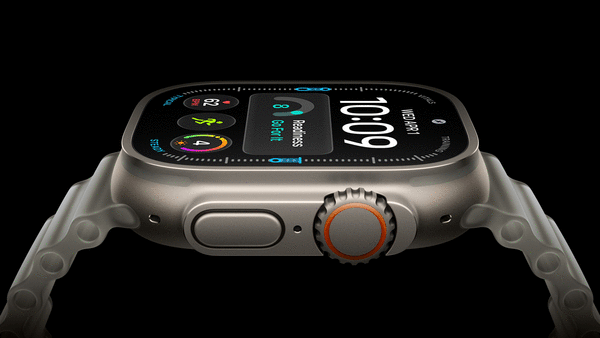
This includes health monitoring devices such as Apple Watches and Oura rings, whose technologies have improved drastically over the years. They can now precisely track heart rate, step count and metabolic rate, and can even predict phases of a user’s menstrual cycle. But data, though personal and medical in nature, is not covered by HIPAA, the Health Insurance Portability and Accountability Act, which protects personal electronic health data in other contexts.
The fact is, surveillance of women’s intimate health data puts them at risk. And although we might not yet recognize the potential, the Centers for Disease Control and Prevention already does. During her confirmation hearing in July, newly appointed CDC director Dr. Erica Schwartz said “abortion surveillance is absolutely a critical component” of the CDC’s work. (The agency currently collects state-level abortion statistics through a voluntary system; several states do not provide this data.)
Fitness devices with comprehensive reporting could also act as Trojan horses that allow others to obtain this data. While fitness tracking companies typically claim consumer data is safe, some tracking apps have already leaked data to Big Tech companies. For example, in 2021, the period tracking app Flo drew a Federal Trade Commission complaint alleging that the company had shared sensitive intimate data, including pregnancy information, with Google and Meta — despite the company’s claim that this information would remain private.
Similar concerns also exist with wearable devices, as they often integrate into third-party softwares like Flo or offer similar tracking capabilities in their apps.
The leaking of personal data to companies like Meta and Google is even more alarming because these companies allow brokers to access consumer data while suffering data breaches themselves.
With such sensitive data being so vulnerable, those who seek to suppress women’s rights could easily access them for this purpose. These breaches of privacy are already happening; in 2024, data broker New Intelligence sold information that disclosed more than 500 trips to abortion clinics across nearly all 50 states to anti-abortion groups for targeted campaigns. As technologies get smarter and efforts to monitor women accelerate, data breaches from our everyday technologies, like smart devices, become increasingly worrisome.
I’m not saying we should all throw out our smart watches and rings. But if we choose to use them, we must do two things. First, we need to be vigilant in how we use them— by reviewing privacy policies, knowing where our information goes, and opting out of information sharing where necessary. And second, we must push for the government to regulate these companies and prohibit the non-voluntary tracking of women’s bodily choices.
Most Americans agree; one survey from Navigator Research found that more than 60% of Americans want Congress to prevent apps and search engines from selling reproductive health data.
Legislation like the “My Body, My Data Act,” reintroduced last year by three Democratic members of Congress, must be enacted to regulate tech companies. This legislation would limit the data collected from consumers and protect data not currently covered under HIPAA. Some states like Washington have begun implementing similar laws, but a patchwork of state legislation is simply not enough.
Right now, health-conscious women have two bad choices: opt out of technologies meant to help them understand their bodies better, or opt in and risk that this data will be used against them. We must call on our legislators to side with consumers, not Big Tech, and fight back against unjust oversight of our autonomy.
____
Sparkle Rainey is a youth activist and communications director at Young People’s Alliance. She is a Public Voices Fellow on Youth Well-Being and Power with The OpEd Project and Hopelab. This column was produced for Progressive Perspectives, a project of The Progressive magazine, and distributed by Tribune News Service.
_____
©2026 Tribune Content Agency, LLC.


















































Comments