Commentary: My students are politically apathetic. Here's what colleges can do to get them involved and engaged
Published in Op Eds
A recent national poll conducted by Harvard University revealed that young Americans are a pessimistic bunch. People between ages 18 and 29 view inflation and the rising cost of housing as national crises. More than a quarter of young adults believe they’ll end up worse off financially than their parents. And only 13% say the country is on the right track.
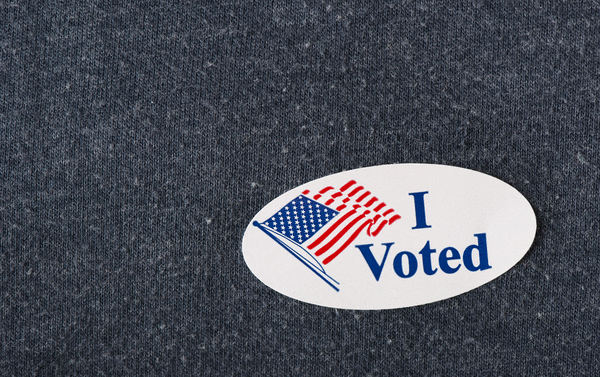
Yet when it comes to doing something about it — such as voting — Gen Z is pretty apathetic. Fewer than half of young Americans voted in the 2024 elections. With the midterms fast approaching, the Harvard survey found that just 35% of Gen Z definitely plan to vote — but without much enthusiasm. Only about 1 in 10 (12%) feel motivated to participate.
Ideally, developing civic engagement and political socialization skills begins at home, with young people listening to their parents discussing the news and going with them to vote. Then, throughout elementary, middle, and high school, students should be formally learning about American democracy and how government works. Long before they reach college, young people should have learned to listen to other people and hold civil conversations.
But whatever civic and political awareness young people are gaining before entering college, it has been smothered by their frustration and disconnection from the larger world. It seems like absolutely everyone around them — their parents, their classmates, their real and parasocial friends on social media — are yelling about everything. They are bringing this attack-first approach with them to college and the communities where they will live as adults.
Although colleges might not think it’s their job to teach their students how to talk about civics, government and American democracy, it is. Instead of leaving families, the internet, and the nation’s K-12 schools to do the heavy lifting, institutions can help their students learn civic discourse by getting them to grapple with these three questions.
First: Why should we care?
For a generation that possesses little in the way of civic obligation, classes that touch on government and democracy should start with this fundamental question. In Oklahoma, where I was born, raised, and teach, all students who want to earn a college degree must take American Federal Government, a political science course that teaches them about the U.S. government, political parties, political theory and behavior, and civil rights.
But just because this course appears on their degree plan doesn’t mean that students understand why it’s so important to learn about civil liberties, the separation of powers, and the Electoral College. As the Founders might have said, it’s not self-evident.
I start each class by explaining the “why.” Although much of what I teach focuses on what’s happening in Washington, D.C., I urge my students to think about these issues in the context of their friends and neighbors. Government is about establishing the rules we all use to get along, resolve our disagreements, and live our lives. Civil society works only if we care about one another and can use discourse and dialogue to reach consensus on even the most polarizing and divisive issues.
Second: How do I advocate for things I care about when I’m scared of the reaction I’ll get?
Online discourse is rough and tumble — so much so that many students simply don’t bother to start conversations. My students missed out on crucial socialization opportunities during the pandemic by being isolated at home. That makes virtual discussions difficult for them. In-person conversations are nearly impossible. They’re scared to advocate for family, friends, or their community for fear of being ignored or even canceled.
Having hard conversations are fundamental to creating a viable civil society. Removing this intimidation barrier so students will express an opinion and back it up is critical.
Rose State College has been fortunate to partner with Unify America, whose Civic Gym initiative gives my students a forgiving space to build their civic muscles and practice having civil discussions. The program paired my students with students from other colleges across the country for a structured virtual one-on-one discussion about the issues of the day.
In many instances, students agree. When they don’t, the program helps them find some common ground and figure out a way to disagree with respect and with understanding of where the other person is coming from. Not only did my students become more informed about issues facing Oklahoma and the nation, they got to hone their dialogue and thinking skills — skills that should serve them well long after they leave my classroom.
Third: How do I really learn about these issues?
Reading, researching, and talking to other people are great ways to learn about politics and government. The best ways are to see it in action.
Our campus is only about 15 minutes from the state capitol in Oklahoma City, so I take my classes to meet with lawmakers and interest groups, advocate for an issue they’re passionate about, and make their voices heard. If I taught at a more remote campus, I’d urge my students to attend school board and town council meetings to see their local government at work and engage with their local elected officials.
Immersive, first-hand civic experiences such as these are invaluable. Plus, they get my students to practice their conversation skills.
Learning about civic discourse is more than just government, politics and voting. It’s about building community and learning valuable skills — communications, critical thinking, disagreeing in a civil way — that will help students at home, at work, and throughout their lives.
_____
Emily Stacey is a Professor of Political Science at Rose State College.
_____
©2026 The Fulcrum. Visit at thefulcrum.us. Distributed by Tribune Content Agency, LLC.


















































Comments