Commentary: Venezuela has bent to US will. Is that good for Venezuelans?
Published in Op Eds
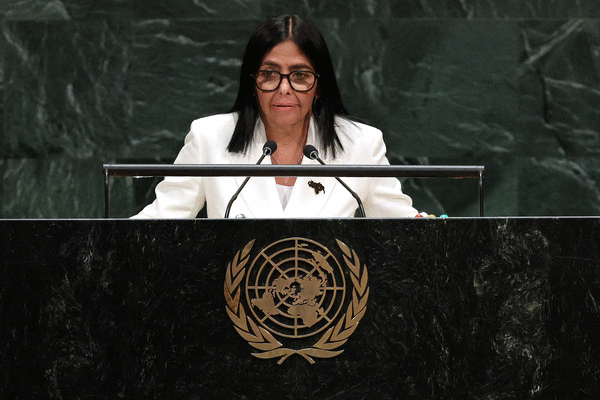
The juxtaposition was striking. On stage was Delcy Rodríguez, Venezuela’s interim president, addressing the United Nations General Assembly and meeting with President Donald Trump less than a year after both considered her somewhat of a pariah. Her old boss, Nicolás Maduro, was sitting in a jail cell in Brooklyn a few miles away awaiting trial for drug trafficking and narcoterrorism — two crimes that could keep the former Venezuelan despot behind bars for decades. The message was clear: Cooperate with Trump and get rewarded; defy him and get plucked out of your home in the middle of the night to face justice in a U.S. courtroom.
Relations between the United States and Venezuela, two countries that have been adversaries since the late Hugo Chávez took power in 1999, are the best they’ve been in a quarter-century. With Maduro out of the way, the South American country is now led by a woman, Rodríguez, who at the very least is cooperative and at the most extreme a proxy for Americans. Trump’s decision to greet her on the sidelines at the U.N. gathering for a short 15-minute meeting was the culmination of months of the president complimenting her leadership qualities. In reality, what he’s happy about is Rodríguez’s ability to give him headline-grabbing economic concessions that he can brag about at a time when his foreign policy remains hamstrung by the war in Iran.
If Maduro was a thorn in the president’s side, Rodríguez is proving to be the opposite. While it might be too unfair to call her a “puppet,” Rodriguez no doubt is trying to demonstrate her usefulness to the Trump administration — if only because she has no other choice but to comply with Washington’s demands. We may think of expansionism as a word from a bygone era, but what’s playing out in Venezuela today is nothing short of modern-day colonialism, with the faraway master setting the terms of engagement.
Whether you agree with the Trump administration’s Venezuela policy, there’s no disputing that the U.S. has achieved success there. By using the carrot of U.S. investment and the stick of U.S. coercion, the Venezuelan government has been pushed into enacting policies — such as reopening the country’s oil, gold and mineral industries to foreign companies — that likely would have Chávez rolling in his grave. The biggest win for Trump came in August, when Venezuelan officials agreed to hand over 46 billion barrels of oil reserves, approximately one-fifth of the country’s entire supply, to a U.S.-backed private company that the White House claims will help refill the U.S. Strategic Petroleum Reserve at below-market cost.
Security coordination, sorely lacking in the past, also is improving. In June, the U.S. military killed the head of the Tren de Aragua transnational criminal organization in the southeastern Venezuelan state of Bolivar, an operation assisted by the same Venezuelan security forces that were taken by surprise by U.S. special operations forces during Maduro’s capture.
Success, however, isn’t equally shared. U.S. policymakers in Washington might be thrilled with how the year is going, but ordinary Venezuelans continue to exist in a labyrinth of servitude and poverty. The vast majority of Venezuelans aren’t shedding tears for Maduro, who presided over a massive contraction of the Venezuelan economy, threw thousands of people into prison for dissent and stole multiple presidential elections. Yet the hope many had after Maduro’s ouster is now dissipating as the Trump administration appears more interested in striking commercial agreements and exerting leverage than bringing democracy back to a country whose last legitimate election happened more than a decade ago.
Indeed, even as Rodríguez continues to hand her country over on a silver platter, today’s Venezuela doesn’t look a whole lot different than it did when Maduro was ruling. Hundreds of political prisoners have been released, but hundreds still remain behind bars. The political transition in the Venezuelan government hasn’t changed much, to the surprise of no one. Outside of Maduro, the new government is staffed by the same people as the old one — some, such as Interior Minister Diosdado Cabello, are still technically wanted by the FBI. And as a U.N. fact-finding mission revealed earlier this month, the Venezuelan security forces’ apparatus of repression is still in operation.
For now, the Trump administration isn’t particularly bothered by any of this. The name of the game is deals, deals and more deals. Economic rewards are more of a priority than democratic reforms. This is not without reason. As Washington learned the hard way in Afghanistan and Iraq, pushing too quickly on reforms — let alone removing a country’s political system altogether — can have adverse impacts, particularly for those who are left without jobs and find themselves short of power, prestige and influence. This is why Trump chose to keep the current Venezuelan government in place rather than throw unfettered backing to Nobel laureate María Corina Machado, who had virtually no support among the Venezuelan elite and whose return from exile still remains a source of controversy.
Still, there will come a time when this pragmatic calculation begins to look like obstructionism. The White House continues to claim that new elections will eventually take place after Venezuela’s stabilization and economic recovery are locked in. Trump, however, says a lot of things, and the notion he would be willing to effectively break what’s working is difficult to envision, even if the Venezuelan people themselves get the short end of the stick.
Eventually, the ambitions of both parties will clash. When that time comes, and until Rodríguez stops being useful, expect more of the same.
____
Daniel DePetris is a fellow at Defense Priorities and a foreign affairs columnist for the Tribune.
___
©2026 Chicago Tribune. Visit at chicagotribune.com. Distributed by Tribune Content Agency, LLC.
















































Comments