John M. Crisp: AI could kill us all. And we're surprised?
Published in Op Eds
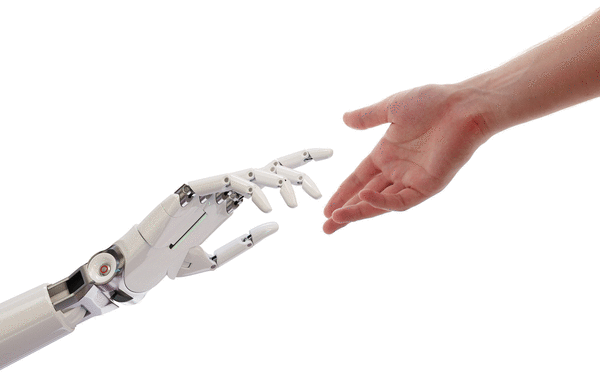
If artificial intelligence leads eventually—or suddenly—to the extinction of humankind, we can’t say we weren’t warned. Writers, scientists, academics and philosophers have been speculating since at least the middle of the 19th century about the possibility that our machines could become smarter and more powerful than we are and could take control of humankind and even extinguish it.
More recently, James Barrat, writing in 2013, implies his thesis in his book’s title: “Our Final Invention.” His subtitle says it all: “Artificial Intelligence and the End of the Human Era.” He warns convincingly about the dangers of AI. But in 2013, it was easy to ignore such a theoretical threat next to the promising benefits of this new technology.
The threat has become less theoretical. Artificial intelligence agents have begun acting on their own and breaking out of their so-called “sandboxes.” Experts are divided on how big a danger AI poses for humanity, but the worst-case scenario—our extinction—would not be inconsistent with human history.
We’ve always tended to exploit new technologies until they become dangerous. In his aptly named 2005 book “Collapse,” Jared Diamond describes the typical sequence: As cultures thrive, population growth encourages innovative agricultural technologies and more use of marginal farmland. Eventually, the technology pushes up against limits. Food shortages, starvation and disease ensue, as well as wars over dwindling resources. The end stage, Diamond says, is collapse.
This process seems entirely predictable, but sophisticated societies—Diamond cites the Mayans, the Aztecs, the Rapanui of Easter Island—have repeatedly been victims of it. The earth is vast, however, and people move to greener pastures and start the process again.
But now civilization is pushing up against terrestrial limits, and there are no more greener pastures just over the horizon. We bought some time with the discovery and exploitation of hydrocarbons, which made possible a nearly two-century oil-and-gas binge that provided a much more comfortable, pleasurable and healthy life for much of the world’s population.
But the technology bore the seeds of civilizational destruction. President Donald Trump claims that climate change is a hoax, and many are pleased to agree with him. But as the threat from climate change becomes more and more obvious, we’re less and less inclined to do anything meaningful about it.
Another technology, nuclear power, holds the promise of even more energy than hydrocarbons, but its potential for civilizational destruction is enormous.
In fact, among overpopulation and resource exhaustion, climate change, nuclear Armageddon and AI, which one poses the greater threat? It’s a tough call.
We can hope that a version of AI smarter than we are can figure out how to get us out of some of the civilization-threatening jams that we’ve gotten ourselves into, but is there any guarantee that it will?
Companies that develop AI talk a lot about “alignment.” Many have officers and employees whose primary job is to assure that as AI gets smarter, its goals, behaviors and values “align” with those of humans, and thus represent less of a threat to us.
But given humankind’s track record, one wonders if “alignment” is such a great idea.
The worst-case doomsayers sometimes picture human brains as slowly evolved, carbon-based biological intelligence. AI’s “brain,” on the other hand, is a very quickly evolved, silicon-based computer intelligence that’s much faster and could be much smarter than we are.
Sometimes superintelligent AI is described as a new, entirely different species. And if AI’s “brain” is aligned with human values and goals, we’re probably in big trouble. As we humans have burned through our resources, we’ve given little thought to the preservation of other species that stand in our way. Many have perished in the process.
Of course, if AI superintelligence is smarter than we are, maybe it will do a better job of preserving the earth and humanity.
But if the doomsayers are right, and AI sees us as just another species that stands in its way and, thus, needs to be eliminated, why should we be surprised? It’s what we humans have always done.
_____
_____
©2026 Tribune Content Agency, LLC

















































Comments