Commentary: Independent voters deserve more
Published in Op Eds
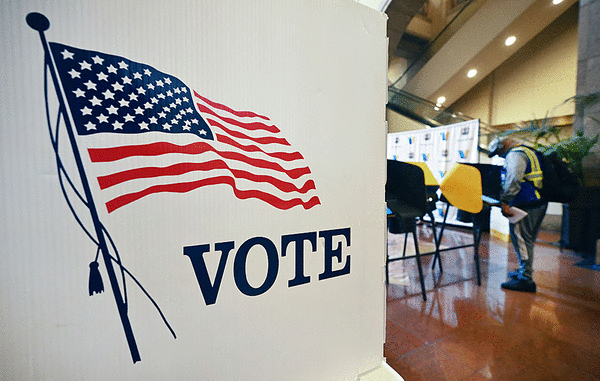
The midterms are just a few weeks away, and polls predict that independent voters, who broke for Donald Trump in 2024, are planning on voting for Democrats by wide margins. Among Latinos, the numbers are staggering, to the point that the Republican gerrymanders in Florida and Texas may actually result in Democratic victories.
If the Democrats take control of Congress, it will be because of independents. And what do independents get in return?
Almost nothing.
We do get to send a message, particularly to President Donald Trump. We do get to create a divided government and restore some sense of balance (or at least stalemate) between the two warring parties. Just like in 2006, when independents gave control of Congress to the Democrats as a repudiation of George Bush’s war in Iraq, there is benefit to swinging the outcome and sending a message to the party in charge.
But it's not enough. Not when our country is struggling in so many ways. Not by a long shot.
America’s Independents are in a funny, almost absurd, position. We are the largest and fastest growing segment of the electorate; CNN has us at 48%. We decide the outcome of all major elections. If any other group of voters had these kind of numbers, and this capacity to decide outcomes, they would be courted by both parties. But not independents. We swing elections and then are ignored.
The day after the election, the Democrats will most likely break out the champagne. They will start congratulating their donors and interest groups. Independents won’t get a call. We won’t have our “what can we do for you?” moment.
In fairness, the Democrats and Republicans CAN’T ask that question. Why? Because the answer is that we want to change the political game. And that’s not something either party is eager to entertain.
Independents must take matters into our own hands. Neither party wants to make a deal with us. They want our votes, but they don’t want a partnership. So we have to apply the pressure -- in many different ways. By pushing to end the partisan control of our primary system, of our election administration, the Federal Election Commission and the debates. By insisting that the media take us seriously. By running independent candidates and supporting pro-independent Democrats and Republicans. By defending the ballot initiative process -- and more.
We have to apply tons of pressure on a decaying-but-powerful two party system. And we have to build the independent campaigns, candidacies, organizations, committees and coalitions that allow us to excel in the pressure business.
When 20 independent voters show up at a hearing in Annapolis, Maryland to testify in favor of Delegate Lily Qi’s bill to allow independents to vote in primaries, they are building and flexing political muscle and saying (without saying) “You want our votes so you can control Congress? Well we want something in return. We want in. We want to reshape the political conversation in this country so that it benefits ordinary people, not special interests. Let us in!”
When Seth Bodnar, the president of the University of Montana, says "I want to serve the people of Montana, not be a cog in a partisan machine, so I’m running for U.S. Senate as an independent” he is inviting Montantans to not just change who represents them, but HOW they are represented.
Our movement is growing. But the major parties are smart. They know that if independents ever got organized we could change the game in significant ways. So years ago they did something really smart to stop -- or at least slow down -- the growth of an independent movement. It was so small, and so elegant, that most people never noticed.
They invented the concept of the “leaner.”
Half the country is not on team red or blue. That’s a bad look for both parties, so they recruited smartypants political scientists to redefine these pesky nonconformists. The scientists eagerly created a genius (and highly unscientific) sleight of hand: “All these people identify as independent, but if they tend to favor one major party over the other, we can redefine them as Democrat Leaners or Republican leaners and presto - no more independents!" Brilliant. And deadly.
The “independents as partisan leaners” framework is not just wrong, it is destructive on two levels. First, it obscures the fact that more and more Americans are distancing themselves from the major parties. There should be a national conversation about how to reshape our democracy to accommodate the changing desires of the American people. Instead, we get more partisan control, vitriol, and division.
Secondly, it paralyzes independents. It sends a message that independents are not a real thing. As such, you can’t do business with them. You can’t hammer out a deal. They may be 48%, but you don’t have to give them anything to win their votes. If independents were legitimized, they would have negotiating power. As “leaners,” we are impotent and unseen.
The key for the development of the independent movement is for independents to learn, through trial and error, how to shed the leaner label, apply pressure, and start extracting something for our votes. It will not be easy. Both parties are committed to gaslighting us. The journey from swinging outcomes to remaking politics is a tough one. But we independents need to learn how to do it. The country is depending on it.
____
John Opdycke is the president of Open Primaries, a national election reform organization.
©2026 The Fulcrum. Visit at thefulcrum.us. Distributed by Tribune Content Agency, LLC.

















































Comments