Commentary: Prop. 40 lacks spending safeguards to ensure it improves care
Published in Op Eds
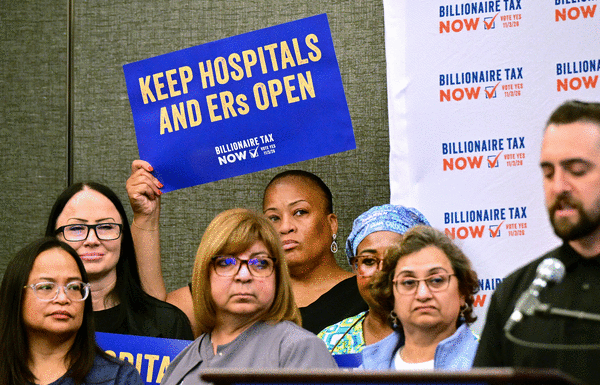
California’s healthcare system is in a code blue moment. Federal and state budget cuts threaten healthcare for millions. Costs are skyrocketing. Doctors, nurses and hospitals are all stretched thin, and patient care isn’t getting any better.
“Do no harm” is the core ethical principle of medicine. Yet Proposition 40 — the billionaire tax on the ballot in California on Nov. 3 — would inflict long-term damage to our healthcare system and make California’s problems worse.
This initiative would send billions to health insurance companies with no accountability, no oversight and no guarantee that any of the money would go to patient care or to help lower healthcare costs.
This is not a minor drafting concern. It goes to the heart of whether Proposition 40 would deliver on its stated purpose to ease the crisis in healthcare.
It wouldn’t.
The measure would impose a one-time tax on billionaire wealth. Supporters say the money would help address federal funding cuts and protect Medi-Cal, the state’s Medicaid program, which provides healthcare for millions of low‑income Californians.
But California’s healthcare system is not simply a network of doctors and hospitals. More than 90% of Medi-Cal enrollees receive their care through managed care plans, the majority of which are operated by health insurance companies. Managed care accounts for nearly 70% of total Medi-Cal spending. Under the state’s system, health plans receive per-patient payments that include a profit for the insurance company.
Put simply: Insurance companies can expect billions more in revenue from Proposition 40 without new checks and balances or new requirements to improve patient services or access.
The question is not whether managed care plans have a role in Medi-Cal. They do. The question is whether Proposition 40 provides adequate safeguards. Would a onetime windfall be used to strengthen care rather than simply pad insurance company profits?
The measure’s language raises serious concerns. It says funds may be used for a broad range of purposes, including addressing reductions in federal funding, supporting health coverage programs, preventing facility closures and making payments to providers. That is a list of possible uses, not a binding commitment to any specific outcome.
The measure also states that its funds cannot supplant existing state funding. But that provision is not accompanied by the kind of detailed protections found in previous healthcare funding initiatives. This is the equivalent of giving Sacramento politicians the keys to the safe. The script has played out nationwide: When new money is allocated to a specific priority, other funding for that priority dries up — a shell game that has happened in many states when gambling revenue added money to schools and then legislatures cut other education funding.
We’ve seen this bait and switch in California before. Proposition 56, the tobacco tax approved by voters in 2016, and Proposition 35, which was passed by voters in 2024 and made a tax on managed healthcare insurance plans permanent, directed new revenue toward supplemental Medi-Cal payments and prohibited the replacement of existing funding. But state officials still grabbed the money for other, unrelated purposes.
Proposition 40’s language is even less specific than Propositions 56 and 35. It does not establish a clear requirement that new revenue result in new healthcare spending. It does not guarantee that providers will receive higher reimbursement rates. And it does not establish a specific mechanism to prevent the Legislature from using the money to backfill existing obligations.
Proposition 40’s supporters are right to call attention to the challenges facing Medi-Cal. But good intentions are not enough. California voters deserve to know where the money will go, who will control it, and whether it will produce lasting improvements or simply fatten profits for health insurance companies.
California should pursue reforms that protect patients, strengthen the healthcare workforce and provide stable support for providers. Any new tax revenue should come with enforceable spending requirements, transparent oversight and clear evidence that it is improving access to care.
California needs a durable solution to its healthcare funding crisis. Proposition 40 falls short. Its false promises will not address the most pressing needs of patients, providers and our healthcare system. By delaying real solutions, it could make our long-term problems worse.
_____
Jennifer Kent is a former director of the California Department of Health Care Services.
©2026 Los Angeles Times. Visit at latimes.com. Distributed by Tribune Content Agency, LLC.

















































Comments