Editorial: Good luck to Canada and the EU. They'll need it
Published in Op Eds
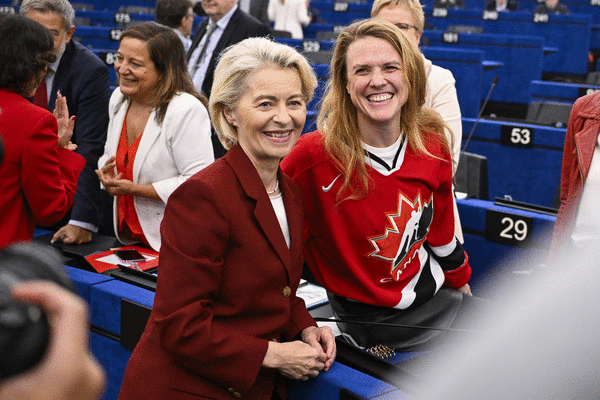
European Commission President Ursula von der Leyen has raised a seemingly incongruous possibility: Perhaps Canada, 3,500 miles from Brussels, might become an “associate member” of the European Union. Prime Minister Mark Carney seems open to the idea.
Exactly what this might mean is far from clear. Whether Canada or the EU’s member governments would actually want such an arrangement once they’ve sorted out the details is even more uncertain. Still, the effort to build a closer relationship is to be commended. With luck, it could also be a useful model for the EU to adopt with the UK and other partners.
Washington’s turn to tariffs and peremptory demands as weapons of economic warfare has hit Canada with particular force. The U.S. and its northern neighbor have built a tightly integrated system of commerce. Dismantling it is hurting both countries — but the shock to Canada’s much smaller and more specialized economy is especially severe.
In response, Carney has rightly emphasized the need to form closer ties with other countries. A deal with the European Union offers mutual gains and new opportunities. As a tactic for negotiations, it also tells Washington that Canada has alternatives — and assures Canada’s furious citizens that their government isn’t about to roll over.
Unfortunately, though, the EU has no template for “associate membership.” By now, to be sure, it should have one, to replace the numerous complex pacts with neighbors that it’s reluctant to admit to full membership or that reject the deep political integration the union expects. In different ways, Norway, Iceland (whose voters recently halted talks toward full membership), Liechtenstein, Switzerland, Ukraine, Turkey, the UK and others all fall into this category.
In one sense, you could say that Norway, Iceland and Liechtenstein are already associate members because, as part of the European Economic Area, they’re in the EU’s single market. Yet they’re also required to be “rule-takers” — with no say on the rules in question or in EU decision-making more broadly. It’s hard to imagine Canada’s government, much less its citizens, accepting any such dispensation. On the other hand, if Canada’s associate membership allowed real input into the union’s rules, Norway and the others will surely demand no less.
A deal that balances rights and obligations more fairly in this way would indeed be a good outcome — and one that might very well appeal to the UK and others. But for the EU this would be a radical departure, likely requiring a new overarching treaty and unanimous agreement among current members. Also, more than a few of those members might prefer this model of associate membership to the deal they already have. That prospect will call Brexit to mind and alarm the EU’s champions of “ever-closer union.” The chances of any such deal, desirable as it might be, are therefore slim.
Instead, something along the lines of the bloc’s arrangements with Switzerland is more likely: a vastly complicated, ever-shifting tangle of separate agreements, which EU officials often say should not be replicated. In which case, Canada had better moderate its ambitions and settle in for years (or decades) of talks.
Speaking of years, Ottawa ought to bear one more thing in mind. The White House’s current devotion to tariffs and disdain for allies is, one hopes, temporary, while the logic of close economic integration between the two countries will remain compelling over the long term. A new trade deal with the EU may serve Canada’s interests — so long as it doesn’t complicate or, worst of all, foreclose restoring the US partnership when Washington finally comes to its senses.
____
The Editorial Board publishes the views of the editors across a range of national and global affairs.
©2026 Bloomberg L.P. Visit bloomberg.com/opinion. Distributed by Tribune Content Agency, LLC.


















































Comments