Editorial: The Shedd Aquarium did all it could to save the beluga whales
Published in Op Eds
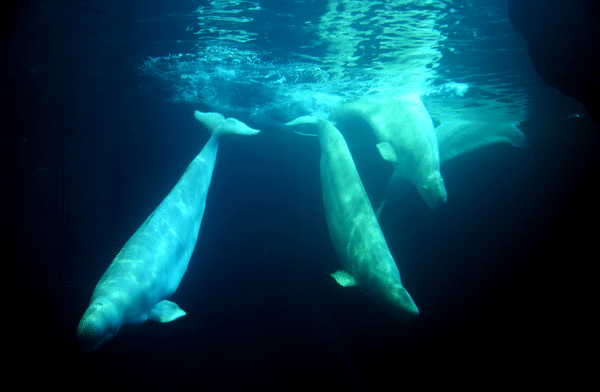
Chicago’s Shedd Aquarium surely hoped its dramatic rescue of 10 beluga whales from the widely despised and imminently liquidating Marineland of Canada in Niagara Falls, Ontario, was going to be a public relations boon. The sensational international rescue of the famously sentient creatures, replete with colossal cargo planes, huge crates and Shedd staffers working in the dead of night to transport and care for the whales must have looked made for social media.
Instead, three of those whales have died, along with another Shedd whale that did not come from Marineland. And now aquarium has found itself stuck in damage control for what should reasonably be seen as an altruistic act by a responsible institution responding to a real-time emergency.
If you’ve missed the details of these events, they begin with the crisis at Marineland, founded in 1981 and a relic of another era in a tawdry tourist town; Marineland combined hundreds of performing marine animals with land animals and amusement rides. The privately owned park closed to the public in 2024, done in by a combination of the pandemic and the 2018 death of its owner, but its 30 beluga whales remained on site. With the site getting sold for redevelopment, the whales had to go somewhere, lest they be euthanized. An initial plan to send them to China was rejected by the Canadian government on the grounds that the Chinese government did not have restrictions on breeding and performance, leading to a new plan to send them to a consortium of willing aquariums in Spain and the United States.
Enter the Shedd, which received four belugas — Acadia, Osiris, Sierra and Lillooet — in July and then four more — Caspian, Peekachu, Secord and Rain — in August. Others went to Seaworlds in San Antonio and San Diego and the Georgia Aquarium in Atlanta. The final two went to the Shedd at the start of September.
It now is clear the conditions at Marineland wrought lasting damage on the belugas. We’re just not of the view that the Shedd deserves reputational damage from its willingness to try saving these whales.
This has been a media opportunity for activists who oppose not just amusement parks like Marineland, which had a poor record of animal care, but whale-holding aquariums like the Shedd that describe their mission more in terms of conservation and education than entertainment. Those boundaries, of course, can depend on the perceptions of the boundary-maker, and there is long-standing disagreement as to the morality of breeding belugas in captivity.
The transportation of the Marineland whales has been labeled as a rushed job, even though it is not clear Marineland was willing to wait and certainly not that the transporting of the whales caused their deaths, as distinct from prior poor treatment. One activist group, the Whale Sanctuary Project, which has a mission to “end the exploitation of captive whales,” had something of a conflict of interest in that it wanted the whales for its own sanctuary off the coast of Nova Scotia, which it describes as a “natural environment.” The nonprofit says it has some 500,000 square yards of space for the whales. Far more than a typical tank. No question about that.
The matter of whether the whales at the Shedd are being kept for “entertainment purposes,” as the Sanctuary Project has asserted, is something on which reasonable people can disagree, ranging as it does into the broader discussion of whether aquariums and zoos in big cities should be abolished, meaning humans wanting to interact with animals have to go visit them in their natural habitats. One counterargument is that a kid seeing a whale in Chicago might spark a future conservationist. Or it could also be argued that the animals pay too high a price.
The debate seems to us to come down to whether an animal like a beluga, even a rescued one, could be said to be happy in captivity, which is surely unknowable. Most of us land in the middle of this debate, seeing the educational value of some urban interaction with creatures of land and sea but having long ago learned that unnatural tricks performed to order are best confined to their inauspicious history.
All of that said, the Shedd here was trying to save whales in a real-world crisis not of its own making. The institution knew the risks and took them anyway, and we’ve seen enough of the people working there to know that they care and that “entertainment purposes” were far from their minds. Mostly forgotten in all of this is the impact of these deaths on the humans rescuing them in Chicago.
Belugas are beautiful, mystical creatures; anyone proximate to them would feel their loss acutely.
___
©2026 Chicago Tribune. Visit at chicagotribune.com. Distributed by Tribune Content Agency, LLC.


















































Comments