Commentary: Partisan loyalty now drives Americans' trust in justice
Published in Op Eds
Americans have rarely trusted their institutions less. In June, Gallup found average confidence in the 14 institutions it tracks was near a record low. Some 9% of the public trusted Congress, 27% trusted the Supreme Court, and 45% trusted the police. The criminal justice system, as a whole, ranked near the bottom.
Below those totals, however, lies a more telling story of divergence. Trust increasingly depends not on how an institution behaves, but on whether your side happens to run it. Republicans and Democrats each only have even a modest degree of confidence in Congress when their party is in control.
Some of that swing is inevitable in an elected body that translates political majorities into policy. But a floor exists beneath which partisan-contingent trust curdles into something more dangerous. And no institution is closer to that floor than the criminal justice system, which determines when a person loses their liberty and, in some cases, their life.
A voter whose candidate loses at the polls can gear up for a better result in the next election. But a defendant gets no do-over on an arrest, a bail hearing, or a sentencing. And a crime victim whose case is ignored or botched never gets justice. What the criminal justice system is supposed to answer, case by case, is a simple question: Will the same rules apply to me, no matter who is in power?
Increasingly, Americans are answering that question by team. In 2013, the year before an officer’s fatal shooting of a young Black man caused an uprising in Ferguson, Missouri, Republicans and Democrats were separated by just 9 points in their confidence in the police. That means Republicans were more likely to trust police, but not by a large margin. This year, however, Gallup put the gap at 45 percentage points, the widest ever recorded for a non-elected institution, and larger than the partisan gaps on the Supreme Court, big business, or the church.
The same lens now warps how Americans assess crime itself. Ninety percent of Republicans said crime had risen the year before Donald Trump returned to office even though it had declined; roughly half said the same the year after. Democrats moved in the opposite direction over the same 12 months, even as crime continued to fall.
Once justice starts to look like a team sport, the country loses something it will not easily rebuild: the shared conviction that the process is fair even when your side does not like the outcome. Two bulwarks undergird the system: the formal rules are largely fixed, and the informal rules are the fulcrum. Due process, the formal constitutional promise that the same procedures apply in every American courtroom regardless of who is in charge, is reasonably robust on paper. What varies far more, and what shapes whether the guarantee feels real, is procedural justice: how a person is actually treated by the officer who stops them, the deputy who books them, the parole officer who supervises their release. When the daily practice matches the paper guarantee, legitimacy holds. When it does not, even the strongest formal protections begin to look like scenery.
Decades of research on procedural justice converge on a core finding: How a case is handled matters to public confidence about as much as how it turns out. Americans who perceive the police and courts as fair are more likely to obey the law without the threat of force, report crimes, and cooperate as witnesses — the last of which is among the strongest predictors of whether a crime will ever be solved. One evaluation of a procedural justice training program at the Chicago Police Department found that it reduced both complaints against officers and use-of-force incidents.
Fair process depends on playing by the rules even when it costs you. Consider the exclusionary rule. Evidence obtained in violation of the Constitution may be relevant to a case, even damning, but the courts will — and should — throw it out anyway. The reason goes well beyond any particular case: The credibility of every future stop, arrest, and prosecution depends on the public believing the same process is used for every individual, regardless of the circumstances. When an officer explains why a person is being detained, follows the rules through a tense encounter, and treats that person with dignity, the person is more likely to see the outcome as legitimate, even if he or she disputes it.
Recent history in policing shows both the fragility and the promise of building that kind of trust. After George Floyd was murdered by a Minneapolis police officer in 2020, confidence in the police dropped to a record low of 43% in 2023 before rebounding to 51% in 2024 — the largest one-year jump Gallup has measured. Although causality is difficult to establish, over those years states passed hundreds of policing laws, and many departments banned chokeholds, required officers to step in when colleagues use excessive force, and joined shared online registries that flag officers who have lost their credentials for misconduct. Many of those policies were endorsed by the Council on Criminal Justice Task Force on Policing, which called for a national database of decertified officers, increased oversight, and formal training of officers in the principles of procedural justice that studies say can build public trust.
Research in jails and prisons documents a similar pattern. Facilities become safer, and rule-breaking decreases, when people behind bars perceive that grievances are addressed through clear, consistent procedures and when decisions are explained rather than just announced. Procedural justice inside those walls protects the people held there. It also protects everyone outside the prison gate by maintaining the system's credibility for anyone who might one day end up on the wrong side of a case.
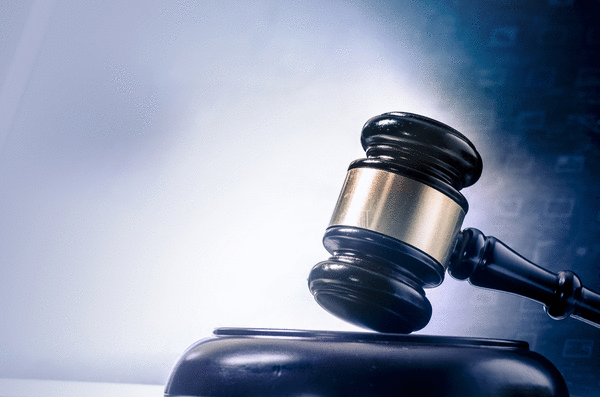
The argument for reinforcing due process through procedural justice is never stronger than when confidence in the system largely depends on whether one’s own team is in power. A democracy can live with a Congress that many see as tribal; after all, voters get to hire and fire that group every two years. It has much less room to spare when Americans come to believe that whether they get equal treatment from a police officer, a prosecutor, or a judge depends on which side is holding the gavel.
Politics may continue to be about red and blue teams, but all Americans win when the justice system is a neutral zone where fairness prevails.
____
Marc Levin is Chief Policy Counsel for the Council on Criminal Justice. He previously developed the concept for the Right on Crime initiative at the Texas Public Policy Foundation.
Khalil Cumberbatch is Director of Engagement and Partnerships at the Council on Criminal Justice and a formerly incarcerated advocate who, as Associate V.P. of The Fortune Society in New York City, spearheaded efforts to help other former prisoners rebuild their lives.
_____
©2026 The Fulcrum. Visit at thefulcrum.us. Distributed by Tribune Content Agency, LLC.














































Comments