Noah Feldman: We are still living in the broken world Sept. 11 created
Published in Op Eds
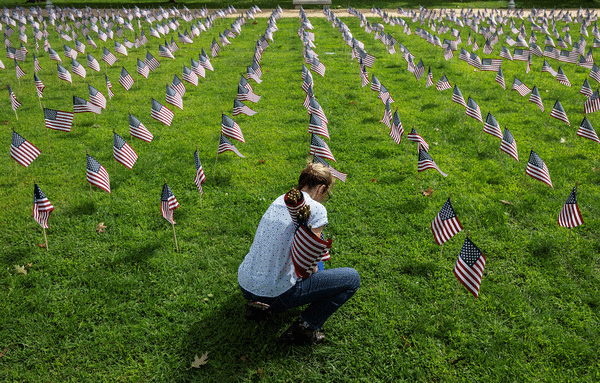
At 8:46 a.m. on Sept. 11, 2001, I was on a plane somewhere over Connecticut. I was flying from Logan to La Guardia, on my way from my home near Boston to teach my second week of class as a baby professor at New York University Law School, when the pilot told us we were going into a holding pattern because a plane had just hit the World Trade Center.
I did not know it then, but my career would be shaped by the events and aftermath of that day. Half of the books I’ve written are about the Middle East and the trajectories of war, terrorism and democracy there. The other half have focused on the U.S. constitutional system, especially its protections of speech and civil liberties, both of which have been deeply inflected by the war on terror. As for my teaching, my current students take for granted a broken world that, in many ways, began that day.
When I was applying for law-school teaching jobs the year before, no one had shown the slightest interest in the Islamic studies doctorate I had earned before law school. Suddenly things were different. The dean of NYU’s law school took me uptown to meet Bill Clinton at his foundation offices, introducing me as the faculty member who would organize an international conference with the former president. My mentor from Yale Law School told me I should write a book on Islam, democracy and what might happen next. He introduced me to an agent, who introduced me to an editor, who agreed to publish the book.
In my books about the Middle East, I argued for the U.S. to change its policies in the region: away from supporting dictators and toward allowing democratic experiments by movements that saw Islam and democracy as compatible. I wrote about what we owed Iraq after our invasion; about the moving efforts of Islamic democrats in the aftermath of the Arab Spring; and about the tragedies of the Syrian civil war and of Egypt’s semi-collective decision to abandon democracy after a very brief experiment.
The arc was one of hopeful beginnings and ultimate failure. I continue to believe that the deep problem for constitutional governance in the Middle East is not Islam itself, but rather the broken systems associated with oil monarchies and military dictatorships. But I am certainly chastened, as are many Arabs who hoped that they could improve their own lives through democratic self-determination.
Meanwhile, over the last quarter century, the U.S. has seen an extraordinary increase in presidential power and a corresponding decrease in privacy and other constitutional rights. These trends started immediately after Sept. 11, when the George W. Bush administration launched the war on terror abroad and asserted unprecedented authority to surveil at home. Like other liberal constitutional law professors, I argued strenuously against the administration’s detention policies at Guantanamo Bay and elsewhere. When Barack Obama, himself a former constitutional law teacher, became president, his administration proved unable to close Guantanamo. Then the Obama administration embraced the use of drone strikes, including against U.S. citizens abroad, replacing the Bush administration’s detention strategy with something much more lethal.
At least Bush and Obama’s expansions of presidential power were undertaken in the name of national security. President Donald Trump’s constitutional overreach has been mostly devoted to self-aggrandizement. The war in Iran, launched without congressional authority and still continuing, has mostly been criticized for its stupidity rather than its unconstitutionality — a sign of how much we seem to have given up on the constitutional design that requires congressional authorization for prolonged hostilities abroad.
My job as a constitutional law professor has turned into a quest to do whatever I can to shore up our constitutional system and the liberties it’s designed to protect. The presidents aren’t the only ones to blame. The conservative Supreme Court, whose majority was consolidated under Trump, has launched a constitutional revolution in which, astonishingly, the president is even more powerful than he was before. In what will go down as one of its most incomprehensible decisions, the court declared in 2024 that the president could not be held criminally liable for acts taken in furtherance of his official duties.
Some of my smartest younger constitutional law colleagues on the left have turned against the Supreme Court as an institution. I can well understand their disillusionment with the decisions of the current conservative majority, which I share. But the cold, hard reality is that neither the president nor Congress has any real interest in preserving constitutional rights and norms. The Supreme Court is the only institution in our system capable of standing up for the rule of law, fundamental rights, and the separation of powers. Just because it is doing a bad job does not mean we should weaken its powers further.
It’s as though those younger colleagues have forgotten the ways the Supreme Court protected and expanded fundamental rights, including rights to equality and liberty. That apparent forgetting of the courts’ capacities is a product of the last 25 years of jurisprudence, in which the courts have not only failed to stem rising presidential power but have extended it. Here, too, Sept. 11 is in the background.
A good number of my law students this fall were not yet born when I started teaching, the week before the towers fell. To them, our constitutional mess is business as usual, and the broken politics of the Middle East are an immemorial legacy. But their world has been profoundly shaped by the Sept. 11 attacks and the U.S. reaction at home and abroad.
The last quarter-century has been a time of American experimentation and failure. The way to stave off decline, which Osama Bin Laden surely hoped for, is to gradually rebuild American institutions. That, in turn, demands not only strength and bravery, but also optimism about what we can accomplish.
____
This column reflects the personal views of the author and does not necessarily reflect the opinion of the editorial board or Bloomberg LP and its owners.
Noah Feldman is a Bloomberg Opinion columnist. A professor of law at Harvard University, he is author, most recently, of “To Be a Jew Today: A New Guide to God, Israel, and the Jewish People."
©2026 Bloomberg L.P. Visit bloomberg.com/opinion. Distributed by Tribune Content Agency, LLC.















































Comments