Commentary: The Fed's credibility depends on resisting politics, not playing it
Published in Op Eds
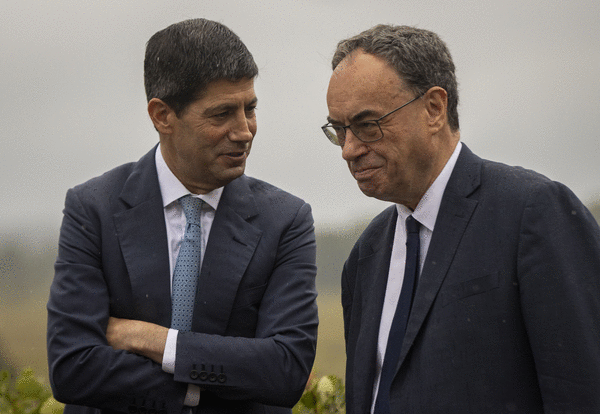
At Jackson Hole last month, all eyes were on Federal Reserve Chair Kevin Warsh in his first speech at the Fed’s annual conference. But all thoughts were about the Fed’s rate decision next week.
Kenneth Rogoff, a Harvard economist who was at Jackson Hole as a lunchtime speaker, offered this advice to a New York Times journalist: “If they can possibly put it off till after the midterms, it would be good for the institution.” Given President Donald Trump’s attacks on the Fed, he asked: “If you’re trying to preserve Fed independence, are you preserving it better by spitting in his face, or are you preserving it better by laying low and waiting until the winter?”
But playing politics to preserve independence is a terrible strategy for the Fed. And one of the best explanations comes from a junior economist at the Fed who wrote a paper, now considered foundational to the study of central bank credibility, back in 1983. His name was … Kenneth Rogoff.
Using a stylized model, Rogoff showed that economic outcomes, on average, would be better if the head of the central bank were more averse to inflation than the average person. That extra credibility as an inflation fighter would lower expected inflation and, by extension, actual inflation. One can quibble over the details of his model, but it’s an early example of the many research papers that formalize why central bank credibility matters.
Rogoff today would likely push back, saying this time is different: His 1983 model did not contemplate a president threatening to fire the Fed chair, or actively trying to remove Fed governors. Maybe, if the existence of the institution is on the line, it’s appropriate to think more strategically about politics, and less about inflation.
No. It is not appropriate.
First, playing politics would mark a real shift. Consider that, in any two-month period from 1984 to 2024, the Fed changed its target 45% of the time. In the two months before a federal election — midterm or presidential — it changed its target 43% of the time. In other words, there is no evidence that the Fed’s decisions are affected by the timing of elections. More recently, the Fed hiked days before the 2022 midterms, and cut rates before the 2024 election. A more systematic study finds no evidence of monetary manipulation. The exception — the Arthur Burns Fed supporting Nixon’s reelection — has been connected to higher inflation and remains the example of what not to do at the Fed.
Second, the Fed does not have to play politics to protect itself. Congress built the Fed precisely for moments of political pressure; if the Fed won’t lean on its protections now, when will it? Earlier this year, the Supreme Court blocked Trump’s attempt to remove Fed Governor Lisa Cook, even as it allowed the president to remove heads of other agencies in a separate decision.
The Fed is special. To have that protection and then cave to politics would undercut the Fed’s own case for independence.
Finally, appeasement is not a strategy that works with the Trump administration. The Fed knows. In early 2025, Michael Barr resigned as vice chair for supervision to avoid a fight with the White House. The legal battle came to the Fed anyway: First the attempted firing of Cook in the summer of 2025, then the Department of Justice investigation of then-Chair Jerome Powell in early 2026.
Rogoff has been a chess grandmaster since 1978, so he knows the game is won by thinking several moves ahead. Delay past November and an emboldened Trump comes back demanding even more control in December.
None of this means the Fed must hike this month to show that it’s serious about inflation, or that it’s independent of the White House. My advice to the Fed: Forget the electoral calendar and stay focused on the economy. The Fed’s rate decision should reflect a wide range of data. The date of the election is not one of them. Hold or hike, the decision must rest on the outlook and risks to the economy — not the risks to the Fed.
Rogoff is right that the Fed should not spit in Trump’s face, but he’s wrong that it should let politics affect its decisions. What makes his advice so troubling is that it comes from someone who holds the Fed in high regard and knows the research better than anyone. As his own model showed, credibility lives in what people believe the central bank will do under pressure. It is precisely when the pressure is greatest that the Fed’s credibility is won or lost.
____
This column reflects the personal views of the author and does not necessarily reflect the opinion of the editorial board or Bloomberg LP and its owners.
Claudia Sahm is the chief economist at New Century Advisors and a former Federal Reserve economist. She is the creator of the Sahm rule, a recession indicator.
©2026 Bloomberg L.P. Visit bloomberg.com/opinion. Distributed by Tribune Content Agency, LLC.













































Comments