Commentary: The country that vaccinated the world is unlearning how
Published in Op Eds
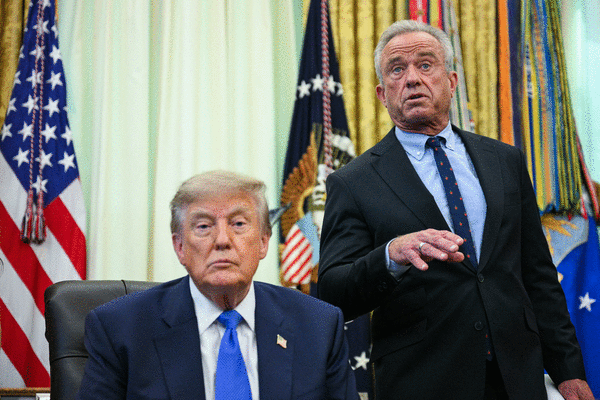
On Aug. 10, in the Oval Office, President Donald Trump signed an executive order telling American parents to break the measles, mumps, and rubella shot into three separate injections and to space childhood vaccines across many more trips to the doctor.
He said the change would "align the United States with other advanced and developed nations." That line is the whole argument, and it is false. No advanced country gives measles, mumps, and rubella as three single-disease shots. The vaccines do not exist in that form anywhere. A parent who wanted to follow the new American recommendation could not, because there is nothing to buy.
This is not a small drafting slip. It sits at the center of the case the White House is making, and it falls apart the moment you look past America's borders.
Here is what should worry anyone outside the U.S. For a quarter century, the American taxpayer was the single largest force holding measles down on every continent. Now Washington is not just walking away from that job. It is rewriting its own rules to match the people it once spent billions correcting.
The scale of the retreat is easy to miss from inside a domestic argument about autism. Between 2000 and 2024, global measles deaths fell by 88 percent, and the World Health Organization credits vaccination with saving roughly 58 million lives across that period. A large share of that money and logistics ran through Gavi, the vaccine alliance, where the U.S. was the third largest donor and contributed about 300 million dollars in 2024 alone. In July, the Trump administration cut the WHO out of Gavi and made any renewed American support conditional on reforms it gets to define. Nearly half the low- and lower-income countries the WHO surveyed this year already report moderate to severe disruption to their immunization programs, mostly because donor money dried up.
The virus does not care about any of this. Measles is among the most contagious pathogens known to medicine. It finds the gap and moves through it.
And the gap is now inside the U.S. American measles cases have already passed 2,300 this year, the highest count in 34 years, with outbreaks burning in South Carolina and Utah and infections logged across more than 40 states. Canada lost its measles elimination status last November. Mexico has recorded more than 12,000 cases. The North American wall that public health officials spent decades building is cracking, and Washington's response is to make its own vaccine schedule harder to complete.
Splitting the MMR shot is not a neutral choice dressed up as parental freedom. The American Academy of Pediatrics estimates it would take about a decade to develop and license three separate vaccines that don't currently exist. Until then, the recommendation points at a product no pharmacist can hand over. Where separate shots eventually appear, each one means another appointment, another copay, another chance for a child to slip out of the schedule. Every additional visit is a place where coverage leaks out. Health systems in poorer countries learned that lesson the hard way years ago. The U.S. is now paying to relearn it.
For a reader in Karachi or Lagos or Manila, the useful question is not whether American parents end up confused. It is what happens to the world's defense against a virus when its biggest underwriter starts acting like a doubter. Credibility is contagious too. When the country that ran the planet's measles campaigns tells its own citizens the standard schedule is dangerous, health ministers who spent years fighting local anti-vaccine movements lose their strongest reference point. The rumor that Washington debunked for twenty years now carries a presidential signature.
Even inside the president's party, the science did not hold. Senator Bill Cassidy, a physician, called the order wrong and said the president lacks the expertise to make the change. The American College of Physicians described it as an attempt to overturn decades of transparent scientific review by decree. These are not activist outfits. They define how American medicine is practiced.
The order goes beyond a recommendation. It directs the Justice Department to investigate states that enforce childhood vaccine mandates, treating school entry requirements as a matter for federal lawyers. At home, that is a fight about federal power. Seen from abroad, it is a signal, and a plain one: the U.S. is now willing to use its own courts to loosen the immunization rules that much of the world modeled on American practice. Governments that copied the CDC schedule for decades will notice which direction the model now points.
The practical damage will arrive on a delay, because the vaccines the order recommends are years from existing. The reputational damage is already here. A measles outbreak anywhere is one unvaccinated traveler away from anywhere else, and the U.S. has spent this week telling the world that the shot which stops it is worth pulling apart.
The countries that leaned on American money and the American example to keep measles cornered now have to decide, fast, who fills the space Washington is vacating. Beijing has been quietly building health partnerships across Africa and Southeast Asia for years, and it will read this order as an opening rather than a warning. If health security follows the same path as ports and telecoms, the U.S. is handing away one more form of influence it spent generations earning, and getting a discredited theory in return. The measles will move first. The competitors will move next.
_____
Imran Khalid is a physician, geostrategic analyst, and freelance writer.
_____
©2026 The Fulcrum. Visit at thefulcrum.us. Distributed by Tribune Content Agency, LLC.












































Comments