Mark Z. Barabak: California's recall system is a mess. Voters can do something about it
Published in Op Eds
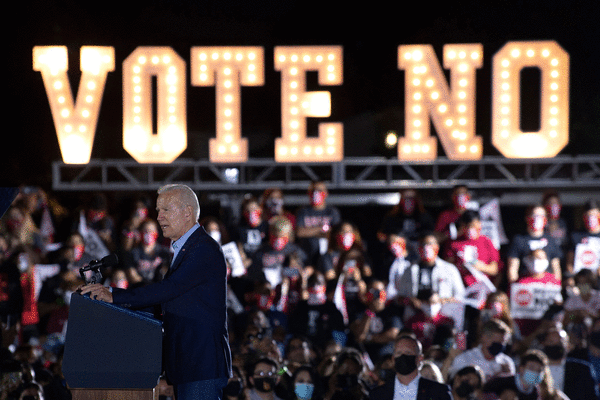
Is a hissy fit worth $200 million?
That was the tab in 2021, when California held a recall election less than a year before Gov. Gavin Newsom was set to face voters.
There was angst — the COVID-19 pandemic was raging. There was anger — the lifesaving restrictions imposed by Washington and Sacramento made daily living a chore and drove many small businesses to the brink. Others went clear over the edge.
There was also no small amount of political opportunism at play.
The recall gave Newsom’s critics, mainly on the right, a chance to try to chase the Democrat from an office that Republicans, under normal circumstances, stood little chance of winning.
In the end, the recall effort amounted to scarcely more than a partisan tantrum. The result — 61.9% voting no, 38.1% voting yes— matched the outcome of the 2018 gubernatorial race down to the decimal. All that money and effort wasted on an election in which voters said pretty much, yep, we meant what we said. Not too long after, they gave Newsom a second term.
The plebiscite, and its pointlessness, underscored the many flaws inherent in California’s recall system. In November, voters will get a chance to remedy at least one of them, eliminating the chance a candidate could take office with just marginal support from voters.
Trigger warning: What follows is a somewhat wonky explanation of election rules and procedures.
One choice, not two
Currently, a recall election is conducted in two parts. Voters are asked whether a lawmaker should be removed and, if so, who their replacement should be. If the incumbent is ousted, whoever gets the most votes takes their place, even if they fall well shy of attaining majority support. (Which is not out of the question in a large multi-candidate field; in 2003, 135 people were on the ballot, vying to replace Gov. Gray Davis.)
Among its provisions, Proposition 5 would amend the state Constitution so that voters would be asked a simple yes-or-no question: Do you wish to recall the incumbent? If so, the lieutenant governor would serve as governor for the rest of the ousted executive’s term — unless the recall occurred during the first two years a governor was in office and before the filing deadline for the next statewide election.
In that case, a special election would be held on the same date as the next primary and a candidate receiving a majority of votes would serve out the governor’s term. If no candidate received a majority, the top-two finishers would face each other in a November runoff, with the winner taking over as governor.
Still there?
Proposition 5 has two benefits. It would save taxpayer dollars by consolidating elections and it would enhance the legitimacy and political standing of a replacement governor by ensuring he or she assumed office with at least 50% support.
But there’s still more to be done.
Ending political promiscuity
California makes it way too easy to qualify a gubernatorial recall measure.
Of the 19 states that allow their governor to be booted, California is by far the most permissive. Forcing an election requires signatures reflecting just 12% of the ballots cast in the prior gubernatorial contest. In Newsom’s case, proponents needed just under 1.5 million signatures in a state with more than 22 million voters and nearly 40 million residents.
Not exactly a thundering roar.
The threshold should be higher and the reasons for kicking a governor out of office should be more serious, such as corruption, official malfeasance or conviction for a serious crime. Not just because a governor is a member of the opposite party, or people on the losing end of an election are unhappy with the result.
“The system in its current form offers bad actors an incentive to target an elected official with whom they disagree and to have the official replaced by someone who otherwise would not enjoy the support of a majority of voters,” Josh Newman of Fullerton and Isaac Bryan of Los Angeles said in advocating change. The two Democratic lawmakers authored the constitutional amendment, which was placed on November’s ballot by the Legislature.
If you think overhauling the process is simply about protecting partisan interests, consider: Should Republican Steve Hilton pull off an epic upset and become California’s next governor, is there any doubt a recall effort would be underway before he and Mrs. Hilton even had the chance to start boxing their belongings for the move to Sacramento?
The recall is a vestige of the Progressive-era good-government movement. But the process needs to be revamped to reflect today’s bad-faith political environment.
The Little Hoover Commission, California’s independent oversight agency, has recommended several changes, including raising the signature requirement and prohibiting recalls undertaken during the first 90 days and the last six months of an officeholder’s term.
Elections, it’s said, have consequences. They also have — or should have — end dates and final results that are respected, not re-litigated until the losing side gets its way.
Proposition 5 is a step in the right direction. More should follow.
©2026 Los Angeles Times. Visit at latimes.com. Distributed by Tribune Content Agency, LLC.


















































Comments