Ronald Brownstein: Sept. 11's political legacy is overreach and division
Published in Op Eds
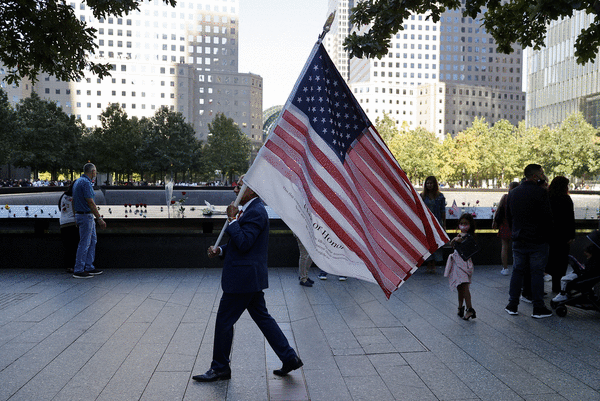
Few memories are more vivid for most Americans than the images of New York City’s twin towers collapsing in flame and dust against a cloudless blue sky on September 11, 2001. But 25 years later, the policy legacy of the al-Qaida attacks is much cloudier.
America’s domestic response — from changes in airport security to greater coordination among intelligence and law enforcement agencies — has succeeded in preventing another attack of that magnitude. But events have almost entirely discredited the two foreign policy doctrines President George W. Bush’s administration developed in reaction to Sept. 11: preemptive war to remove hostile regimes and the promotion of democracy across the Muslim world. And the broader lesson that many American policymakers took from the attack — that the U.S. faced an existential “clash of civilizations” — now seems more relevant to America’s domestic frictions than to any foreign threat.
After the swift overthrow of the Taliban in Afghanistan seemed to validate the idea of force-led regime change, Bush’s vision of preemptive war got buried in the shifting sands and bloody instability of the Iraq invasion. One poll of historians named the war as the worst decision in the history of American foreign policy.
The broader post-Sept. 11 vision of promoting democracy across the Muslim world lasted longer. But that commitment expired too. Not much has been heard about Arab democracy from presidents of either party since the fading of the Arab Spring in 2012.
These ideas persist only in zombie form in President Donald Trump’s attack on Iran. After condemning Bush’s “forever wars,” Trump’s assault on Iran resurrected his predecessor’s vision of removing threats with preemptive conflict. But Trump has offered a cut-rate version of Bush’s approach that appears even less likely to succeed.
In all these ways, one legacy of Sept. 11 has been to reaffirm a core lesson of the 20th century — that the world is inevitably more complicated than presidential doctrines. One generation’s wisdom regularly becomes folly to the next.
The lesson American leaders took from our involvement in World War I, for instance, was to withdraw from the world. A quarter century later, Hitler’s rise made that isolationism seem dangerously misguided. World War II in turn convinced the next generation that all aggressors must be met with force. But within 25 years, that conviction produced its own disaster, in Vietnam.
By the 1990s, Presidents George H.W. Bush (in the first Iraq War) and Bill Clinton (with the NATO bombing campaigns in Bosnia and Kosovo) had rejected the “Vietnam syndrome” that discouraged presidents from deploying U.S. forces abroad. Their actions opened the door for George W. Bush’s greater interventions in Afghanistan and Iraq. Yet the discouraging outcomes of the wars in Iraq and Iran seem likely to turn this wheel again.
What links all these episodes of disillusionment is the hubristic belief that because we are the world’s most powerful nation, our leaders can bend the globe to their demands and desires, says Ivo Daalder, the former president of the Chicago Council on Global Affairs. Those vanities have repeatedly led the U.S. into unsustainable overreach, like Trump’s war of choice in Iran. “We are paying the price, in a bigger way under Trump than we have under anybody before him, because he is the personification of American hubris,” says Daalder, who served as U.S. Ambassador to NATO under Barack Obama.
Some of that same hubris is evident even in the flickering focus on terrorism at home. Congress created the Department of Homeland Security, and reorganized the intelligence agencies, to focus more attention on terrorist threats. But DHS has been redirected toward Trump’s ethnic purge of immigrants, and the intelligence agencies have been enlisted in his attempts to concoct evidence of election fraud. As Daalder notes, that reorientation could increase U.S. vulnerability to new forms of terrorism, like cyber or AI attacks.
In those perversions of the post-Sept. 11 goals, there’s a larger point. Many conservatives (though not George W. Bush himself) saw the attacks as validation of the “clash of civilizations” theory advanced by political scientist Samuel Huntington during the 1990s. Huntington posited that the post-Cold War world would be defined by cultural and religious tensions that included inexorable conflict between the West and Islam.
That idea has also had a zombie half-life under Trump. In his first term, Trump nodded toward Huntington with a major speech in Poland portraying his administration as the defender of the West’s traditions; Secretary of State Marco Rubio reaffirmed those themes, with an even more ethnocentric emphasis on Christianity as the glue binding together the free world, in his 2026 speech at the Munich security conference. But in practice, Trump’s interest in the Muslim world has been less to contain or reform it than to profit from it — both in terms of American commerce and, especially, his personal enrichment.
If there is a clash of civilizations now threatening the U.S., it is the rising internal conflict between red and blue America. Today, the gravest threat to America’s future isn’t Islamic radicalism, or any other foreign adversary. It’s the hardening separation of the nation into two antagonistic blocs with inimical visions of the country’s future. Rather than trying to bridge this divide, Trump has built his political identity on dangerously widening it by treating blue jurisdictions as “the enemy from within.”
For years, leaders in both parties despaired over America’s failure to respond more urgently to the mounting signs of danger from abroad before Sept. 11. Let’s hope future Americans won’t say the same about our accelerating descent into an internal rupture that presents an even greater risk.
____
This column reflects the personal views of the author and does not necessarily reflect the opinion of the editorial board or Bloomberg LP and its owners.
Ronald Brownstein is a Bloomberg Opinion columnist covering politics and policy. He is a CNN analyst and the author or editor of seven books.
©2026 Bloomberg L.P. Visit bloomberg.com/opinion. Distributed by Tribune Content Agency, LLC.
















































Comments