Commentary: The Trump administration is claiming success in drug strikes. Not so fast
Published in Op Eds
Last Wednesday came and went as if it was an ordinary day. But the date held significance: It marked the one-year anniversary of Operation Southern Spear, the Trump administration’s military campaign against drug trafficking organizations based in Latin America.
That campaign, which includes airstrikes against alleged drug-carrying vessels on the high seas and the occasional deployment of U.S. special operations forces, continues to this day. The results have been far less impressive than the White House claims.
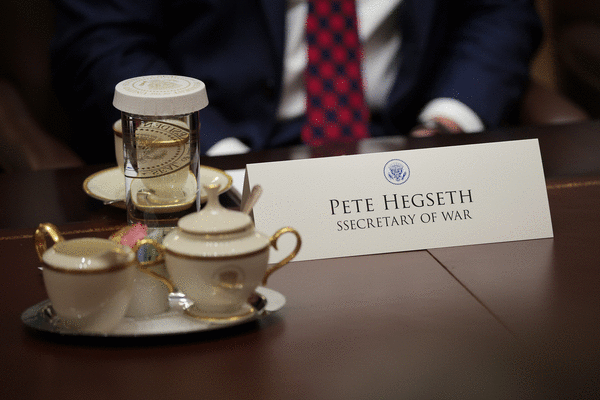
As the White House tells it, Operation Southern Spear is meant to tackle drug trafficking in a different way. President Donald Trump, Defense Secretary Pete Hegseth and Secretary of State Marco Rubio spent the months before the operations began making the case about why the old way of fighting the so-called war on drugs was grossly ineffective.
There was so much cocaine and fentanyl pouring into the country, they said, that business as usual was not only a poor prescription for the problem but also akin to enabling the very national emergency — drug addiction — that continues to kill tens of thousands of Americans every year. Simply interdicting drugs and arresting the perpetrators, Rubio alleged, didn’t work.
“What will stop them is when you blow them up, when you get rid of them,” he declared.
The Trump administration has spent the last year trying to make good on that statement. Cartels in Mexico and gangs in Ecuador are now considered to be in the same league as al-Qaida and the Islamic State — this, despite the fact that cartels have no political ideology and are predominately concerned with making money, not overthrowing governments.
Washington has listed nearly two dozen Latin American drug trafficking groups as foreign terrorist organizations, a designation U.S. officials argue provides them with unique authorities they otherwise wouldn’t have. Any person even remotely connected to these groups, whether it’s the poor fisherman being pressured to work for them or the teenager peddling drugs on the street corner, is now fair game for U.S. targeting.
Over a year’s time, the United States has conducted 68 strikes on small boats in the Caribbean and Eastern Pacific that U.S. officials assessed were smuggling drugs up north. More than 225 people have been killed. The Pentagon has made a big show of these strikes, posting clips of exploding vessels on social media and giving speeches outlining all of the supposed success the United States is having.
As one Pentagon official told reporters last week, Trump made a promise to the American people to “take the fight to the cartels and narco-terrorists who have poisoned our communities for far too long.”
Fair enough. Ask any American about getting tough on criminals, and many likely would express support. But just because U.S. officials are claiming success doesn’t necessarily mean it’s true.
In fact, the boat strikes don’t seem to be doing much of anything to reduce the flow of drugs to the United States, a conclusion analysts at the Drug Enforcement Administration and the Pentagon’s own intelligence agency reaffirmed in their own assessments. By waging an actual war on drugs, the powers that be in Washington are confusing tactical accomplishments with strategic ones.
If the boat strikes were truly working, we would be seeing two things happening. First, U.S. agents would be seizing fewer drugs at the southern border. And second, the price of drugs on the street would rise because of the squeeze on overall supply.
With respect to cocaine, the predominant narcotic that cartels in South America produce and smuggle to the United States, we aren’t seeing either trend. According to the most recent data available by U.S. Customs and Border Protection, approximately 63,200 pounds of cocaine were seized at the border in the 10 months since the boat strikes began — a nearly 1% increase from the same time period prior to the campaign.
In other words, there has actually been more cocaine heading north, not less. As a result, cocaine retail prices have remained stable despite the dozens upon dozens of U.S. airstrikes authorized since last September.
In short: If the Pentagon’s intention is to deter the cartels from trafficking drugs here, it has failed. At best, the boat strikes are forcing traffickers to search for alternative routes and modes of delivery. At worst, they’ve made the job of the DEA even harder.
Trump, however, can take some pride in the fentanyl numbers. U.S. border officials registered a 45% drop in fentanyl seizures between 2024 and 2025, and the number is projected to decline again once this year is out.
But these figures have nothing to do with the U.S. military activity that’s occurring in Latin American waters. Mexico produces fentanyl, not countries in South and Central America. The drop in fentanyl exports has far more to do with the cooperation Washington is receiving from Mexican President Claudia Sheinbaum’s government as well as the technology-driven measures U.S. border agents are making at legal points of entry.
In the months to come, the Trump administration will likely expand its war on the cartels to land targets. U.S. special operations forces are already operating in Ecuador to help that country’s own battle against gangs. Colombia’s new far-right president, Abelardo de la Espriella, was quick to join Trump’s counter-cartel coalition after he assumed office and approved joint operations with U.S. forces against the criminal outfits now occupying swaths of Colombia. In June, the United States even conducted a strike in Venezuela to eliminate the head of the Tren de Aragua criminal network.
Whether any of this will produce the victory Trump is so desperate to declare remains to be seen. But based on what we’ve, don’t bet on it.
____
Daniel DePetris is a fellow at Defense Priorities and a foreign affairs columnist for the Tribune.
___
©2026 Chicago Tribune. Visit at chicagotribune.com. Distributed by Tribune Content Agency, LLC.


















































Comments