Michael Hiltzik: Today's tycoons learn a lesson from history -- public esteem for rich entrepreneurs inevitably sours
Published in Op Eds
It's a story that seems almost as old as time itself: business tycoons forced to make a public defense — whether before a jury or a congressional committee or in the court of public opinion — of products that made them billionaires but turned out to exert hidden harm on society.
They often betray their shock at being brought to public book by displaying a deer-in-the-headlights look from the witness table while making performatively abject apologies or insisting on the world-changing virtues of their work, if it isn't misused.
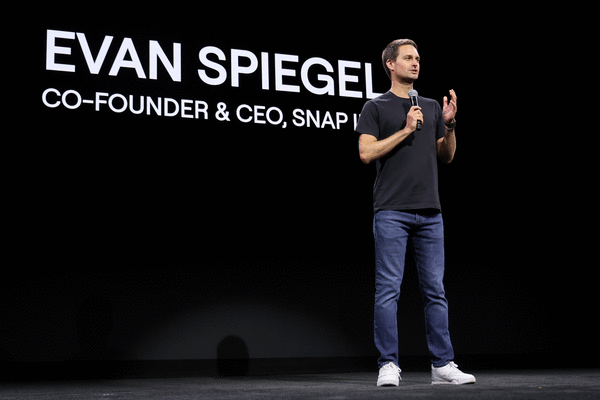
For example, here's Snap co-founder and CEO Evan Spiegel — whose company faces numerous lawsuits over its alleged failure to protect children from harmful content on its Snapchat app — testifying before the Senate Judiciary Committee in January 2024:
"Words cannot begin to express the profound sorrow I feel that a service we designed to bring people happiness and joy has been abused to cause harm." He called for "broader industry support for legislation protecting children online."
Public discontent has been rising over the potential dangers of artificial intelligence, and a political backlash has erupted over the proliferation of data centers planned and built by AI firms and their voracious demands on local water and electricity supplies. In Independence, Mo., one city councilman lost a recall vote last Tuesday by 68% due to his support for a data center.
A record 375 bills related to data centers have been introduced in state legislatures this year, according to a survey by the Washington Post; the vast majority seek to limit their proliferation, a reversal from past years, when lawmakers sought to encourage them through tax breaks and other blandishments.
Meta Platforms, whose Chairman and Chief Executive Mark Zuckerberg has been a serial apology issuer for his company's repeated violations of privacy safeguards, just agreed to a $17-billion settlement over accusations brought by California and other states that it knew that its youngest users were the most likely to be targeted by bullies, extortionists and sexual predators.
The settlement doesn't include an admission of wrongdoing by Meta, but does require it to institute policies to address the issues raised by the plaintiffs.
Zuckerberg, Spiegel, AI magnates like OpenAI's Sam Altman and other tech bros formerly lionized as social benefactors for bringing us new technologies and who have moved from the public pedestals to the public dock wouldn't have been surprised at this transition if they paid attention to the lessons of the past.
For this is the fate of technology tycoons down through history. At first, the public accepts them at their own level of self-esteem, showering them with wealth. In time, however, it becomes evident that their personal interests don't entirely conform to the public interest, and a backlash grows. The financial manipulations that undergirded their fortunes get scrutinized as theft from the public purse, praise for their courage and perspicacity yields to condemnation for their conduct.
Sometimes the seeds of discontent get planted early, only to sprout with the turn of the seasons. That was the case with the first transcontinental railroad. When word of the driving of the golden spike was telegraphed west on May 10, 1869, every fire bell in San Francisco was struck to mark "a victory over space" that would unite the city with markets across the country (according to the San Francisco Bulletin).
Among those who sounded a cautionary note was the cultural critic Henry George, who predicted in an 1868 essay titled "What The Railroad Will Bring Us" that it would benefit only the already rich: "Those who have it will make wealthier," he wrote; "for those who have not, it will make it more difficult to get." He was right.
When Cornelius Vanderbilt took steps to break up a railroad monopoly along the Hudson River in 1867, he was praised as a public benefactor. That lasted until he moved to secure the same monopoly for himself, in part by stranding passengers on a competing line during a frigid night in Albany. Asked by a legislative commission why he ignored the pleas of shivering patrons, he replied, "I was at home, gentlemen, playing a rubber of whist. And I never allow anything to interfere with me when I am playing that game."
Financial scandal brought low the railroad industry, notably when a firm named the Crédit Mobilier became a national symbol of graft and corruption, upon its exposure in 1872 as a tool through which Union Pacific officers steered construction contracts to themselves and plied politicians with bribes.
Not until early in the next century did Congress take on the depredations of Gilded Age plutocrats. In 1912 Rep. Arsène Pujo, Democrat of Louisiana, launched an investigation of the so-called Wall Street money trust, with J. Pierpont Morgan as its prime target.
Morgan was at the center of a web of banks and industrial enterprises that exerted unprecedented control over the country's commerce. Pujo's counsel, Samuel Untermyer, interrogated Morgan relentlessly, forcing the banker into transparently false denials.
"You do not think you have any power?" Untermyer asked. Replied Morgan, "Not the slightest.... I am not seeking it, either."
Morgan's resolute denials pleased his family and friends, but in fact he was deeply rattled. About two months after his testimony, Pujo's report mapped out in pitiless detail all the interrelationships between Morgan and his small network of industrialists. About a month after that, the financier, tormented by fears of further investigation, died of apoplexy.
The next turn of the screw came in 1933, with a congressional investigation of the causes of the 1929 crash. A key target of the chief investigator, Ferdinand Pecora, was Charles E. "Sunshine Charley" Mitchell, the chairman of National City Bank (precursor of today's Citigroup), which had moved from commercial into investment banking.
Under Mitchell, Pecora showed, the nation's largest bank had become an impeccably groomed racketeering enterprise, dressing up crooked enterprises as gilt-edged to sell their bonds and stocks to unsuspecting buyers. Pecora forced Mitchell to admit that he was a tax cheat. Charged with tax evasion, Mitchell was acquitted of criminal charges but paid a $1-million fine to the government.
Pecora's investigation didn't always seize public attention for the right reasons. The enduring image generated by the appearance of J. Pierpont "Jack" Morgan Jr. before the Pecora committee was that of circus dwarf Lya Graf sitting on his lap in the hearing room, the product of a Ringling Bros. PR man's brainstorm.
(The stunt did neither of them any good. Jack Morgan's reputation for stolid rectitude was permanently undermined — "Until last Tuesday," wrote a New York Times columnist, "Mr. Morgan was a legend." Graf, aiming to shed the mortification of having become a national joke, returned to her native Germany, only to be deported by the Nazis to Auschwitz, where she died in the gas chambers.)
More recently, investigations of financial misdeeds have inspired public ennui. The prime specimen here is the Financial Crisis Inquiry Commission, which was empaneled under former California Treasurer Phil Angelides to report on the financial meltdown of 2007-2008. The commission issued its 633-page report in January 2011 to what I've described as a "resounding public yawn." And of course, no major participant in the meltdown has served a day in jail.
It's possible that the tide has turned again. The public appears to be less tolerant of high-tech executives' claims of public beneficence than it has been in years. This may be because the gap between their claims and the reality has seemed wider than ever.
AI, which was once promised as a tool to eliminate drudgery, has complicated daily life in myriad ways. Elon Musk, once glorified as a technological genius,
has come under fire for making bigoted and antisemitic comments. The claims of his DOGE agency to have made strides in government efficiency have been exposed as a budget-busting maladministration, according to the Government Accountability Office.
Today's tycoons represent a greater concentration of wealth than has been seen in the U.S., possibly ever. Their willingness to spend their money on elections is making Americans who question their political goals nervous. But President Trump and his fellow Republicans have indulged cryptocurrency magnates, AI promoters and their ilk in ways that impose costs on American households that are visible from kitchen tables coast to coast.
Is a reckoning coming? According to a line often attributed (probably apocryphally) to Mark Twain, history doesn't repeat itself, but it does rhyme. The first verses may already be sounding.
©2026 Los Angeles Times. Visit at latimes.com. Distributed by Tribune Content Agency, LLC.
















































Comments