POINT: Post-9/11 lessons -- We overlooked festering geostrategic issues
Published in Op Eds
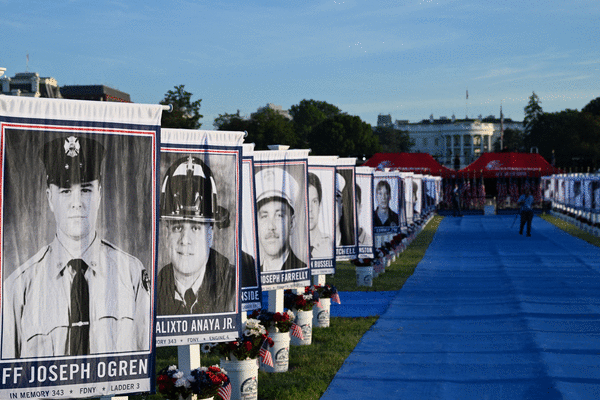
As we approach the 25th anniversary of Sept. 11, it is important to reflect on the historic significance of that atrocity and on the lessons we have drawn and should draw from it.
The 20 years that followed al-Qaida’s massive attack on the United States were anything but typical in the history of international affairs. Indeed, until the Taliban’s takeover of Afghanistan and, even more, the full-scale Russian invasion of Ukraine, we were living through an exceptional period of international consensus and counterterrorism cooperation.
Before 1990 we had the Cold War; before 2001, we had state sponsorship of terror and weak international cooperation against it. Since 2022, we have been living with a new Cold War, and state sponsorship — or, at least, tolerance — of terrorism is increasingly common.
During the two decades in between, the United Nations increasingly organized itself around counterterrorism principles that were as universally welcomed as motherhood and apple pie. The Security Council passed binding resolution after resolution on counterterrorism, established new structures, and inspected and appraised U.N. member states’ compliance with it all.
However, the Taliban challenged this consensus, Vladimir Putin damaged it, and the Hamas attack on Israel on Oct. 7, 2023, accelerated its demise. The Gaza conflict drew battle lines between the United States and Israel on one side and Iran’s “Axis of Resistance” on the other. Islamist propaganda has since been heavily focused on opposing Israel’s military campaign in Gaza. Organizational and sectarian affiliation — Hamas, Hezbollah, Houthi, al-Qaida — have become less important than attacking Israel, the United States and the wider West.
An important but often overlooked factor in this is that the United States — when it killed Ayman al-Zawahiri in Kabul in 2022 — unintentionally moved al-Qaida’s headquarters to Tehran, where Zawahiri’s deputy Sayf al-Adl resides. Over the past four years, Sayf’s pragmatism in the face of Iranian moral and practical authority over him has been to integrate al-Qaida into Iran’s axis. Sayf’s now-deceased son was deployed in Yemen, where he brokered a truce between al-Qaida in the Arabian Peninsula and the Houthis. AQAP in turn helped the Houthis develop what is now a load-bearing partnership with al-Qaida’s affiliate in Somalia, al-Shabaab. The recent spike in instances of Somali piracy in the Arabian Sea is not just coincidental with Houthi aggression in the Red Sea and Iranian aggression in the Strait of Hormuz.
Meanwhile, another axis has emerged in opposition to the United States, and that is a mutual support system between Iran, Russia, China and North Korea, sometimes described as the “Axis of Aggressors.” This links Russia and China, indirectly, with Iranian proxies like the Houthis, who have received weapons from Russia and protection money from China to allow its ships to transit the Red Sea unmolested.
The ideological contradictions within this broad grouping of nations and substate actors are extensive, as is true of the BRICS (Brazil, Russia, India, China, South Africa, Egypt, Ethiopia, Iran, Saudi Arabia, the United Arab Emirates and Indonesia) grouping. It is not what they are for that unites them; it is what they are against. The United States (and Israel) provide an adversary that they want to harm more than they want to quarrel among themselves.
Finally, we have the emergence of Hamas as a cause celebre in parts of the Muslim world, with Turkey, supported by Qatar, building its own front against Israel and openly supporting the Muslim Brotherhood, which the United States is just starting to treat as a terrorist organization.
So, if the international situation is as difficult as it was in the 1980s, perhaps more so, what are the lessons of Sept. 11? First, the counterterrorism laws and structures put in place are still there, so the time wasn’t entirely wasted. Large numbers of terrorist plots have been disrupted, thousands of terrorists killed, ISIS has risen and fallen in that time, and few successful jihadi terrorist attacks have occurred outside areas of conflict in the developing world over the past decade.
However, in our preoccupation with the terrorist threat, we overlooked festering geostrategic issues like Chinese expansionism and Putin’s rejection of the finality of the dissolution of the Soviet Union. Many Western intelligence services and other departments underinvested in training Russian and Chinese linguists for a quarter of a century. We also overlooked Islamist entryism, as embodied primarily by the Muslim Brotherhood, which has now manifested in unprecedented strength on our streets and university campuses in protests against the war in Gaza.
The main lesson is not to overinvest or underinvest in the many complex policy challenges we face. The United States is big enough and wealthy enough to manage them. We must walk, chew gum and carry a big stick all at the same time.
____
ABOUT THE WRITER
Edmund Fitton-Brown is a senior fellow at the Foundation for Defense of Democracies; he focuses on Arabian Peninsula issues as well as terrorism and its enablers. He wrote this for InsideSources.com.
___
©2026 Tribune Content Agency, LLC


















































Comments