COUNTERPOINT: Post 9/11 lessons -- Reform immigration, end perpetual wars
Published in Op Eds
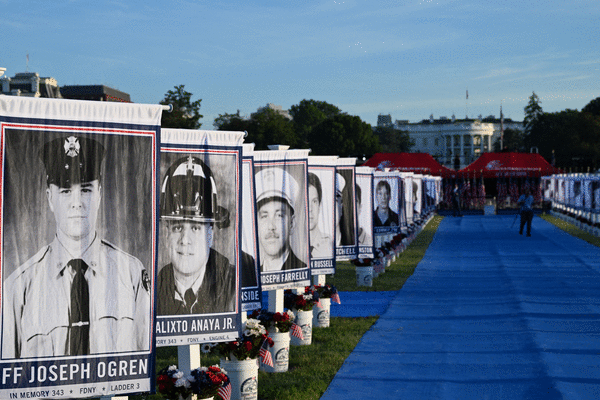
Remember where you were 25 years ago, on Sept. 11? I was driving back from a nice day at the beach in France when I heard that 19 terrorists had hijacked jet planes and flown them into the Twin Towers in New York City and the Pentagon in Washington.
For every generation, there’s a date people remember. For the “Greatest Generation,” it’s probably the day the Japanese bombed Pearl Harbor. For boomers, the day of John F. Kennedy’s assassination. Maybe for millennials it was the day COVID was declared a global pandemic.
For Generation X, it surely was Sept. 11.
In February 2000, I took my wife to Windows on the World, the restaurant on top of the North Tower. A year and a half later, it was a smoking pile of rubble, along with its twin.
What did we learn from this horror?
First, we learned that the continental United States, isolated from foreign wars since 1812, was no longer immune. World War I, World War II, Korea, Vietnam and the Gulf War were all fought “over there.” The U.S. faced economic, political and social fallout at home, but little enemy action. However, Sept. 11 brought the ancient blood feuds of the Middle East home to our capital and biggest city.
The 9/11 Commission Report’s 428 pages detailed how the terrorists got here and were able to commit their vile acts. It concluded there had been a failure to share information across law enforcement and intelligence agencies.
In the following years, the United States reorganized, most notably by forming the Department of Homeland Security, which absorbed other agencies that failed to share information. Today, federal agencies share security-related intelligence on foreign nationals through linked databases. Consular officers overseas issued visas to all the hijackers, all of whom qualified under our immigration laws.
Today, we take fingerprints and photos, and we screen every applicant through all U.S. government data before issuing a visa. If an alien commits a crime or becomes a threat once they are here, our security agencies are more likely to know it. The system isn’t foolproof. Combined with the irritating, time-consuming, but necessary screening at airports, the chances of another successful hijacking are much lower than they were 25 years ago.
We also learned on Sept. 11 that American heroism, the kind exemplified by explorers Lewis and Clark, frontiersman Daniel Boone, and soldier Audie Murphy, was still alive. When Todd Beamer said, “Let’s roll,” a bunch of regular guys tried to retake United Flight 93. They died in the attempt but brought the plane down in a Pennsylvania field and not on the U.S. Capitol or White House.
Most important, we learned that Islamist ideology is categorically opposed to and incompatible with Western civilization. Put simply: Al-Qaida, ISIS and others of that persuasion want us dead. They want our families dead. They want our civilization dead.
That has implications. We cannot allow people to visit or stay here who wish our destruction. Weeding them out at the visa line is hard. Deporting them once they are already here is even harder. We learned on Sept. 11 that it was a fight we could not dodge, or wage remotely.
Today, we are polarized between those who want our borders strong and enforced, and those who want them open; between those who want to deport undocumented aliens, and those who want to grant them amnesty and ultimately, citizenship.
We can argue about who to let in and on what terms. However, America must demand that all visitors accept our basic constitutional freedoms and that all immigrants assimilate to our way of life. A multi-ethnic society can survive. A multi-cultural one, when some cultures are anathema to our founding principles, cannot endure.
Finally, we should have learned from Sept. 11 that we should not fight perpetual wars, and certainly not on borrowed money. Dwight Eisenhower’s administration and Congress used high taxes to pay off the massive war debts and loans of World War II. Lyndon Johnson, however, decided to build his Great Society welfare programs while simultaneously fighting North Vietnam, beginning a cycle of borrowing that endures to the present day.
Coincidentally, the last time the federal budget had a surplus was in 2001. Not only did we have a rare surplus of money then, but we had reserves of patriotism and national unity. All those currencies are thoroughly debased today. The wars in Afghanistan and Iraq, and now the conflict with Iran, are fought with borrowed money and shrinking public support.
____
ABOUT THE WRITER
Simon Hankinson is a senior research fellow in The Heritage Foundation’s Border Security and Immigration Center. He wrote this for InsideSources.com.
___
©2026 Tribune Content Agency, LLC















































Comments