Editorial: Chicago had the fewest summertime homicides in 60 years. Good but far from good enough
Published in Op Eds
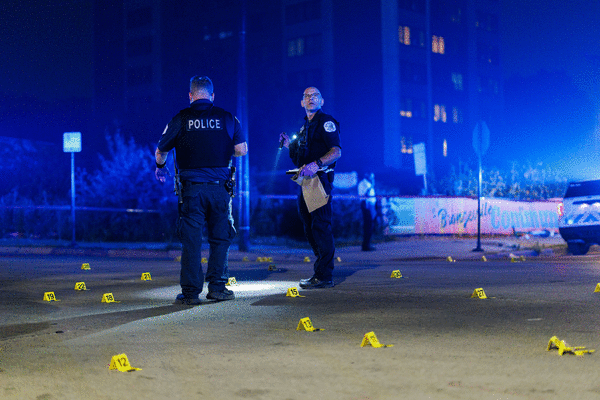
The number of homicides in Chicago was lower in June, July and August than in any year since 1965. As we mark the bittersweet end of summer over the holiday weekend, this is undeniably good news.
The Chicago Police Department recorded 122 homicides in those three months, down from 129 in the same period last year and a still-staggering 271 in the post-COVID violent-crime peak of 2021, according to the various local reports.
Most other categories of violent crime are down, too.
We’re grateful that Chicago is safer, at least statistically speaking, than it has been in decades.
But keep in mind that Chicago is riding a potent national wave. And our city remains far more violent than our big-city peers.
New York City recorded its lowest number on record in homicides and shootings over the three hot-weather months. There were 66 homicides in New York in June, July and August, a little over half the toll in Chicago despite New York’s population being more than three times that of Chicago.
In Los Angeles, there were 192 homicides in all of 2026 through Aug. 29, down from 219 at the same point last year, according to the L.A. Police Department. Through Aug. 30, Chicago saw 288 homicides, up slightly from 283 over the same period last year. At about 3.8 million, the population of Los Angeles is roughly 40% more than the population of Chicago.
In other words, Chicago still has a long, long way to go to be the “safest, most affordable big city in America,” as Mayor Brandon Johnson frequently states is his goal. For all the statistical improvement, Chicago actually is lagging many peer cities’ progress in making its streets safer.
So what explains the positive national trend? There are many theories but little consensus. One explanation we find persuasive is the growth in technology that makes it far harder to get away with street crime. The proliferation of cameras at homes and businesses and on public transit, cellphone data that pinpoints the location of would-be perpetrators and more sophisticated law-enforcement tools almost certainly serve as deterrents to would-be criminals.
We think that trend benefits Chicago as well, but that’s not to say individuals in key leadership positions here haven’t played an important part. At the top of the list in our view is Larry Snelling, who as superintendent restored the Chicago Police Department’s morale, which had been badly sapped in the wake of the pandemic, the George Floyd backlash to law enforcement across the country and the absurd defund-the-police movement.
Snelling’s appointment proved to be Mayor Johnson’s single best decision of his term and one for which the mayor, as he nears an announcement of his expected reelection bid, deserves credit.
But at the same time, we were disappointed that Snelling opted to retire in mid-July, a decision that we had on good authority was due in part to the top cop’s frustration with Johnson’s chaotic fifth floor. So while Snelling is a feather in Johnson’s cap, his exit is a demerit. A more competent mayor’s office would have ensured Snelling remained at his post at least through the coming election.
Johnson likes to emphasize his efforts to address the “root causes” of violent crime more than he does effective policing. The results of Johnson’s investments in social programs and community violence intervention are harder to quantify than police-oriented stats like arrests and clearance rates for homicides and shootings.
But we’re supporters of providing summer jobs to teens as an effective crime-reduction tool, which Johnson has lauded as a major prong of his strategy. You know who else was a big believer in the same thing? Former Mayor Rahm Emanuel, whom Johnson derides whenever he gets a chance.
Whoever is mayor after next year’s election should continue the emphasis on summer jobs within the confines of budgetary reality.
Last but certainly not least is the powerful impact of a local prosecutor who focuses on the main task of that job — prosecuting criminals. We met with Cook County State’s Attorney Eileen O’Neill Burke earlier this week and, as we’ve felt in the other times we’ve had the opportunity to sit down with her, we were struck by the speed at which she’s moved to restore an office left understaffed and demoralized by her predecessor.
In a year’s time, the office has added 200 much-needed new attorneys, she told us. Given a $30 million budget increase, her operation has filled all vacancies and now is fully staffed. That would suggest it is now a desirable place for a young attorney to work.
O’Neill Burke rapidly deployed a new digital evidence management system that greatly eases the sharing of the massive volumes of evidence, particularly videos, within the office and with defense attorneys during discovery. That will get more cases in front of judges or juries more quickly in a county whose record on speedy trials has been woeful.
And, at least as importantly, the office under O’Neill Burke has emphasized keeping the public safe from accused violent criminals as they await trial and seeking meaningful sentences rather than plea deals for those serious crimes. We’ve heard both from CPD brass and from O’Neill Burke that the relationship between police officers and the state’s attorney office now is cooperative and productive, which it certainly wasn’t before Snelling and O’Neill Burke arrived.
“There are two things that deter crime: likelihood of being caught and likelihood of being punished,” O’Neill Burke told us.
Amen to that, and we believe we’re seeing the positive effects of the acknowledgment of such on the streets in the improved statistics as well.
Some are asking why candidates for mayor continue to say public safety is a major issue in Chicago when the numbers have improved as much as they have this year.
We believe the answer to that question is simple.
In too many parts of the city, people don’t feel safe — and for good reason. Look no farther than Washington Park, the site on Aug. 30 of Chicago’s worst mass shooting of 2026 when a hail of gunfire fired by at least one AR-15 with a loathsome automatic switch claimed the life of a man and wounded 14 others. That is just one example.
To our minds, any and all declarations of victory are absurd when New York has posted 115 fewer homicides than Chicago through August despite being more than three times as large.
_____
©2026 Chicago Tribune. Visit at chicagotribune.com. Distributed by Tribune Content Agency, LLC.
















































Comments