Commentary: Nepal's disaster is today's terrifying climate change reality
Published in Op Eds
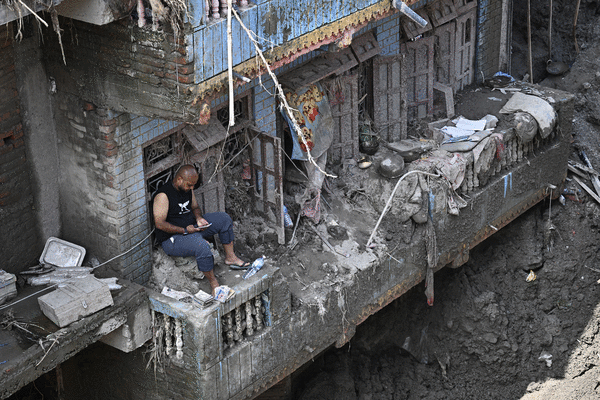
On the morning of Aug. 26, a catastrophic flash flood traveled around 60 miles along the Nepal-Tibet border region, destroying bridges, buildings and a border crossing. It swallowed entire villages and swept thousands of people along with it. Whole tour buses are still missing. More than 1,200 people have been confirmed dead, with thousands more still unaccounted for, including hundreds trapped in the tunnels of hydropower projects.
This shocking event, at the end of a summer when the world was already on fire, was yet another reminder that climate change is no longer a hypothetical threat to our future, but a deadly and ever-present threat that can strike us without warning at virtually any time, anywhere.
No rain was in the forecast. Many videos capturing the racing wall of water revealed blue skies above. Heavy rains can cause raging waters too, but at a rate that people and communities can often respond to. This tragedy offered its victims little time to find safe cover. It was a nightmare come to life.
When it first occurred, the cause was a mystery, but scientists have since established, through before-and-after satellite images, that a 2,000-foot-wide chunk of ice snapped off a glacier at 17,000 feet and fell nearly three-quarters of a mile to the valley floor, triggering a massive landslide and the flood. The crash caused the equivalent of a 4.4 magnitude earthquake. The wave of water moved at an average speed of 120 mph. That means it advanced 14 miles in less than seven minutes.
Those who survived the horrors of the flood are now faced with the long-term struggle to survive in its aftermath with what little of value it left behind. The after scenes are apocalyptic. Buildings are gutted or gone. What was once a lush, green landscape is now broken and painted brown, covered in thick mud and debris.
This disaster was made possible by climate change. Warmer temperatures are melting ice rapidly, destabilizing glaciers that have stood for tens of thousands of years and longer. While that period has seen ice advance and retreat at various times, the speed of melting today has no precedent. Since the 1980s, as global average temperatures have risen, ice melt has dramatically accelerated too. Although the specific tragedy in Nepal was unexpected, massive glaciers make the impact of climate change obvious to the naked eye.
I’ve seen the scale of that impact firsthand on France’s largest glacier. For two decades, I’ve skied the Vallee Blanche in the Alps, a 14-mile run, considered the longest in the world, that descends the Mer de Glace, a glacier whose name translates to “sea of ice.” The famous ski run ends at the Montenvers Railway, which has carried skiers and sightseers from the end of the glacier back to the village of Chamonix since 1909. Or at least that is what it did before the ice began its rapid retreat. A metal plate marks the spot where the ice reached in 1985, still nearly level with the station built almost 80 years before. In 1988, three steps were added to ease access to the station level as the glacier began to drop. By 1990, 12 steps were required, as it receded at a faster pace. Only 10 years later, 118 steps. By 2015, 321.
The last time I skied the Vallee Blanche two years ago, its beauty and scale were still awe-inspiring, but signs of its decline in the face of a warming world were all around us, dampening our spirits as we wondered about the future, of the Alps and our world. When we reached the end of the glacier, we followed spits of snow across the dirt where the glacier used to be. It was much farther and more challenging than I’d remembered, and when we reached the end of the trail, we had to climb 580 metal stairs up to the station. I was clad in ski boots with skis on my shoulder as I solemnly followed the reverse chronology of the glacier’s retreat. It was a striking visual of just how much and how fast global warming had changed the landscape there. The hike out became so difficult that a new lift was recently installed to bring tourists in and out instead.
Melting glaciers are more than a disappearing tourist attraction in Europe and America. While wealthier countries are often equipped with better tools to detect and respond to climate change-induced crises than poorer ones are, they also face increased risks of landslides, catastrophic floods and rockfall. But you don’t have to be near the glaciers themselves to be affected by them. Melting ice will affect us all, as the water makes its way from mountains to rivers to seas, raising sea levels and altering ocean circulation in ways that will affect populations everywhere.
Some climate change disasters are slow but steady, easy to track but also easy to ignore: rising temperatures of air and water, heat waves that get progressively worse, shrinking lakes and rising seas. Others, such as this flash flood, come fast and furious. What is even more alarming, though are the climate change nightmares we haven’t imagined yet, since we don’t fully understand where the trajectory of rising temperatures will lead.
____
Elizabeth Shackelford is a foreign affairs columnist for the Chicago Tribune and a lecturer with the Dickey Center at Dartmouth College. She was previously a U.S. diplomat and is the author of “The Dissent Channel: American Diplomacy in a Dishonest Age.”
___
©2026 Chicago Tribune. Visit at chicagotribune.com. Distributed by Tribune Content Agency, LLC.


















































Comments