Commentary: Let livestock clear hard-to-reach shrubs and grasses before the next wildfire
Published in Op Eds
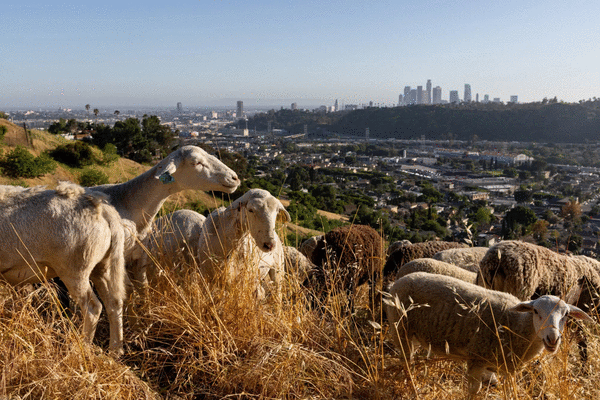
In grasslands across the American West, four-legged fire prevention crews are busy at work, helping keep wildfire risk under control. These cattle, goats and sheep stomp down tall grasses as they munch their way through plants that could otherwise burn, lowering the risk of catastrophic fires.
When livestock are intentionally used for wildfire control like this, the practice is known as targeted grazing. And it’s gaining attention as severe wildfire seasons push firefighters and public land budgets to the brink.
Strategically removing trees, shrubs and grasses can help alter the trajectory of future wildfires, but it is complex and expensive work that often involves intentional burning, herbicides and heavy machinery to thin forests or create fuel breaks.
Livestock can do some of this work instead, simply by grazing in the right places.
Current leaders of the U.S. Forest Service and Bureau of Land Management are pushing for more targeted grazing in national forests and on other public lands as part of the 2025 Grazing Action Plan and its accompanying directives.
As rangeland scientists who study how to effectively use livestock grazing to manage wildfire fuels and invasive plants, we see potential but also limitations to this strategy.
Targeted pyrograzing can help manage wildfire risk well in certain contexts.
Most wildfires burn in grass and shrublands that livestock can help maintain. Beef cattle, for example, consumed about 600 pounds of vegetation per acre across nearly 34 million acres in California alone in 2017. In places such as Santa Clara County, grazing is now a formal part of wildfire management plans.
The goal is not necessarily to prevent wildfire altogether but to reduce flammable vegetation enough to avoid fueling catastrophic wildfires.
Removing hazardous fuels through livestock grazing and trampling can help slow a fire’s spread so firefighters can stop the fire before it enters communities or reduce its intensity so ecosystems are able to rebound afterward.
In some cases, grazing can be more practical or cost-effective than other fire risk reduction methods.
For example, intentional burning is dangerous where there is so much vegetation that fires would burn too hot and fast to control. In other places, it isn’t feasible to spray herbicides across large areas or bring in heavy equipment to clear vegetation in remote locations.
But goats, sheep and cattle can eat their way across remote or steep terrain with little trouble.
We’ve spoken with savvy land managers who are also using livestock grazing to remove vegetation before carrying out intentional burns to make conditions safer for those fires. We’ve heard from others who are planning to use grazing before spraying herbicide to treat flammable invasive grasses to make it more effective.
A quarter of the U.S. Forest Service’s ranger districts in the Pacific Northwest, Intermountain and Pacific Southwest have used some kind of targeted grazing to manage fire risk. When we surveyed more than 1,000 U.S. Forest Service staff members, we found a majority think targeted grazing can be at least moderately effective to help with wildfire risk management, and more than two-thirds rated past projects as moderately to extremely effective.
Using targeted grazing at the scale needed to address widespread wildfire risk across federal lands would be difficult, and it won’t work everywhere.
To effectively reduce wildfire fuel with grazing, ranchers often need to bring livestock to certain areas at different times of year, haul water so livestock can work in areas without natural water sources or keep livestock in areas for longer than would be ideal for their weight gain.
Those factors cost ranchers money and can require shifts in their operation that aren’t practical. Or in certain contexts, animals simply may be unable to graze enough to achieve the desired reduction in wildfire risk.
Just 5% of Forest Service staff in the survey we conducted in 2025 reported that they were very likely or extremely likely to use targeted grazing in the next few years. Their answers were driven by how effective they believed targeted grazing could be, but also whether they felt they would have time to plan and manage it.
In particular, we found they were concerned about a lack of monitoring to ensure projects have the intended effect. Their ratings were also strongly connected to whether they felt that ranchers who already graze livestock on public lands could actually implement targeted grazing. And very few staff thought it would be feasible for the agency to pay ranchers to conduct targeted grazing as a vegetation treatment.
As the Grazing Action Plan pushes federal agencies to expand the use of targeted grazing, work is underway to evaluate where it could be effective. Some uncertainties remain, including around the question of paying ranchers and herders to perform targeted grazing as the practice scales up. Environmental groups have sued over the plan, arguing that it would put wildlife at risk and is simply an excuse to open more land for ranchers.
Although grazing is not appropriate everywhere, our research finds good examples of U.S. Forest Service staff incorporating livestock grazing into fire and fuels planning.
In Idaho, we are working with ranchers to test using sheep to reduce highly flammable and invasive grasses. In some years, the sheep have reduced the amount of flammable invasive grass by more than 20% and even boosted the cover of native wildflowers. Other times, the invasive grass matures so early that it is difficult to get the sheep to the target areas at the right time.
We have documented the value when ranchers, herders, agency staff and scientists work together toward shared environmental goals. The U.S. would benefit from financial and technical investment in both agency staff and ranchers to plan and perform targeted grazing so the practice can become a tried-and-true part of America’s strategy to live with wildfire.
____
Briana Swette is a social-ecological systems scientist at Boise State University, where Kelly Hopping is an associate professor of human-environment systems. This article was produced in collaboration with the Conversation.
_____
©2026 Los Angeles Times. Visit at latimes.com. Distributed by Tribune Content Agency, LLC.


















































Comments