Chris Bryant: Germany is in a very dark place, and time's running out
Published in Op Eds
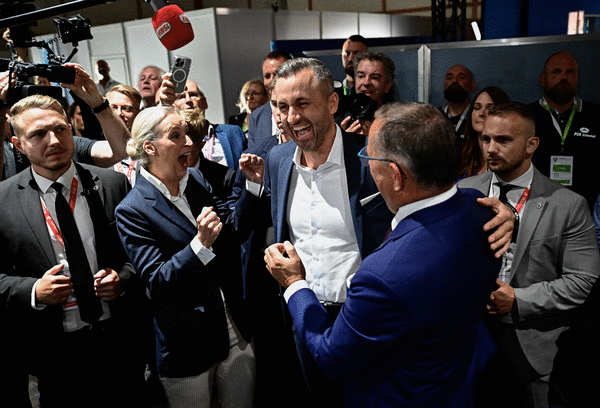
The far-right Alternative for Germany’s dramatic election win in the eastern state of Saxony-Anhalt on Sunday is a watershed in the country’s postwar history. In a nation known in the modern era for stability, Germans in this small federal region have embraced populist, nationalist ideas in large numbers.
Whether this electoral censure marks the low point for Germany, or the start of a descent into something far worse, is now up to Chancellor Friedrich Merz’s coalition. It needs to deliver economic growth and a renewed sense of optimism and trust in democracy. I’m not confident that Merz is up to the task.
After gaining 44% of the vote, the AfD doesn’t quite have the seats in Saxony-Anhalt needed to form a state government by itself. While various permutations are possible, in theory it could still end up ruling there, either by securing defections from other parties or with the tacit support of the BSW, a leftist but culturally conservative and Russia-friendly group. Governing would give it authority over domestic security and education.
Whatever happens, its electoral win will further normalize the AfD’s anti-immigrant agenda and policy of drawing closer to Moscow. Skilled migrants and foreign investors might reasonably decide to steer well clear.
It’s true that this former communist state isn’t representative of Germany as a whole. Its 2.1 million residents make up less than 3% of the population. The AfD has gained less ground in the more prosperous west of the country. Overall, some 28% of German voters favor it, compared with 21% for Merz’s conservative bloc.
That means the AfD is still a long way from taking power at the federal level — something one can’t say about France’s nationalists ahead of a presidential election next year where Marine Le Pen could secure victory. (The AfD and Le Pen’s National Rally aren’t on good terms). Yet one cannot underestimate the repercussions of the AfD winning such overwhelming support in Saxony-Anhalt. The result certainly can’t be blamed on apathy: Turnout was a post-reunification high of 78%.
Contrary to the party’s normally angry tone, its win was achieved by running an upbeat campaign and presenting itself as a bastion of hope. Its candidate for state premier, Ulrich Siegmund, is telegenic and charismatic. The 35-year-old’s smiling demeanor, moped rides and election slogan “everything is possible” earned him a big fanbase on social media.
It’s quite a claim to be the party of “good vibes” when domestic intelligence considers the party “right-wing extremist” and its electoral program includes: separate schooling for refugee children, overhauling history teaching to emphasize Germany’s positive achievements (rather than its ugly past), establishing a “remigration” taskforce and having voluntary citizens’ patrols to support policing.
But attempts by national media to portray Siegmund as the “most dangerous man in Germany” backfired, as did calls by senior politicians for the AfD to be banned. These interventions only elevated his iconoclast status while compounding his supporters’ feelings of being ignored.
Confronting the AfD is difficult. Germany’s mainstream parties rule out cooperating with it at state or federal level. But this “firewall” forces them into uncomfortable coalitions, while the far-right party takes no responsibility for the inevitable letdowns and compromises that come with governing. Its spending plans are reckless and its vow to quit the euro would be disastrous for Germany. Ruling in Saxony-Anhalt, a comparatively poor state, might inject a dose of reality. We’ll see.
But its success also underscores how centrist parties lack the answers to Germany’s many problems. An aging population is pressuring government finances and the social security system. As an export nation, the country has been hobbled by U.S. tariffs and China’s emergence as an industrial competitor, particularly in carmaking where Volkswagen AG is having to cut tens of thousands of jobs. Meanwhile, Russia — with whom the AfD wants closer ties — is carrying out hybrid attacks on European soil and is no longer a reliable source of cheap energy.
Previous governments made things harder by shutting down the country’s nuclear power plants, failing to equip the armed forces properly and opening the doors to a huge influx of refugees — a laudable humanitarian gesture but one that fueled the populist lurch. Heavy-handed measures curtailing civil liberties during the Covid pandemic added to the loss of trust in politics.
Merz understands what ails the Germany economy. He’s loosened constitutional restrictions on borrowing to fund defense and infrastructure, and he’s overhauling the tax and pension system so that workers have more spending power and more of their savings are channeled into the capital markets.
Although one shouldn’t get carried away, the economy is starting to respond, with output and business sentiment improving. Germans’ are founding more startups, partly because of the weakness of the labor market.
Last month Merz urged his fellow citizens to leave behind their frustration and discontent, and look more confidently to the future. But he’s no Ronald Reagan declaring, “It’s morning again in America”. Instead, Merz often comes across as aloof and polls show hardly any Germans are satisfied with his performance. He was largely absent from the campaign trail in Saxony-Anhalt.
Even after his party’s resounding defeat on Sunday, I can’t see him stepping aside any time soon. Yet reversing his disastrous poll ratings looks like mission impossible. His government’s controversial, but necessary, pension reforms will inevitably cause further division when they’re debated by parliament in the coming weeks.
This was unquestionably a dark weekend for Germany. But there was also a hint of sunlight for those still hoping Europe’s biggest economy can turn things around. On Saturday evening, a rocket built by Bavaria-based startup Isar Aerospace blasted off from a spaceport in Norway and delivered a payload of satellites into orbit — thus becoming the first privately funded company to do so from the continent’s soil.
It’s exactly the kind of pioneering spirit Germany desperately needs to overcome its economic malaise. It felt like a symbolic riposte to the U.S. billionaire Elon Musk, who has declared repeatedly that the AfD is Germany’s “only hope.” Merz’s coalition needs to tap some of the same entrepreneurial energy and upbeat vibes. Time is running out.
____
This column reflects the personal views of the author and does not necessarily reflect the opinion of the editorial board or Bloomberg LP and its owners.
Chris Bryant is a Bloomberg Opinion columnist covering industrial companies in Europe. Previously, he was a reporter for the Financial Times.
©2026 Bloomberg L.P. Visit bloomberg.com/opinion. Distributed by Tribune Content Agency, LLC.


















































Comments