Commentary: A relic we should leave behind
Published in Op Eds
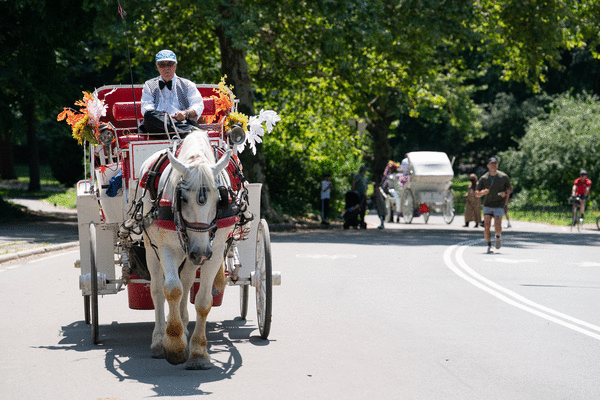
If an industry’s track record included a tourist’s death, multiple hospitalizations, runaway animals crashing into traffic, damaged vehicles and workers collapsing and dying on the job, most people would question whether it should continue operating at all.
Yet horse-drawn carriage rides remain common in cities and tourist destinations across North America. How many deaths, injuries and preventable accidents will it take before legislators put an end to the carnage?
In New York City, a metropolis filled with traffic, noise, construction, crowds and extreme weather, horses are still forced to pull heavy loads. The late Holly Cheever, D.V.M. and equine expert, long pushed for a ban, saying, “Since New York City’s asphalt surfaces have reached temperatures of 200 degrees Fahrenheit, it is evident that keeping horses sufficiently cool on hot summer days in the humid northeast is virtually impossible.” When they’re not toiling, horses are confined to cramped stalls in multi-level warehouses, with not a blade of grass in sight, much less a pasture in which to graze and roam.
The steady stream of reported incidents, along with many that likely go unreported, make it clear that these operations place both horses and humans in harm’s way. In Charleston, South Carolina, a horse bolted, sustained catastrophic injuries and was euthanized. In Atlanta, a horse collapsed in the street after being struck by a car, leaving blood smeared across the pavement. In Savannah, Georgia, construction noise startled a horse, sending seven passengers to the hospital after the carriage careened out of control. In St. Augustine, Florida, five passengers jumped out of a carriage when a horse bolted and ran for several blocks. Two people were injured, including one who was taken to a hospital. The list goes on and on.
Horses are excluded from protection under the federal Animal Welfare Act, so their welfare falls to local animal control officials. But state and local anti-cruelty laws have failed horses, since many humane authorities just don’t have the staff or the time to regularly monitor carriages to ensure that horses are not being overworked or that operators are remaining within the law. In St. Augustine, one carriage company owner admitted to police that he may have gone “overboard” when he punched a horse he considered unruly.
No amount of regulation can eliminate the fundamental conflict between a horse’s needs and the demands of urban carriage work. These animals are vulnerable to extreme temperatures, traffic hazards and the cumulative physical strain of pulling heavy loads over hard pavement day after day.
Modern, humane options provide the same sightseeing experience without forcing horses to work in an environment fundamentally unsuited to their needs. Battery-powered, turn-of-the-century replica e-carriages mimic the open-air tourist experience without using animal labor. Cities around the world, including Brussels and Cartagena, Colombia, have already demonstrated that visitors are interested in replica carriages that provide the same ambiance without the risk of injuries, runaway animals, heat stress, traffic collisions or intensive confinement.
Nostalgia has long been the industry’s go-to defense. But traditions that depend on animal suffering belong in the past.
_____
Jennifer O’Connor is a senior writer with the PETA Foundation, 501 Front St., Norfolk, VA 23510; www.PETA.org.
_____
©2026 Tribune Content Agency, LLC.


















































Comments