Commentary: The real target of 9/11-style terrorism is American values
Published in Op Eds
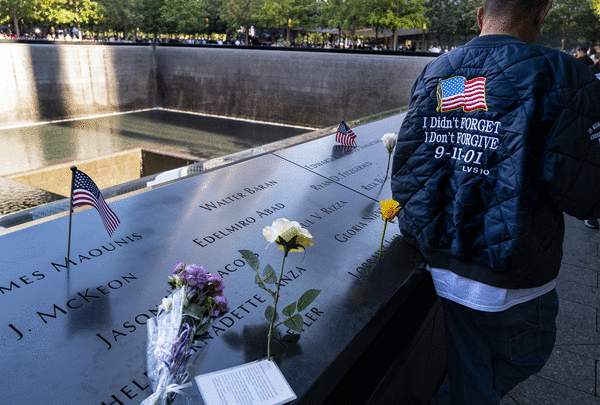
Virtually everyone in their mid-30s or older remembers where they were when they heard that an airplane struck the World Trade Center in New York on Sept. 11, 2001. I was in a hotel gym in Slovakia; it took two weeks to get home.
That was the goal of the terrorists: to destroy the ability of the American people to live their lives normally.
The concept of terrorism as a useful strategy emerged during the French Revolution. On Sept. 5, 1793, France’s National Convention declared that “Terror is the order of the day!” The government would henceforth use violence and intimidation to advance the revolution.
Until then, terror was universally understood to be wrong — a tool of despots. Republics’ driving force, by contrast, was “virtue.”
By calling for terror, the French revolutionaries transformed the shameful tool of despots into a badge of honor for themselves. And they did so with a vengeance.
During the French Revolution’s Reign of Terror (1793-94), Maximilien Robespierre and the “Committee of Public Safety” oversaw the killing of 30,000 to 40,000 people, about half by guillotine, historian Donald Greer reported in his authoritative 1935 monograph, “The Incidence of Terror During the French Revolution.” For almost a century thereafter, terror was primarily a tool of governments.
That changed suddenly in 1878, when Vera Zasulich, a Russian revolutionary, shot and wounded (but didn’t kill) the governor general of St. Petersburg, Dmitri Trepov. When asked at her trial why she didn’t finish him off, Zasulich replied, “I am a terrorist, not a murderer.”
Suddenly, “terrorism” meant not state-operated violence to intimidate the people, but individual actions to destabilize the state. Helped enormously by the invention of dynamite, anarchists, labor activists and communists adopted a new tactic.
They called this “propaganda of the deed,” as if blowing up people and property was no different than handing out propaganda leaflets at rallies. Their goal was to instigate revolutions that would overthrow the “capitalist bourgeois” state and usher in a revolutionary utopia.
In Russia, they found fertile ground. In the decades prior to the 1917 Russian Revolution, revolutionaries committed 23,000 terrorist attacks, killing, wounding or maiming 17,000 people. They averaged 1,000 victims yearly. (By comparison, the World Trade Center bombing killed 3,000 people in one morning.)
At its worst, from 1905-1907, more than 6,680 people were killed over the course of 1,000 days. This destroyed Russia’s social fabric.
The terrorism fever spread. On June 28, 1914, Gavrilo Princip shot Archduke Franz Ferdinand of Austria, starting World War I. Four years later, 20 million people were dead, and four of Europe’s long-standing empires were gone.
The United States was not spared. On Sept. 6, 1901, anarchist Leon Czolgosz shot President William McKinley. McKinley died a week later.
The “propaganda of the deed” again hit the United States during the counterculture era of the 1960s and early 1970s, with acts of terrorism peaking between 1971 and 1973.
In those three years alone, home-grown terrorists, largely driven by ideology, exploded 2,500 bombs. Bombings were conducted by such groups as the Weather Underground, Symbionese Liberation Army, Black Liberation Army, and the FALN (Fuerzas Armadas de Liberación Nacional).
Terrorism — whatever its motivation, and however it is organized — is still terrorism. Terrorists seek to make it impossible for normal people to live normal lives. They seek to disrupt and destroy free societies and remake them according to their own blueprint.
There is no middle ground between American principles and terrorism. Terrorists are opposed to entrepreneurship, equality, free speech, individual rights and opportunity. They abhor the idea of limited government, reject the risks and potential rewards of competitive enterprise, and are dedicated to abolishing an open, civil society.
As we remember the victims of 9/11, and the damage terrorism and the threat of terrorism have done to our freedoms, let us all recognize that the people who lost their lives on Sept. 11, 2001, could just as easily have been any of us.
The target was not New York or Wall Street, the Pentagon or the U.S. Capitol, it was the core of what it means to be an American.
____
ABOUT THE WRITER
Frederic J. Fransen is the president of Amerion College in Huntington (W.Va.) and CEO of Certell Inc. He wrote this for InsideSources.com.
___
©2026 Tribune Content Agency, LLC.
















































Comments