Commentary: Don't let Washington confuse you about vaccines. Talk with your pediatrician
Published in Op Eds
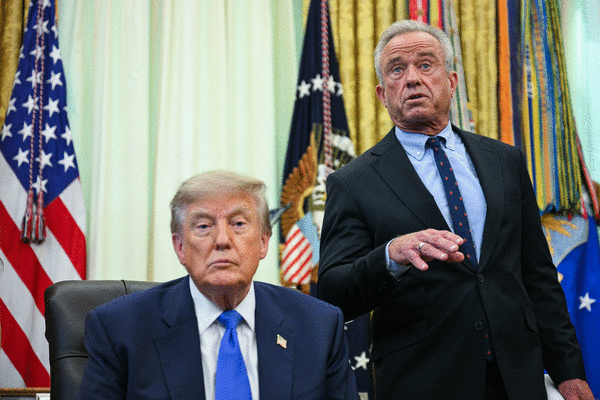
In August, we reached another grim milestone in the United States: Two deaths from measles were confirmed in Pennsylvania. These losses are a painful reminder that measles is still deadly and that the consequences of falling vaccination rates are measured in people’s lives. For pediatricians, the lives of our patients—children and babies—are our immediate concern.
It is heartbreaking to witness deaths from a disease that is preventable with a vaccine that has been widely used since the 1970s, helping to have eliminated domestic cases of measles by 2000. What families need today is strong, steady leadership from the U.S. government, in partnership with the medical community, to urge MMR vaccination for all who are eligible. Instead, the President and the Secretary of the Department of Health and Human Services are spreading falsehoods about vaccines, delivering chaos and confusion to families rather than clarity and reassurance.
In fact, earlier in August, the president signed an Executive Order calling for fewer routine childhood vaccines but more doctor’s visits to space out shots. As a pediatrician for more than 30 years, I can tell you plainly: this makes no sense.
Particularly troubling against the backdrop of the recent measles deaths in Pennsylvania, the Executive Order also suggests that parents should receive separate vaccines for measles, mumps and rubella instead of the combined MMR vaccine. These separate vaccines are not even currently available in the United States, and even if they were, substituting them for the combined vaccine would lead to more appointments for parents, more individual shots for young children, greater costs to families, and more unnecessary expense to the healthcare system. There is no medical reason to split up or space out these shots. None. At a time when measles is spreading across the country and many children remain too young to be vaccinated, we should be making it easier for children to get immunized, not harder.
All of the noise coming from Washington is part of a political agenda that has nothing to do with how doctors evaluate research and offer advice to their patients. When politicians give credence to false messages about vaccines, children and their families pay the price.
Right now, U.S. children are going back to school with kindergarten vaccine rates continuing to decline nationally, an indicator that many communities do not have enough people vaccinated to stifle outbreaks. The consequences are real: measles cases have reached a 35-year high in the U.S.
I want to reassure parents that as of today, nothing has changed for your family. The vaccines pediatricians recommend for children today are the same ones they needed a few weeks ago, and they are still available and still covered by insurance. The American Academy of Pediatrics' 2026 immunization schedule — the one backed by over a dozen major medical organizations— still recommends routine childhood vaccination against about 18 diseases, including measles, influenza, RSV, hepatitis A and B, rotavirus and meningococcal disease. Children in the U.S. who are up to date on their vaccines, are better protected today than any time in history.
The advice I’ll share here is the same advice pediatricians are giving parents across the country: Be sure your back-to-school checklist includes a conversation with your pediatrician. Ask whether your child is up to date on recommended immunizations. Ask why certain vaccines are given at specific ages. No question is too small. As pediatricians, we are here to listen to your concerns and support you as you make decisions about your child’s health. Our advice, as always, is based on what's best for children's health and well-being, not politics.
____
Andrew D. Racine, M.D., Ph.D., is president of the American Academy of Pediatrics.
____
©2026 Tribune Content Agency, LLC.















































Comments