Commentary: The liberal arts college tradition doesn't have to die, just evolve
Published in Op Eds
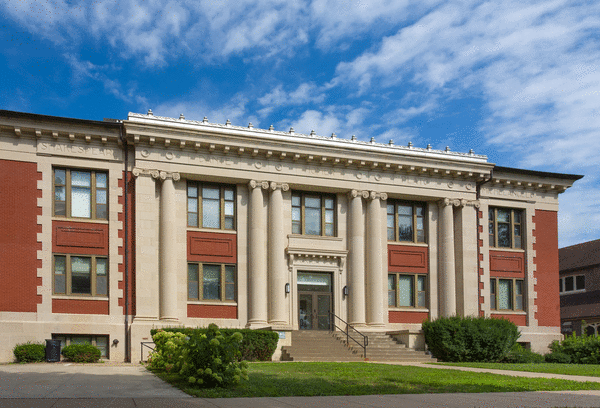
Many private liberal arts colleges are entering death throes, even as education in the humanities in our tumultuous world is more important than ever. There may be ways to save the tradition, if not all the ivied brick-and-mortar campuses.
There are about 200 “national liberal arts colleges” in the popular U.S. News & World Report reputational rankings, and hundreds more “regional colleges” that also tend to focus on the humanities, social and natural sciences. Since 2020, about 100 American degree-granting colleges have closed or merged, according to bestcolleges.com.
The enrollment picture has changed dramatically in recent decades. Fewer students are graduating from high school, and fewer of those graduates are going on to traditional four-year colleges. In the business of higher education, the dreaded enrollment cliff drop-off has begun.
Without adequate enrollment and the tuition payments that accompany the students, many more colleges will close.
Over recent decades, liberal arts colleges have been separating into “tuition-driven” and “endowment-driven” models of finance; that is, colleges with modest endowments have had to rely primarily upon student tuition to finance their operations.
In contrast, colleges that husbanded big endowments from wealthy alumni could rely on income from these assets to finance much of their college operations; tuition has been less important and can be waived for high-achieving prospective students.
Today, a college’s success is almost all about the money. The elite Ivy League and similarly well-known colleges tend to have big endowments and can buy the best students and faculty. Private colleges with $1 million or so of endowment per student, such as Grinnell in Iowa and Berea in Kentucky, will also do just fine going forward. Berea provides $54,000-plus in support annually for each student; tuition cost to each student is $0.
On the other hand, private colleges with less than $100,000 endowment per student, which is most of them, are in a fix.
A $100 million endowment for a college that enrolls 1,000 students sounds like big money, but it works out to about $5,000 annual revenue per student. Yet, that college needs an order of magnitude more revenue per student than that to keep the doors open.
The present model simply doesn’t work for many of these colleges, with fewer students in the overall pool, intense competition from wealthy, well-branded colleges that can waive tuition charges, and campuses often inconveniently located in small towns far away from anywhere.
Today, students and families want quality, convenience, low out-of-pocket cost and jobs right out of college. Many colleges can’t provide all that, not without revenue from large student loans, which have become understandably toxic to many students and parents.
But that doesn’t mean the liberal arts tradition has to die with Old Ivy. The underlying purpose of 19th century colleges was not to provide four-year residences far away from home for young men and women. The purpose was to enlighten future leaders, and the campus offered the only way to do so.
The following proposed model may not be the answer, yet it is illustrative of the thinking necessary.
To the college with $100 million in endowment: Save the endowment, rather than lose it in trying to stave off an institutional death spiral. Since students won’t come to campus in adequate numbers, sell the physical campus, dorms and recreational facilities.
If the students won’t come to your campus, go to them. Use the endowment income to keep a core faculty that would provide dispersed, online liberal arts education. Work with public libraries to create low-cost, local “Old Ivy Liberal Arts Chapters.” In addition to providing online courses to “chapters” of students from 16 to 80 in age, faculty members could travel now and then to chapter locales to lead in-person discussions. Micro-credits, certificates, even degrees could be awarded.
For many colleges, the old model doesn’t work anymore. New approaches must be shaped that invest the remaining endowment wisely. Reconstituted colleges could provide quality, convenient, low-cost education in the liberal arts to a wider public, which could delve into the big questions, more important than ever, of “What matters?” and “How should I lead my life?”
____
Jim Nowlan has taught at the University of Illinois in Urbana and Chicago, Knox College, Black Hawk College and Fudan University in Shanghai. His Ph.D. dissertation was about “The Politics of Higher Education,” published by the University of Illinois Press in 1973.
_____
©2026 Chicago Tribune. Visit at chicagotribune.com. Distributed by Tribune Content Agency, LLC.


















































Comments