Commentary: How the Senegalese and the Village People's 'Y.M.C.A.' introduced me to the World Cup
Published in Op Eds
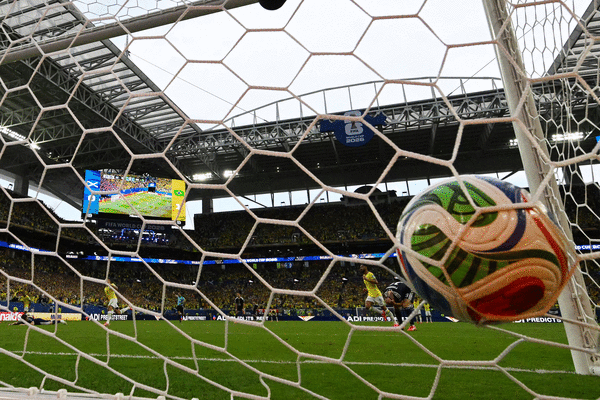
Every four years when the World Cup rolls around, no matter where in the world I am watching — in a pub in England, in a crowded restaurant in Spain or in a bar in Chicago — my mind always conjures up images of that night in Senegal where I saw my first match on a portable black-and-white TV hooked up to a truck battery.
I had barely made it through my first year as a Peace Corps volunteer, struggling with depression and bouts of amoebic dysentery, babbling like a 4-year-old in the ancient language of the Wolof, and every day realizing how helpless I was to these families trying to eke out a living growing peanuts in the semiarid savannas of West Africa.
I grew up in the 1970s in a small factory town in the Midwest. Soccer was an exotic sport that could not compete with those singular American pastimes we played in our backyards and ball fields. Consequently, I never quite understood the global phenomenon of soccer and the near religiosity it inspired in people. It was a mystery to me how a sport where 11 players kick a ball into a box lined with netting could incite violence and even war between neighboring countries. But that was until I came to Senegal.
Observing the daily lives of the Senegalese, I began to understand something of the near mystical powers this sport had on the lives of people, particularly those on the margins of this world. In the mud-brick huts of boys, who shared beds of straw with their brothers and cousins, photos of soccer stars covered the walls from floor to ceiling. Even the elders had posters of French teams nailed to their crumbling walls alongside portraits of marabouts and Senegal’s founding father, Leopold Sedar Senghor.
In the evenings, when the sun mercifully began to set, I watched as boys began to set up their pitch next to the village mosque. With sticks marking the goals and a ball made of rags bound tightly with strips of tire tubing, boys of all ages came to play after their long days weeding in the fields. There was no true out of bounds, no limit to the numbers of players; even the boy with the dangling foot from polio chased the ball like everyone else.
The night of a match between France and West Germany, I returned to the village after a weekend with my Peace Corps pals, and as I stepped out of the bush taxi, I could hear the chief’s sons shouting out my Senegalese name as they ran to greet me at the road.
“Mustapha, Mustapha, come, come, we have a tele be!”
They were beside themselves with excitement, repeating again and again, the news that I couldn’t quite fathom: that they had a television to watch the World Cup.
As the younger sons dragged my heavy bags through the sand, the eldest grabbed my hand and walked me to the chief’s compound, where I discovered that they were right: There, on top of three burlap bags of peanuts, stacked on the flat bed of a wooden cart, was an 18-inch portable television with rabbit ears.
Flabbergasted, I stood there in amazement, as the chief’s brother explained to me that he had rented the TV for “la Coupe de Monde,” or World Cup, and he was going to hook it up to the battery of a truck that had sat unused outside the compound since the day I arrived.
Though the Senegalese seemingly were able to fix anything with a bit of wire, getting the most dilapidated trucks and taxis to work, I had my doubts about this TV broadcasting the World Cup
The compound was abuzz with villagers coming to get a look at this modern machine, which almost no one there had seen before. Men approached the TV a bit afraid to even touch it, like it was some foreign object that had fallen from the sky.
Tired from traveling, I retreated into my thatched hut and buried myself in a book. But I was jolted out of the gloomy world of novelist Fyodor Dostoevsky’s Moscow by one of the chief’s sons pounding on my door: “Mustapha! Mustapha! Your people! Your people are on the tele be!”
But I didn’t need to step outside. I could hear them, my people, belting out their worldwide hit before the beginning of the World Cup:
Young man, there’s no need to feel down, I said
Young man, pick yourself off the ground, I said
Young man, ‘cause you’re in a new town
There’s no need to be unhappy.
And there on the TV before a throng of excited village people were the Village People, singing “Y.M.C.A.” in their construction hats, Stetsons, police outfits, Indian headdresses and biker caps. My people.
I could only laugh at the absurdity of it. But then, who better to celebrate the coming of television to a Senegalese village than the joyous voices of the Village People?
I had failed pretty much in all my projects in the Peace Corps: the flyless latrine that nobody used, the clay stoves that crumbled from the heat of cooking fires and the vegetable gardens that only created more work for the overburdened women.
But that night in 1982 when France lost in penalty shots to West Germany in the semifinals of the World Cup, I was somewhat of a hero, as I figured out that if I held the antenna over my head, the rolling image on the small screen would stabilize and come into focus so that we all could watch our first match of “la Coupe de Monde.”
____
Michael McColly, a Chicagoan, is the author of the book“Walking Chicago’s Coast: A 63-Mile Journey to the Indiana Dunes.” He also is a former instructor in the creative writing graduate program at Northwestern University.
___
©2026 Chicago Tribune. Visit at chicagotribune.com. Distributed by Tribune Content Agency, LLC.





















































Comments