Editorial: Higher prices are making Americans into smarter, tech-savvy shoppers
Published in Op Eds
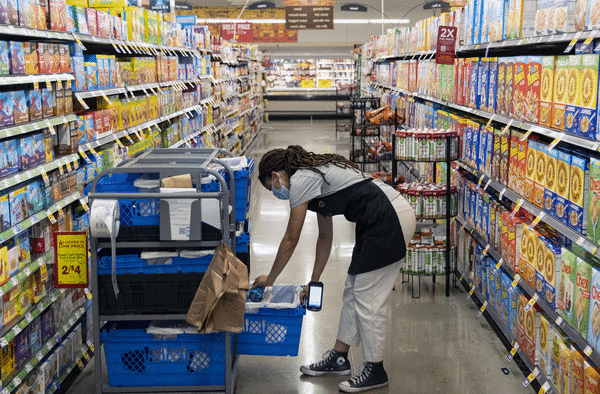
The U.S. government’s monthly reading on inflation is due July 14, but American consumers already know the score. Even if the consumer price index dips from last month’s three-year high, the cost of living has gone up across the economy, putting a squeeze on household budgets.
One result? People are becoming better shoppers, spending their money more purposefully.
For the three-fourths of the population who say prices have outpaced their incomes, according to a CBS News poll in May, making ends meet could involve trading down to lesser brands, moving into cheaper living quarters, canceling planned vacations and dining out less. But it also means making calculated decisions about what to splurge on.
Inflation hasn’t made Americans stop spending, but it has made them spend differently.
Small luxuries are still selling to people at all income levels, and even strapped consumers have new tools to help them stretch their dollars and find the products or services they want the most. If you’re not using artificial intelligence and social media to help shape your purchases, it’s time to update your tool kit.
Shopping for food has become an augmented experience. Online sales now drive the vast majority of growth in consumer-packaged goods, with 74% of shoppers using AI for product discovery to guide their purchases, according to Chicago’s NielsenIQ.
AI-assisted shopping makes it easy to compare prices and features. The majority of Gen Z and millennial consumers have shopped on social media platforms like TikTok Shop. Amazon’s grocery service, meantime, has become a multibillion-dollar juggernaut.
AI-based apps like the new WISEcode can be customized to screen out products that contain unwanted ingredients like artificial colors or certain allergens, giving shoppers new authority over what they buy. WISEcode is so easy to use it puts the widely disliked Jewel supermarket app to shame, and it’s one of many improved tools for helping consumers find the products they want.
Don’t underestimate the role of influencers, a vague description that includes practically anyone whose opinions attract attention online. In the food business, the viral result can be crowds swarming like a bank-run on Asian markets selling fruit-shaped ice creams or bakeries making candy-sprinkled “dot cakes.”
Shopping has never been so personalized. Someone on GLP weight-loss drugs, for instance, has different needs than other shoppers, and today’s consumer-facing technology can take those into account.
Higher prices have raised the stakes, and you might think consumers are mainly opting for a lower cost when they can find it. That’s not how the marketplace is operating today.
Consider butter, a basic commodity staple. Plain old butter in 1-pound bricks or quarters is readily available in any grocery store, and it isn’t a budget-buster. But consumers who are saving money by preparing more food at home see an opportunity to upgrade their experience for a few bucks more.
Sales of private-label and mainstream butter brands still account for most of sales, but the growth is coming in premium brands from grass-fed cows, often raised organically, and sometimes incorporating ingredients like sea salt or olive oil.
Business is strong at Wyke Farms, a Somerset, England-based dairy whose 8-ounce packs of creamy, fresh butter sell for $5 or $6 at Whole Foods in the States. “It tastes how butter should taste,” John Morton, who manages U.S. exports for Wyke, told us at a food industry conference last week.
At that same Fancy Food Show, Joseph D’Alessandro of Chicago Importing Co. lamented how tariffs have forced his business to raise prices of its imported European candy by about 10% over the past year. “If tariffs went down, we would lower our prices,” he told us.
Nevertheless, the Huntley, Illinois-based company has benefited from increasing numbers of high-income customers who want a first-rate product and don’t care what it costs. “They’re not looking at the price. That luxury end of the market is getting bigger. We’re not competing with the Hershey bar.”
The so-called K-shaped economy is indeed remaking the marketplace — the top of the “K” reflecting the rising fortunes of high-income households, while the bottom includes most Americans, who are losing ground economically. It’s no stretch to observe that people who may never afford to buy a house are compensating with products like fancy butter and sweets.
Companies have found that catering to smaller numbers of wealthy customers has a richer payoff than trying to expand sales across the mass market. That so-called “premiumization” is especially conspicuous in food, retailing and travel.
Once-mainstream destinations like Disney World increasingly sell different experiences at different price points. The long lines at popular rides tell the story: The price-conscious endure long waits, while those who pay for more expensive tickets can cut over to a shorter line.
Galling? Perhaps. But the lesson is old as time: People need to live within their means, and the good news is that technology is helping. In a K-shaped economy, scrappy consumers are finding the smartphone can be an equalizer.
___
©2026 Chicago Tribune. Visit at chicagotribune.com. Distributed by Tribune Content Agency, LLC.




















































Comments