Editorial: Chicago separated its mental health emergency response from public safety. Bad idea
Published in Op Eds
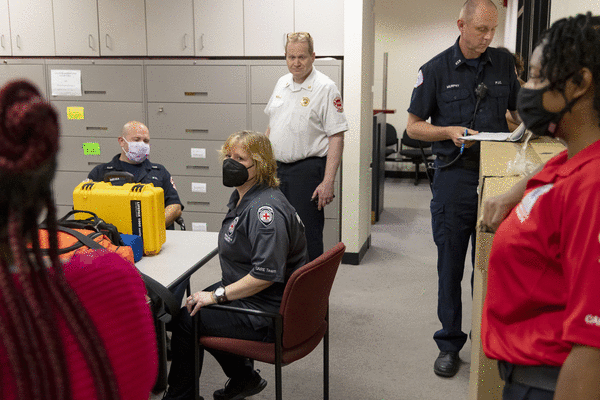
Former Chicago Mayor Lori Lightfoot in 2021 created a pilot program called Crisis Assistance Response and Engagement to weave mental health experts into public safety responses.
The idea was both compassionate and practical. Many 911 calls involve people suffering psychiatric crises, severe depression, schizophrenia, bipolar disorder or substance abuse, situations where a mental health clinician may be better equipped than an armed police officer to de-escalate. CARE was designed to provide that expertise while remaining part of Chicago’s broader emergency response.
It was set up as a co-responder model, incorporating Chicago police, a mental health clinician and Chicago Fire Department paramedics.
Mayor Brandon Johnson on the campaign trail criticized the co-responder approach and, upon taking office, made drastic changes.
He made CARE permanent. He doubled staffing. Worse, he shifted the program from the original co-response model to one run by the Chicago Department of Public Health with clinicians and EMTs but no police officers. In doing so, he removed police officers from CARE field responses, an unsurprising move from an administration famously skeptical of police.
Johnson’s redesign moved CARE toward a stand-alone public health response rather than an integrated public safety partnership, treating public health and public safety as competing systems instead of complementary ones.
What’s followed is a program that became less coordinated, less available and far less used.
Tribune reporting shows CARE responses peaked at 773 in 2023; by 2024, responses dropped to 239. That drastic decline tracks with Johnson’s transition.
It took journalists asking questions to get these numbers. Chicagoans no longer have access to the city’s public dashboard that displayed response volume over time, after Johnson replaced it with a page that shows a single data point on the program, as the Tribune reported.
CARE has lost access to key police dispatch terminals, arguably for good reason, given the lack of a police partnership. It operates in extremely limited hours, remains understaffed and has gotten bogged down in interagency conflict — the opposite of the 24/7, dispatch-integrated, accountable models that work elsewhere.
Mental health intervention is a good thing when deployed properly. But it should be fully integrated into Chicago’s broader public safety system, not treated as a stand-alone service.
Johnson weakened coordination in a system in which coordination actually is the key ingredient. On top of that, his CARE team operates only on weekdays between 10 a.m. and 4:30 p.m.
Unfortunately, mental health crises aren’t restricted to regular business hours.
Analysis of the program from the University of Chicago Health Lab acknowledges real operational challenges under the pilot but also concludes that the Chicago Police Department and CFD were engaged partners. It says the evaluators did not observe evidence that police or fire were removed because of adverse incidents or lack of support. Today, CDPH is now the only agency involved in CARE field responses, as Health Lab noted.
What makes this particularly striking is that Health Lab’s evaluation pointed in a different direction from the path City Hall ultimately chose. The experts did not recommend separating CARE from police and fire. Rather than making the case for separation, the report repeatedly stressed stronger coordination among CDPH, CPD, CFD and the Office of Emergency Management and Communications, better dispatch integration, clearer governance and improved staffing. Not for the first time, Johnson let his ideologically driven mistrust of the police lead him to provide weaker services to Chicagoans.
Denver offers an instructive contrast. Its civilian STAR teams are housed in the health department, but they operate alongside — not instead of — a police co-responder program. Both are part of Denver’s 911 emergency response system.
The lesson isn’t that Chicago should simply restore the original pilot, it’s that emergency response works best when agencies work together rather than apart. Whatever its shortcomings, Lightfoot’s pilot was built around coordination among police, fire, public health and dispatch.
Johnson’s team told the Tribune it is building another pathway to route mental health calls to CARE and plans to launch a second evening shift by October. Those are welcome improvements. But they don’t answer the bigger question: Why isn’t CARE more deeply embedded within the emergency-response system Chicago already has?
“You’re the executive, buck stops there,” Progressive Caucus co-chair Ald. Andre Vásquez, 40th, told the Tribune. “If we came into office saying we’re trying to deliver this as the opposite of neoliberal solutions, you can’t leave that thing lying on the table.”
Exactly.
Mental illness doesn’t keep office hours, and neither should the system designed to respond to it. Chicago needs a CARE program integrated into public safety, not one operating in isolation.
___
©2026 Chicago Tribune. Visit at chicagotribune.com. Distributed by Tribune Content Agency, LLC.




















































Comments