Abby McCloskey: America's religious pluralism has never been tested like this
Published in Op Eds
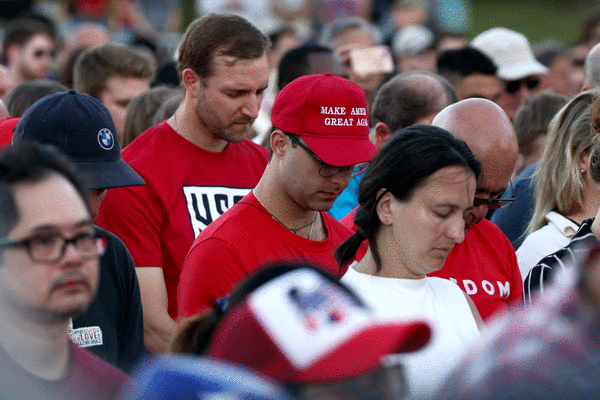
Growing up as a Christian, I frequently heard from other churchgoers how fortunate we were to live in a Christian nation. These days, I’m more likely to hear fellow Christians lament that the nation has fallen into secularism.
But as America turns 250, it’s worth remembering that the history of Christianity in America is complicated. So, too, is its future. Church membership has waxed and waned in our country before. But the decline in a broadly shared Christian worldview is unprecedented. Already, it’s putting the pluralistic religious ideals of our Founders to the test.
The colonial era was — perhaps surprisingly — a largely unchurched one, with church membership levels hovering around 15–20% due to strict membership requirements and geographic isolation. Yet while church membership was relatively low and a national religion was (in explicit contrast to Europe) banned, Christianity provided a shared moral framework for the new country.
As historian Mark Noll wrote in his book In the Beginning Was the Word, the Bible provided a dominant cultural and religious understanding for the vast majority of Europeans who arrived on American soil. Nearly all of the Founders expressed some version of Christian faith, and that faith inspired much in our founding documents. (The idea that people are “endowed by their Creator with certain unalienable Rights,” for example.)
Then came the revivals and Great Awakenings of the 18th and 19th centuries, which alongside new waves of immigration, began driving up church attendance.
But it wasn’t until the 20th century that church membership reached its apex. By 1948, church membership reached a historic high of 76%, according to Gallup. Around half of Americans attended church weekly. A whopping 91% of Americans identified as Christian or Catholic.
On our semiquincentennial, we are far more religiously diverse — and far less religious overall. Regular weekly or near-weekly church attendance has dropped to roughly 33% of the adult population, according to Gallup. While Christianity is still adhered to by approximately two-thirds of Americans and remains a large part of our national story, nearly half of Americans say that religion is not very important. For the first time, one in four Americans claim no religious affiliation, rising to one in three Americans under age 30.
This is a huge change in a relatively brief period of time and has helped create new political dynamics. For example, it once was the case that an equal share of Democrats and Republicans would have had similar Christian worldviews; now it’s skewed, with Republicans having disproportionate representation among churchgoers and Democrats having a disproportionate share of religious “nones.” This contributes to our political polarization and a belief that the other side is immoral and closed-minded.
Most Americans see their fellow citizens as “morally bad,” according to Pew, and we have deep divisions on a number of moral topics.
Of course, a widely shared religious framework doesn’t mean everyone gets along. The 19th century saw North and South go to war over slavery, after all. But now there’s not even a common language or sense of higher authority from which to persuade.
Some conservatives are trying through political means to turn back the clock, but this is not the way forward. There has been an increase in movements on the political right to restore a common language of morality, such as by displaying the 10 Commandments in public school classrooms.
But symbols and language do not create spiritual belief; that comes from families, churches and communities. A top-down push risks creating the kind of state religion that has been endemic elsewhere and that the American Founders were trying to avoid. And of course, a state powerful enough to mandate religious language is powerful enough to do the opposite. History is also replete with the elevation of secularism over religion in public life.
In some ways, we find ourselves coming full circle and back to the Founders’ original experiment. It was new for them to establish religious freedom. To celebrate the virtues and morality that enable self-governance. To encourage a proliferation of religious and spiritual life and to protect it from the interference of the government and the public majority.
The challenge of the next 250 years is not how to restore “a Christian nation” through political means. It will be how to resolve our disagreements without a broadly shared set of moral ideals.
While our nation has long been religiously pluralistic in theory, it has not been in practice. The future beyond our 250th seems to hold no other choice.
____
This column reflects the personal views of the author and does not necessarily reflect the opinion of the editorial board or Bloomberg LP and its owners.
Abby McCloskey is a columnist, podcast host, and consultant. She directed domestic policy on two presidential campaigns and was director of economic policy at the American Enterprise Institute.
©2026 Bloomberg L.P. Visit bloomberg.com/opinion. Distributed by Tribune Content Agency, LLC.



















































Comments