Ronald Brownstein: Supreme Court reform will test Democrats
Published in Op Eds
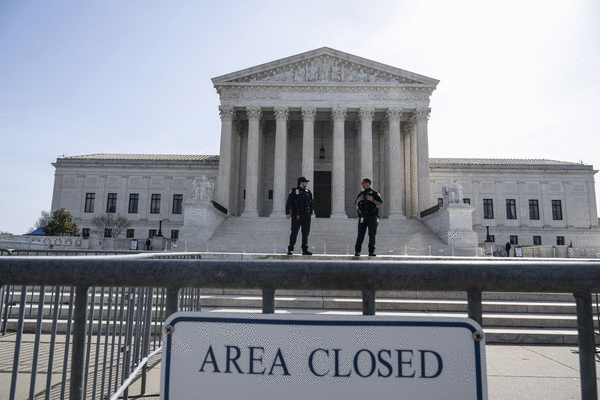
Former Vice President Kamala Harris turned heads with a video earlier this month in which she argued Democrats need an “expanded playbook” to explore structural reforms to the institutions of American government, including the Supreme Court.
Her comments reflected soaring Democratic frustration with the court after its recent Callais ruling eviscerating the Voting Rights Act — and underscored the likelihood that the eventual Democratic presidential candidates will advance aggressive proposals for court reform.
“Any serious Democratic presidential candidate in 2028 will need a plan for how their domestic agenda will not die … at the Supreme Court,” says Josh Orton, president of Demand Justice, a liberal group that advocates for enlarging the court.
But even as demands for change move into the Democratic mainstream, court reform advocates still face a Catch-22. The most legally defensible solution is expanding the court’s size. But it’s the most politically fraught. The most politically defensible solution is imposing term limits on the justices. But it’s the most legally fraught.
Harris, who has kept her name alive as a possible 2028 candidate, jumpstarted the Democratic reform debate with her recent remarks to the activist group Emerge America. Harris called for Democrats to pursue a “no-bad-ideas brainstorm” about structural governmental reform and offered a succession of provocative possibilities, such as multi-member Congressional districts. Near the top of her list of options: expanding the Supreme Court.
For Harris even to float that idea underscored a clear generational break. Harris’ former boss, President Joe Biden, always recoiled from any discussion of enlarging the court, which he invariably dismissed as “court-packing.”
Just before the 2020 election, when Democrats were outraged by the Republican rush to confirm a new justice in the waning days of President Trump’s first term (after the GOP refused to confirm a new justice in the last year of President Obama’s term), Biden agreed that if elected he would appoint a commission to study Supreme Court reform. But Biden betrayed his true feelings when his 2021 executive order creating the commission pointedly did not charge it with producing recommendations. The resulting report, while providing some enlightening historical perspective and legal analysis, was a model of mush.
But the interest in Supreme Court reform among Democrats has revived as the six GOP-appointed justices have repeatedly linked arms to issue rulings (over the unified objections of the Democratic-appointed justices) that advance Republican electoral and policy priorities. “To Biden’s generation, the Supreme Court was the court of Brown v. Board of Education,” says Michael Waldman, president and CEO of the Brennan Center for Justice, who served on Biden’s court reform commission. “To younger people, it is the Supreme Court of Citizens United and Callais.”
The Brennan Center is a leading advocate of term limits for Supreme Court Justices. Most term-limit proposals would limit Justices to an 18-year term; when fully phased in, that would provide every president two appointments for every four years in office.
Term limits have drawn support from both conservative and liberal legal scholars, and are consistently very popular in polls, typically attracting big majorities of Democrats, Republicans and independents alike. Term limits “are seen not as a rebuke” of this particular Court majority, says Waldman, but rather as “basic good governance. Behind it is the public belief that no one should have too much power for too long.” Democratic operatives say they will not be surprised if every party presidential candidate in 2028 endorses Supreme Court term limits (as even Biden belatedly did, soon after he quit the 2024 race).
The debate among Democrats is over whether term limits are a viable, or merely symbolic, response. The Brennan Center, like other supporters, maintains Congress has the authority to set judicial term limits by statute. If that’s right, Democrats could approve term limits should they control the White House, House and Senate in 2029 (though presumably that would require ending the filibuster).
But whatever the legal arguments for that view, Orton raises the inescapable practical obstacle: Does anyone, he asks, believe “this particular [John] Roberts Supreme Court would rule” that a statute limiting “their own power is constitutional?” If the court were to block such a statute, the only solution would be a Constitutional amendment — likely an exercise in futility, given Republicans’ confidence that they have built their most reliable Supreme Court majority since the mid-1930s.
Facing that constraint, Orton’s group wants the 2028 Democrats to commit to enlarging the court, which Congress clearly can do — and repeatedly did during the 19th century.
The last attempt, in 1937, failed spectacularly when President Franklin D. Roosevelt, after repeated blows from that earlier Republican-dominated court, couldn’t persuade even large Democratic congressional majorities to go along with adding justices. But Orton argues that a presidential candidate would fare better now by explaining “not just about the individual rights this court has stolen from people … but how they have essentially rigged democratic institutions and the economy against average people.”
Still, in polling, court expansion triggers much more resistance than term limits. Even California Governor Gavin Newsom, who’s positioning himself as the fiercest fighter in the potential 2028 field, recently questioned the idea using terms akin to Biden’s (while expressing more receptivity to term limits).
How the next cohort of Democratic presidential candidates navigate these contradictory legal and political cross-pressures will determine whether the party’s escalating criticism of the court remains a shout from the bleachers — or coalesces into a serious movement for reform.
____
This column reflects the personal views of the author and does not necessarily reflect the opinion of the editorial board or Bloomberg LP and its owners.
Ronald Brownstein is a Bloomberg Opinion columnist covering politics and policy. He is a CNN analyst and the author or editor of seven books.
©2026 Bloomberg L.P. Visit bloomberg.com/opinion. Distributed by Tribune Content Agency, LLC.





















































Comments