David M. Drucker: America's 'everything is rigged' era is toxic
Published in Op Eds
Everything, it seems, is rigged these days.
Unhappy with the economy? That’s because it’s rigged. Fed up with your healthcare? It’s rigged, too. Frustrated with elected leaders in Washington, Sacramento, Austin or Albany? Rigged, rigged, rigged and rigged.
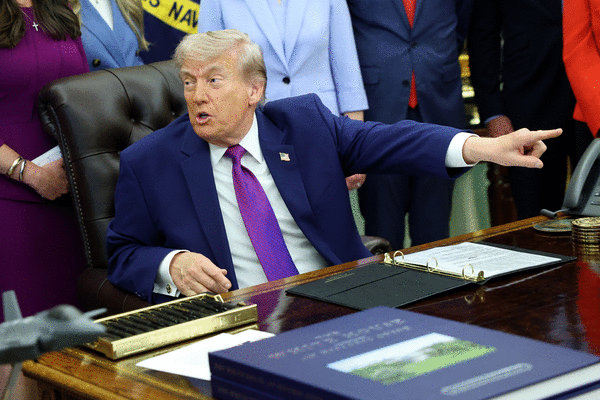
President Donald Trump arguably kicked off this populist trend of referring to everything voters find wrong with the country as the deliberate work of vampiric forces intent on accruing wealth and power at “our” expense. The president continues to issue serial accusations of this or that being rigged against “you,” including elections that don’t go his way. This is perhaps the most perfidious practice of this sort of politics.
“I think it was rigged,” the president said in March, referring to his loss in Arizona all the way back in 2020.
Democrats are getting in on the action, too: “I’m not afraid to name an enemy, and the enemy is the oligarchy,” Graham Platner, the Democrat challenging Republican Senator Susan Collins in Maine, said in the video announcing his campaign. Or take this riff from Senator Jon Ossoff, the Georgia Democrat running for reelection this year after five years in Congress:
“You aren’t the problem. Neither are your fellow Americans. The problem is that the people’s representatives don’t represent the people. They represent the donors and special interests,” Ossoff said in a campaign video (excluding himself, presumably.)
It’s standard practice for incumbents and challengers alike to blame shadowy groups — or the president and congressional majority with lousy job approval ratings — for society’s ills. Then, those candidates declare that “I alone,” — or me and my out-of-power political party — are the exceptions that will repair broken economic and political systems. This message has currency with Americans. Besides, no politician with an eighth of a brain is going to blame voters for their lot in life, even if it’s deserved.
The ubiquitous use of the word “rigged,” and all that it implies, however, is particularly unhealthy for the body politic. It undermines voters’ faith and trust in government and institutions and implies that only suckers bother to protect the crucial elements of our economic and electoral systems. Accusations of “rigging” also give voters the impression that the challenges they face are intentional and intractable, rather than the offspring of policy failings that the US government and its institutions are equipped to remedy.
“It’s an argument that almost gives you license to do something outside of the mainstream, American tradition — to blow it up,” Nicholas F. Jacobs, a political science professor at Colby College in Waterville, Maine, told me.
“If it’s rigged, it presumably means that you can’t unrig it, unless you fundamentally change the rules. And I think both the left and the right use this language to justify the constitutional hardball that they’ve increasingly played,” added Jacobs, the co-author of What Happened to the Vital Center? Presidentialism, Populist Revolt and the Fracturing of America.
Ironically, that dynamic makes it much harder for the elected officials, policymakers and bureaucrats who operate inside the so-called system — and all of them do — to address voters’ legitimate concerns.
The current “everything is rigged” era, ushered in by Trump during his 2016 presidential campaign, is hardly the first of its kind in America. Politics in the US have always featured at least a dose of populism and the sense that aspects of society are unfair.
And at times, it’s been absolutely true that the political and economic systems were rigged. The Jim Crow era excluded Black people from the political process, jobs and civic life, especially in — but not limited to — the South, which was then dominated by the Democratic Party.
Today, some Trump critics view the Department of Justice as being rigged against the president’s political opponents, such as former FBI director James Comey and some Democratic members of Congress. They definitely have a point with the DOJ’s so-called Anti-Weaponization Fund, announced this week as part of the settlement in Trump’s lawsuit against the IRS and Treasury Department. About $1.8 billion in taxpayer dollars is being set aside to compensate Americans — likely the president’s allies — who have allegedly been unfairly targeted by federal law enforcement.
What about gerrymandering? This election cycle’s Trump-instigated, mid-decade redistricting wars are no doubt bad form and politically poisonous. But that doesn’t equal “rigged.” American politicians have been drawing their own, politically advantageous congressional and legislative districts since the dawn the republic. The act of doing so for purely partisan purposes has been ruled constitutional by the courts.
The same goes for the Supreme Court and its 6-3 conservative majority. All nine justices were lawfully nominated by four different sitting presidents, both Democrat and Republican, and confirmed by the US Senate.
Beyond smearing the government and the economic system as essentially criminal enterprises, the rampant use of the word “rigged” carries the sin of making Americans feel powerless to alter their circumstances. Why work hard if you’re not going to get ahead financially? Why improve your community if it’s in inexorable decline? Why vote to change the direction of the government it your ballot doesn’t count?
This detachment is becoming detectable among young voters. A recent Harvard Youth Poll shows that just 33% of 19- to 29-year-olds say they “trust the 2026 elections will be conducted fairly” and that 50% feel “People like me don’t have any say about what the government does.” That’s up 15 percentage points from 2017.
Tell Americans long enough that everything is rigged, and they’re less likely to engage with the system and more likely to throw it overboard. Remember Jan. 6, 2021?
____
This column reflects the personal views of the author and does not necessarily reflect the opinion of the editorial board or Bloomberg LP and its owners.
David M. Drucker is a columnist covering politics and policy. He is also a senior writer for The Dispatch and the author of "In Trump's Shadow: The Battle for 2024 and the Future of the GOP."
©2026 Bloomberg L.P. Visit bloomberg.com/opinion. Distributed by Tribune Content Agency, LLC.




















































Comments