Commentary: What Jews can learn from the pope
Published in Op Eds
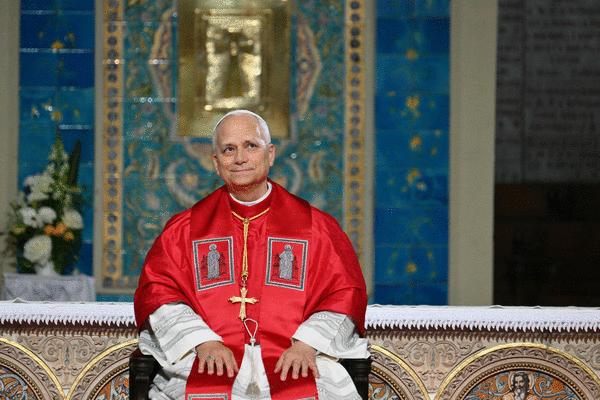
From the moment he took office, Pope Leo XIV became a distinguished proponent of peace, human dignity and concern for disadvantaged people wherever they might be.
He was critical of U.S. immigration policy, pointing out that people who had been living decent lives were being rounded up in a way that was “extremely disrespectful” and called for attention to people’s basic dignity.
Recently, he criticized the bellicose rhetoric coming from government officials in stark terms: “But woe to those who manipulate religion and the very name of God for their own military, economic and political gain, dragging that which is sacred into darkness and filth.”
I have no doubt that the pope realizes the Catholic Church did not always live up to these ideals. I take his message to be that while the history of the church is not perfect, its true teaching is that of peace and respect for human life
Jews should take note. Although there is no one in Judaism who speaks with the authority of a pope, as people of God, Jews also face the question of how to make sense of an ancient and not always consistent tradition.
There are passages in the Hebrew Bible that glorify or seem to condone mass killing, destruction of whole cities, male domination of women, even slavery. Some people believe that because these passages occur in a sacred text, they should be accepted at face value.
For example, “An eye for an eye, a tooth for a tooth” is often cited to show that the Bible recommends harsh or dehumanizing treatment of criminals. The conquest of Canaan is cited to show that God approves of wiping out whole nations.
This is deplorable. Like any quotation lifted out of a work of literature or legal code, these passages require explanation. “An eye for an eye” was never intended to justify dismemberment. Rather, it was meant to ensure that justice is proportional and thus to prevent excessive punishment. Although the conquest of Canaan as described in the Bible probably never happened, there is general agreement that because it talks about nations that have long since perished, it is not applicable in our day. It is also noteworthy that despite his military exploits, David is prevented from building the Temple because there is too much blood on his hands.
Both the Catholic Church and Jewish tradition allow for war in certain circumstances, chiefly self-defense. Without going into detail, both treat war as the option of last resort, both try to limit reckless destruction of life and property and both try to minimize injury to noncombatants. The question is what to do with biblical passages that seem to run counter to this spirit.
The answer is that when you read such passages or hear someone quoting them, you need to stop and ask yourself: Could a just and merciful God really approve of this kind of behavior? Or more specifically: Is this the kind of behavior my religion is trying to promote?
I give Pope Leo credit for speaking out against the facile use of God’s name by people whose primary interest is power. Would a just and merciful God approve of daily bombing raids and threats to destroy civilian infrastructure, let alone a threat to destroy an entire civilization? To answer “yes” is indeed to drag that which is sacred into darkness.
At present, the Jewish community is deeply divided over Israel’s actions in Gaza, Lebanon and the West Bank. My point is that Jews must ask the same questions of their religion. Would a just and merciful God approve of what is happening? Are these the kinds of actions Judaism is supposed to encourage?
I find it hard to answer yes.
In a passage from the Torah read on the holiest day of the year, God reveals to Moses the part of the divine persona that humans are supposed to emulate. Rather than things such as limitless power or notoriety, God lists qualities that even the humblest person can embody: mercy, graciousness, slowness to anger, and willingness to forgive sin.
Normally I favor keeping religion out of politics. But I would love to see a candidate run on a platform based on these qualities. I would love even more if government officials stopped making threats, toned down their rhetoric and put regard for human dignity at the top of their agenda.
Although I’m not placing bets that this will happen anytime soon, neither am I giving up my conviction that unless we move in this direction, it is futile to claim that God is on our side.
____
Kenneth Seeskin is an emeritus professor of philosophy and the Philip M. and Ethel Klutznick professor of Jewish civilization at Northwestern University.
___
©2026 Chicago Tribune. Visit at chicagotribune.com. Distributed by Tribune Content Agency, LLC.





















































Comments