Commentary: A nation running on empty
Published in Op Eds
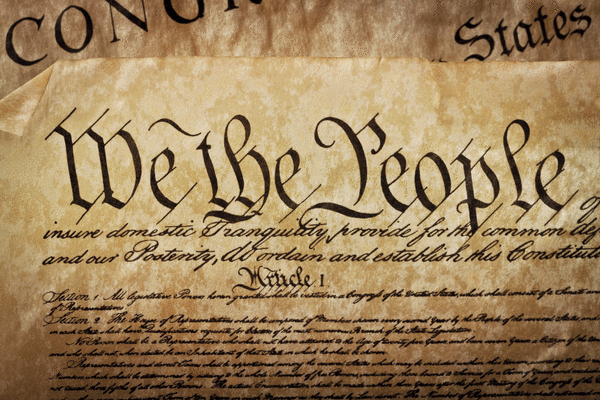
Americans’ fatigue is rising as costs climb, crises multiply, and leaders focus on spectacle instead of solutions. This exhaustion is not personal — it is political, weakening the Republic's guardrails.
Across party lines, Americans are drained of energy and trust. A nonstop cycle of crises leaves little room to absorb or recover from each new event. People feel the strain, yet they are left to navigate it alone. This is what a nation running on empty looks like — citizens trying to participate while the system keeps accelerating.
Americans feel worn down by a political environment that sidesteps accountability. Their concerns differ, but the frustrations — and the belief that citizens’ voices no longer matter — are the same. Stories that once unfolded over weeks now disappear in days, and questions are rarely pursued long enough for answers. A democracy cannot function when citizens are forced to sprint through every crisis without the time or capacity to absorb what is happening.
Election seasons intensify this fatigue. Rather than honoring constitutional principles, citizens face shifting explanations, recycled promises, and attempts to soften past decisions. Americans are told to move on, forget, and accept conditions that have worsened. This deepens public mistrust and contributes to the exhaustion.
The strain grows when commitments made during campaigns are not honored once in office. Many promises made in 2024 have gone unkept in 2025 and 2026, leaving citizens disillusioned. Despite public denials, elements of Project 2025's agenda have appeared in policy discussions and administrative actions. For many Americans, this mix reinforces the sense that their needs are not the focus.
The deeper concern is the growing concentration of power in a single office. When major decisions are shaped without transparency, and other leaders are not informed, included, or able to exercise meaningful checks, the public feels the disconnect. A Republic designed for shared participation begins to function as if only one person holds the authority. Citizens sense this imbalance, and it deepens their exhaustion.
Institutions do not respond with the consistency that citizens expect. Congress’s silence on public needs — even as it fails to advance policies that help families or provide funding with limited oversight — adds to the strain Americans feel. Hearings often feel performative, with little sustained inquiry. Over time, the gap between what citizens need and what institutions deliver widens, reinforcing the sense that citizens are being asked to run on empty.
Lawmakers are not fully informed or briefed on plans. When oversight weakens and leaders disconnect from the pressures families face, the public feels the trust deficit. Americans see rising costs, limited relief, and unresolved crises, yet little coordinated effort to address them. This disconnect deepens the sense that citizens are expected to run on empty.
That gap is where exhaustion becomes consequential. When people feel their voices are not heard or their participation is ignored, the pressure accumulates. Vigilance requires time, energy, and a belief that engagement matters. Without those conditions, even committed citizens become discouraged. When citizens are pushed to the margins, constitutional guardrails weaken because exhaustion makes them harder to sustain.
Over time, exhaustion sidelines. When stamina fades, democratic participation shrinks. The result is a public formally included but functionally distanced from the decisions shaping their lives. A nation running on empty cannot keep its citizens engaged.
The Constitution does not enforce itself. It relies on a public with the energy to stay engaged. When civic fuel runs low, the system’s ability to hold power accountable weakens. Today’s exhaustion is not just cultural fatigue — it is a constitutional vulnerability.
Recent years have shown what happens when a nation is pushed beyond its capacity. Disputes over elections, debates over executive power, and questions about public officials compete for attention. At the same time, economic pressures, public health challenges, and international tensions drain the energy people need to keep up. For many, following even one issue has become a struggle. As crises accumulate, citizens grow more disoriented.
These are the conditions that drain the public’s fuel — the emotional and cognitive capacity a democracy depends on.
The result is a form of national disorientation. As one crisis fades, another replaces it. Disorientation weakens democratic safeguards. A system built on public vigilance cannot thrive when the public is running on empty.
What makes this moment especially concerning is the expectation that citizens will forget. Many Americans no longer accept that. Leadership grounded in service would not ask a depleted public to adjust to dysfunction; it would work to reduce the strain that is draining them.
This is not a partisan demand. It is a democratic one. The principles that sustain the system — accountability, equal justice, transparency, a free press, and the peaceful transfer of power — depend on institutions that take responsibility seriously and on a public with the capacity to stay engaged. When that capacity is drained, even the strongest democratic principles struggle to hold.
Research shows that constant political turmoil, rapid‑fire news cycles, and unending crises drain the emotional and cognitive fuel people need to stay engaged. Episodes of election interference add to that strain. Clinical experts describe "election burnout" as a state that affects sleep, mood, and relationships. Participation becomes harder not because people do not care, but because the system demands more energy than they have left to give.
Polling shows Congress near 25 percent approval and President Donald Trump in the low‑40s — evidence that the nation’s civic fuel is running low. Dysfunction and weakened guardrails take a toll. Exhaustion cannot be reversed overnight, but it can be addressed by rebuilding the conditions that support sustained civic engagement.
Like an automobile running on empty, a democracy requires care, attention, and fuel. Civic participation provides that fuel. Without it, the system slows, strains, and stalls — not because the people are weak, but because the conditions for engagement are neglected.
First, institutions must reduce the strain they place on the public. When citizens are overwhelmed by shifting narratives, power struggles, efforts to restrict rights, or ongoing threats of election interference, democracy is threatened. That requires oversight, clear explanations of decisions, follow‑through on investigations, and attention to election‑related concerns. Leadership grounded in service confronts issues and treats transparency as a constitutional obligation.
Second, institutions must restore consistency. Oversight cannot be selective, and accountability cannot depend on party, personality, or timing. When Congress applies its responsibilities openly, it strengthens trust and reduces the confusion that fuels exhaustion. Rebalancing decision‑making — ensuring that no single office carries choices meant to be shared — is essential to restoring the public’s trust and capacity.
Third, citizens must reclaim engagement in sustainable ways. That includes seeking reliable information, limiting the noise that fuels disorientation, and focusing on what is actionable rather than performative. Sustainable engagement preserves the capacity to stay involved over time. Community engagement — through forums, civic groups, or grassroots efforts — helps distribute vigilance so no one carries it alone.
Above all, citizens must use the tools the Constitution gives them: speaking up, asking questions, challenging overreach, supporting a free press, and voting. These are not small acts; they are the mechanisms by which the people remain in charge of their government.
Exhaustion is real, but not destiny. When institutions and citizens work together, civic energy returns. Running on empty is not the end of the road; it is the moment a democracy chooses to stall or rise. The choice — and the power — rests with the people.
____
Carolyn Goode is a retired educational leader and advocate for ethical leadership, government accountability, and civic renewal. She writes about democratic resilience, institutional responsibility, and the conditions that support sustained civic engagement.
_____
©2026 The Fulcrum. Visit at thefulcrum.us. Distributed by Tribune Content Agency, LLC.
















































Comments