Commentary: In Washington's war on data, the economy and public will lose
Published in Op Eds
We have a saying here at Bloomberg, and it’s one we brought with us to New York City Hall: “If you can’t measure it, you can’t manage it.” The federal government is now in danger of proving just how much truth those words hold.
For more than a century, Republicans and Democrats have agreed on the need for objective data to inform their debates. In the 1890s, when the Senate commissioned a novel study of prices and wages — partly to assess the impact of the McKinley Tariff Act — Senator Nelson Aldrich, a Republican and staunch protectionist, explained the rationale:
There was no expectation that the members of the committee would agree about the political or even the economic bearings of the facts ascertained; but all were desirous that hereafter there should be no reason to question the integrity of the facts.
Or, as New York Senator Pat Moynihan would later put it, “Everyone is entitled to their own opinions, but not their own facts.”
Those common-sense and bipartisan sentiments helped produce a statistical system that became widely recognized as the global gold standard, one that delivers immense value for American citizens for its relatively modest cost, about 0.1% of the federal budget. The categories of data collection are endless — inflation, employment, jobs, wages, trade, housing, crime, population, pollution, disease, investment, consumer spending, food production and so many others — because they are invaluable.
Government officials rely on this data as they make decisions about allocating resources to tackle problems, and as they try to determine whether policies and programs are working. If you think government is inefficient and ineffective now, wait until you see it operate without good data.
Business leaders are even more dependent on this data as they make planning and investment decisions, from retailers figuring out where to locate a store, to farmers and ranchers weighing how much of their production to hedge, to manufacturers deliberating whether to expand their plants.
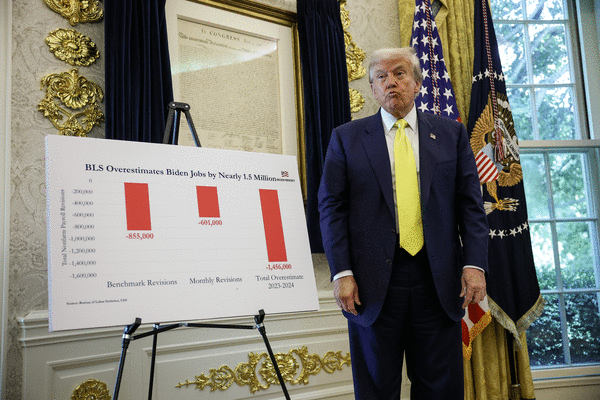
Nevertheless, the administration has been undermining the integrity of the country’s statistical system by playing politics with it. When, for example, the Bureau of Labor Statistics delivered a downbeat jobs report last year, the president abruptly fired its commissioner. After introducing deep cuts in food stamps for the poor, officials canceled a survey measuring how many people were going hungry. Data on inflation, education, farm wages, police misconduct and federal employee morale have also suffered or disappeared amid staff and budget reductions.
The potential harm goes well beyond transparency. To give just one example: The Bureau of Labor Statistics estimates that reduced data collection could at times change its estimates of year-over-year inflation by 0.1 percentage point — a variation that, small as it might seem, can alter Social Security benefits by billions of dollars a year while also potentially leading to financial-market inefficiencies that slow investment and growth.
Making matters worse, the attack on the integrity of federal data is undermining the private sector’s confidence in it — and that uncertainty can also be a drag on the economy. Otherwise obscure technical changes now inevitably raise questions about political motivation and data reliability.
That’s not to say the statistical system is perfect, of course. It’s idiosyncratic, clunky, sprawling and flawed. Some 13 principal statistical agencies and about 100 other programs present users with different interfaces that often produce frustration. Many of the agencies struggle to maintain data quality as people become increasingly difficult to reach with traditional surveys.
The right way to address such shortcomings is to do what successful companies do: invest in modernization. Shift from expensive phone calls and visits to online responses. Share more data across agencies and incorporate private suppliers to improve accuracy and avoid duplication. Take advantage of automation and artificial intelligence. This would entail significant upfront costs to build a new system while simultaneously maintaining the old — but, done right, it would save money in the long run.
Congress never anticipated an assault on federal data. Only four of the 13 principal statistical agencies enjoy any significant statutory protections, and even those are weak. Legislators should strengthen those protections and provide the resources and oversight needed to modernize the systems.
The Senate should also use its confirmation power to reject nominees who, because of partisan or ideological biases, seem likely to fudge numbers or weaken the integrity of data-collection efforts. It was encouraging to see senators raise concerns about the partisanship of a nominee to lead the BLS, which led the White House to drop him.
There’s another saying that I’ve long lived by in business and government: “In God we trust. Everyone else: Bring data.” But if the federal government makes it so that data can’t be trusted, God help us.
We have no shortage of complex and difficult problems in America. Trying to solve them without high-quality, nonpartisan and trustworthy data is sure to make them worse.
_____
Michael R. Bloomberg is the founder and majority owner of Bloomberg LP, the parent company of Bloomberg News, and the founder of Bloomberg Philanthropies.
_____
©2026 Bloomberg L.P. Visit bloomberg.com/opinion. Distributed by Tribune Content Agency, LLC.



















































Comments