Commentary: Antisemitism appears from the left and the right, but not equally
Published in Op Eds
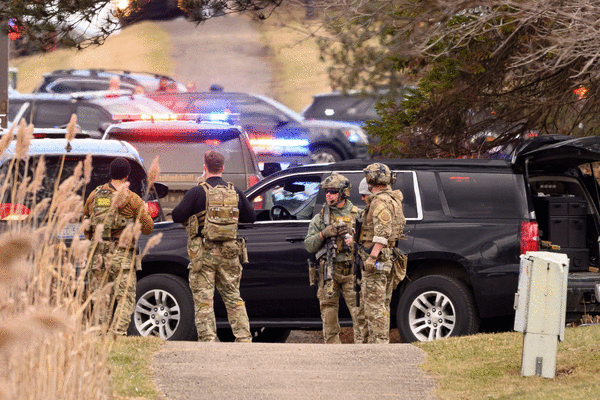
The attack on Temple Israel in West Bloomfield, Michigan, belongs to a terrifying new phase in the global surge in antisemitism that has shown its ugly face in recent months in the United States, Canada, Europe and of course at the massacre at Bondi Beach in Sydney last December. A much larger tragedy was prevented in Michigan by a mix of quick action by the temple’s security and good fortune.
What accounts for this major new uptick in antisemitic expression and action? This has become a hotly debated and intensely political question in the United States, as both sides of the political spectrum accuse each other of being the chief instigators. The right accuses the left of harboring anti-Israel sentiments that all too easily merge with antisemitism. The left accuses the right not only of weaponizing antisemitism but also of harboring neo-Nazis and anti-Jewish conspiracy theorists.
Some observers have sought to add nuance to the matter by arguing that antisemitism exists at both extremes, left and right. They call this approach the horseshoe theory of antisemitism, which posits that antisemitism is to be found in equal measure at both ends of the political spectrum.
We research antisemitism as part of the UCLA Initiative to Study Hate. We understand the appeal of the horseshoe, but our research suggests that the real story is more complicated in two important regards. First, by most standard measures, certainly before Oct. 7, 2023, antisemitism was more prevalent on the right than on the left.
The data tend to follow a few broad patterns. In some cases, antisemitism is relatively low on the left and rises more or less steadily as one moves to the right along the ideological spectrum. In others, the far left exhibits similar or slightly more antisemitic views than the center-left, resulting in a “hockey stick” or “check mark” pattern. Some analyses even find a sort of “bell curve,” in which moderates exhibit higher levels of antisemitism than mainstream liberals or conservatives.
What is notably rare, however, is the classic horseshoe shape in which the far left and far right exhibit similarly and uniquely high levels of antisemitism. Most available evidence found substantially higher levels on the far right than on the far left.
In the aftermath of Oct. 7, a set of new dynamics seemed to emerge. On one hand, a number of reporting agencies noted significant spikes in reports of antisemitism on the far left, in concert with a new definitional scheme that equated anti-Zionism and antisemitism. On the other hand, there have been a good number of anecdotal and statistical reports of an uptick in antisemitic expression on the far right, especially among prominent American media influencers such as Tucker Carlson and Candace Owens. Our own unpublished findings from 2025 suggest that those with “very conservative” views were most likely to endorse antisemitic tropes, while “liberal” respondents were least likely. It is too early to offer a definitive assessment of the landscape of antisemitism in the post-Oct. 7 period; at a minimum, we can say that more evidence than currently exists is needed to validate the horseshoe theory.
But second, and perhaps more importantly, in attempting to make sense of the current spate of violent actions against Jews in the diaspora, we feel it is necessary to address the elephant in the room: Israeli military action as a catalyst to antisemitism. This is an exceptionally delicate and even dangerous link to point out, even if fully substantiated. We approach the proposition with the requisite measure of concern and sensitivity. Sometimes, when people hear that violence against Jews tends to follow violence by the Jewish state, this is interpreted to mean that acts of antisemitism are justifiable if they are in response to Israeli action. We reject out of hand the proposition that such acts are justifiable. And yet the data lead us to acknowledge a consistent association between violent Israeli action and antisemitic hate crimes.
For example, the terrorist who drove his vehicle into the synagogue in Michigan lost his brother, a Hezbollah commander, and the brother’s two children, in an Israeli aerial attack on Beirut. While the rage and sorrow of the Detroit terrorist might be understandable, his attempted murderous action was not justified. It is never justified, in our view, to attack civilians in retaliation for state-sponsored action that leads to the loss of civilian life. And it is surely not justifiable to attack Jewish kids in a Detroit suburb in revenge for an Israeli attack in Beirut. That’s dangerously scrambled moral logic.
Alas, that’s not the end of the story. The data that we’ve reviewed— a string of scholarly studies over the past two decades — have consistently shown that antisemitic hate crimes in the West spike following violent Israeli military operations. Israeli military violence appears to have a particularly strong trigger effect on violent and criminal forms of antisemitism. The effect of Israeli military action on antisemitic attitudes is less clear, but numerous studies have found an increase in antisemitic attitudes following periods of violence between Israel and its adversaries (including in the wake of the ongoing Iran war in which Israel has been a central protagonist).
We must confront the causal factors of antisemitism honestly and address antisemitism where it is most common and most virulent. There are surely antisemitic agitators on the left, including those who reveled in the brutal Hamas attacks of Oct. 7, 2023. They must be called out. More concerning, in our view, are the overt right-wing antisemites who share a media and political ecosystem with the most powerful man in the world, President Trump, who has repeatedly and conspicuously failed to condemn them. Their conspiracy theorizing provides succor to those who assert a global Jewish plot to subordinate the rest of the world.
And yet, if we want to grasp antisemitism today as it manifests itself in the world, we must consider a third factor: Israel’s own actions, especially since Oct. 7. The utter devastation of Gaza, including the killing of more than 70,000 Palestinians, has marked not an end but a beginning to a new era of Israeli military action. Israel has attacked Lebanon, Syria and Yemen with a large degree of impunity, and is now embarked on a second armed conflict with Iran in the last year. To repeat our central point: This does not mean that attacking Jewish civilians is a legitimate response. Ever. But we can’t ignore the real prospect that Israel’s actions have led to violent antisemitic attacks and could lead to more.
The first call to action is to redouble our efforts to educate the world that attacking Jews in retribution for Israeli action is wrong. At the same time, we must call attention to the fact — and Israeli leaders must, in the privacy of their bunkers, come to terms with the prospect — that Israel’s actions may well have hugely deleterious consequences not only for Arabs and Muslims but also for Jews around the world.
____
David N. Myers, a professor of Jewish history, directs the UCLA Initiative to Study Hate, where Joshua Goetz, a Ph D student in political science, is a researcher.
©2026 Los Angeles Times. Visit at latimes.com. Distributed by Tribune Content Agency, LLC.


















































Comments